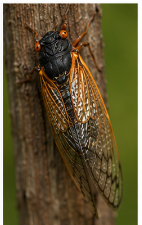
Periodical Cicadas (Magicicada species) are among the most remarkable insects in North America. Famous for their synchronized mass emergences every 13 or 17 years, these insects spend nearly their entire lives underground before emerging in spectacular numbers to molt, mate, lay eggs, and die within a few short weeks. Their extraordinary life cycle has fascinated scientists for centuries and makes them one of the longest-lived insects in the world.
Although their sudden appearance can alarm homeowners due to their loud mating calls and sheer abundance, Periodical Cicadas are not dangerous to humans or pets. They do not bite, sting, or spread diseases. Their primary impact is temporary damage to young trees during egg-laying, while mature, healthy trees generally suffer little long-term harm.
Overview
Unlike annual cicadas, which emerge every summer, Periodical Cicadas remain underground as immature nymphs for either 13 or 17 years depending on the species. During this time, they slowly develop while feeding on sap from tree roots.
When soil temperatures reach approximately 64°F (18°C) in late spring, millions—or even billions—of cicadas emerge simultaneously across large geographic areas. This synchronized emergence overwhelms predators through a strategy known as predator satiation, ensuring enough adults survive to reproduce.
There are seven recognized species of Magicicada, divided between 13-year and 17-year life cycles. Different populations, known as broods, emerge on different schedules throughout the eastern United States.
Taxonomy and Classification
- Order: Hemiptera
- Family: Cicadidae
- Genus: Magicicada
- Common Name: Periodical Cicadas
Periodical Cicadas belong to a unique evolutionary lineage found only in North America. Their synchronized development and extended juvenile stage are unmatched among insects.
Identification
Periodical Cicadas have several distinctive characteristics that separate them from annual cicadas.
- Length: Approximately 25–30 mm.
- Body Color: Glossy black.
- Eyes: Bright, ruby-red compound eyes.
- Wings: Transparent with vivid orange wing veins.
- Legs: Strong front legs adapted for digging during emergence.
- Size: Smaller than many annual cicada species.
Freshly emerged adults appear pale white before their exoskeleton hardens and darkens within several hours.
Life Cycle
The life cycle of Periodical Cicadas is one of the longest and most unusual among insects.
After eggs hatch, tiny nymphs fall from tree branches and burrow into the soil, where they attach themselves to tree roots and feed on xylem sap. They remain underground for either 13 or 17 years, molting several times while slowly growing.
During their final spring underground, mature nymphs tunnel toward the soil surface. Following emergence, they climb nearby vegetation, fences, or buildings and molt into winged adults.
Adults live only four to six weeks. During this brief period they:
- Mate
- Lay eggs
- Produce loud mating calls
- Complete the reproductive cycle before dying
The next generation then begins another lengthy underground development period.
Distribution and Habitat
Periodical Cicadas occur exclusively in eastern North America.
Preferred habitats include:
- Deciduous forests
- Mature hardwood woodlands
- Suburban neighborhoods with established trees
- Parks
- River valleys
- Wooded residential landscapes
Their underground nymphs depend upon long-lived hardwood trees whose roots provide a reliable food source throughout their lengthy development.
Behavior
Adult males gather in large choruses, producing loud songs that attract females. The combined sound from thousands of individuals can exceed 90 decibels, making cicada emergences one of nature’s loudest seasonal events.
After mating, females use their saw-like ovipositors to cut narrow slits into small tree branches where they deposit eggs.
Several weeks later, newly hatched nymphs drop to the ground and immediately burrow into the soil.
Damage
Although Periodical Cicadas do not feed on leaves or fruit as adults, egg-laying can injure trees.
- Flagging: Small branch tips may wilt and die after egg-laying.
- Young Trees: Recently planted trees are most vulnerable to damage.
- Mature Trees: Usually recover with little lasting impact.
- Noise: Large emergences generate significant daytime sound levels.
Despite their overwhelming numbers, Periodical Cicadas do not destroy crops, infest homes, or transmit diseases.
Management and Prevention
Control is rarely necessary because emergences are temporary.
- Protect Young Trees: Cover saplings with fine mesh netting during emergence periods.
- Delay Planting: Avoid planting valuable young trees during major brood years when possible.
- Avoid Insecticides: Chemical control is generally ineffective and unnecessary due to the enormous population size.
- Prune Damaged Branches: Remove severely injured twigs after egg-laying is complete.
Most landscapes recover naturally once adults disappear after several weeks.
Ecological Importance
Periodical Cicadas provide numerous ecological benefits.
- Food Source: Feed birds, mammals, reptiles, amphibians, fish, and insects.
- Nutrient Cycling: Their decomposing bodies enrich forest soils.
- Soil Aeration: Underground tunnels improve soil structure.
- Forest Ecology: Natural branch pruning stimulates new tree growth.
Their periodic abundance plays a major role in eastern forest ecosystems.
Research and Conservation
Periodical Cicadas are among the most intensively studied insects in the world. Scientists continue researching their genetics, synchronized development, navigation, predator avoidance, and remarkable 13- and 17-year life cycles.
Researchers also monitor changing emergence patterns to better understand the effects of climate change, habitat fragmentation, and urban development on these unique insects.
Conclusion
Periodical Cicadas (Magicicada species) are extraordinary insects whose synchronized 13- and 17-year life cycles make them one of nature’s greatest biological spectacles. While their massive emergences can temporarily affect young trees and create considerable noise, they are harmless to humans and provide significant ecological benefits. Their fascinating biology continues to inspire scientific research and captures the attention of homeowners, naturalists, and entomologists whenever a new brood emerges.