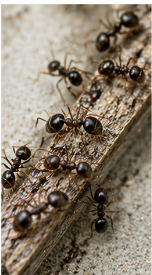
Perimeter Ants is a broad pest control term used to describe ants that nest around the outside edges of homes, businesses, patios, sidewalks, driveways, mulch beds, and foundations. It is not a single species or scientific group. Instead, the term usually includes several common nuisance ants that live outdoors but regularly enter buildings while searching for food, water, or shelter.
Common examples of perimeter ants include Pavement Ants (Tetramorium caespitum), Odorous House Ants (Tapinoma sessile), Field Ants (Formica spp.), and other small structure-invading ants that use cracks, expansion joints, utility gaps, and foundation edges as travel routes. These ants often become most noticeable when long trails of workers appear along baseboards, kitchen counters, bathroom sinks, exterior walls, or concrete seams.
Overview
Perimeter ants are among the most common nuisance pests around residential and commercial properties. Most species prefer to nest outdoors in soil, mulch, under stones, beneath pavement, around landscaping timbers, or beside foundation walls. They usually do not damage wood like termites or carpenter ants, but they can still create frustration for property owners because they repeatedly invade indoor spaces.
The main conflict comes from their ability to locate tiny openings and exploit small food or moisture sources. A few crumbs, pet food, syrup residue, grease, leaking pipes, or damp soil near the foundation can support steady ant activity. Once worker ants locate a resource, they lay down chemical trails that guide other ants from the colony to the food source.
Taxonomy and Classification
Perimeter ants belong to the order Hymenoptera and the family Formicidae. Because “perimeter ants” is a general pest control category, the exact classification depends on the species involved. Pavement ants, odorous house ants, field ants, Argentine ants, little black ants, and other nuisance species may all be described as perimeter ants when they nest outside and forage into structures.
All ants undergo complete metamorphosis, developing through egg, larva, pupa, and adult stages. Colonies contain different castes, including queens, workers, and reproductive males or females. Workers are the ants most often seen by homeowners. Their job is to forage, care for young, expand the nest, and defend the colony.
Identification
Because perimeter ants may include several species, identification can vary. However, most are small to medium-sized ants that travel in visible trails near foundations, sidewalks, patios, garages, kitchens, bathrooms, and utility areas.
- Pavement Ants: Usually dark brown to black and about 1/8 inch long. They commonly nest under sidewalks, driveways, slabs, and patio stones. Small piles of excavated soil may appear between cracks in concrete or along pavement edges.
- Odorous House Ants: Small, dark brown to black ants that produce a rotten coconut-like odor when crushed. They are fast-moving and often form large indoor trails, especially near sweets and moisture.
- Field Ants: Larger ants that may be reddish, brown, black, or mixed in color. They often build visible soil mounds in lawns, fields, and landscaped areas.
- Little Black Ants: Tiny black ants that nest outdoors in soil, wood, masonry gaps, or debris and may enter kitchens in search of sweets, grease, or proteins.
Distribution and Habitat
Perimeter ants are found throughout the United States and many other parts of the world. Their success comes from their ability to adapt to human-altered environments. Sidewalk cracks, foundation gaps, mulch beds, irrigation lines, retaining walls, potted plants, and landscape borders all provide suitable nesting or travel areas.
Outdoor nests may be located under stones, logs, patio blocks, firewood, leaf litter, concrete slabs, landscape fabric, or dense vegetation. Around buildings, ants often follow protected routes where the foundation meets the soil, siding, brickwork, or concrete. Moist areas near downspouts, leaky spigots, air conditioning drip lines, and poorly drained mulch beds are especially attractive.
Behavior and Life Cycle
Perimeter ants are social insects that live in colonies. A colony may contain a single queen or multiple queens depending on the species. Multi-queen species can be especially difficult to control because colonies may spread through budding, where part of the colony separates and forms a new nest nearby.
Worker ants forage for food and water. They may feed on sweets, grease, proteins, seeds, dead insects, honeydew from aphids, or household food scraps. Their diet can shift throughout the year. In spring, some species seek protein to support larval growth. In summer and fall, they may become more attracted to sugary foods and moisture.
Damage and Problems
Perimeter ants are mostly nuisance pests, but their activity can create several problems around homes and businesses.
- Indoor Invaders: Ant trails in kitchens, pantries, bathrooms, laundry rooms, and break rooms can contaminate food and surfaces.
- Outdoor Soil Disturbance: Pavement ants and field ants may excavate soil around sidewalks, patios, pavers, and driveways, sometimes creating uneven surfaces.
- Lawn and Landscape Issues: Mounds and soil piles can be unsightly in turf, garden beds, and around ornamental plants.
- Recurring Infestations: If nests remain active outside, ants may continue entering even after indoor ants are removed.
- Moisture Indicators: Heavy ant activity near walls, sinks, or bathrooms may point to leaks, damp wood, or drainage problems.
Management and Control
Successful perimeter ant control depends on finding the source of the activity. Spraying visible ants indoors may provide short-term relief, but it rarely eliminates the colony. In some species, repellent sprays can make the problem worse by causing the colony to split into multiple nesting sites.
Inspection
Begin by following ant trails to determine where ants are entering and where they are feeding. Look around windows, doors, foundation cracks, plumbing penetrations, baseboards, garages, patios, and exterior walls. Outdoors, check mulch beds, paver joints, irrigation boxes, tree bases, and areas where soil touches the structure.
Exclusion
- Seal cracks around foundations, doors, windows, siding gaps, and utility lines.
- Repair torn weatherstripping and door sweeps.
- Use caulk, sealant, or copper mesh where appropriate.
- Keep branches, shrubs, and vines trimmed away from the building.
Sanitation
- Clean crumbs, grease, syrup, and food spills quickly.
- Store pantry foods in sealed containers.
- Remove pet food after feeding.
- Clean outdoor trash cans and keep lids tight.
- Pick up fallen fruit and reduce insect honeydew sources when possible.
Moisture Reduction
- Fix leaking faucets, irrigation lines, and plumbing.
- Redirect downspouts away from the foundation.
- Reduce excessive mulch depth near the home.
- Improve drainage in wet soil areas.
Baiting
Slow-acting ant baits are often the best control method. Workers carry bait back to the colony, where it can affect queens, larvae, and other workers. Liquid, gel, and granular baits may be used depending on the species and feeding preference. Avoid placing repellent sprays near bait, because they may prevent ants from feeding on it.
Perimeter Treatments
Professional perimeter treatments may include non-repellent insecticides applied along foundations, entry points, soil edges, and active trails. These treatments are most effective when combined with baiting, exclusion, sanitation, and moisture correction.
Prevention
Long-term prevention focuses on making the building less attractive and harder to enter. Keep mulch 6 to 12 inches away from the foundation when possible, reduce clutter near exterior walls, store firewood off the ground and away from the structure, and regularly inspect for cracks or gaps. Keeping kitchens, outdoor eating areas, and trash zones clean can also reduce ant pressure.
Conclusion
Perimeter ants are not one specific ant species, but a useful term for ants that nest around the outside of structures and invade indoor spaces. While they usually do not cause serious structural damage, they can be persistent, unsightly, and difficult to eliminate without addressing the outdoor colony. The most effective approach combines inspection, sealing entry points, reducing moisture, improving sanitation, and using targeted baiting around active trails and nesting areas.