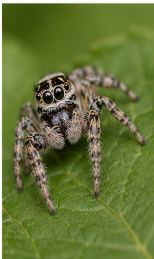
Peppered Jumpers (Pelegrina galathea) are small, active hunting spiders belonging to the family Salticidae, commonly known as jumping spiders. Unlike web-building spiders that passively wait for prey, Peppered Jumpers rely on exceptional eyesight, stealth, and remarkable jumping ability to capture insects. Their mottled gray and brown coloration provides excellent camouflage against tree bark, fences, rocks, and weathered wood, allowing them to ambush unsuspecting prey.
Despite their intimidating appearance to some homeowners, Peppered Jumpers are completely beneficial predators. They rarely bite humans, possess medically insignificant venom, and help naturally reduce populations of flies, mosquitoes, gnats, aphids, and numerous other nuisance insects. Their curious behavior and excellent vision have also made jumping spiders one of the most extensively studied spider groups in the world.
Overview
The Peppered Jumper is native to much of North America and is commonly encountered in gardens, woodland edges, parks, fences, building exteriors, and occasionally inside homes. Rather than spinning capture webs, these spiders spend daylight hours actively exploring vegetation and surfaces while visually searching for prey.
Like other jumping spiders, they possess some of the best vision among all arachnids. Their large forward-facing eyes provide outstanding depth perception, allowing them to accurately judge distance before launching impressive jumps many times their own body length.
Taxonomy and Classification
- Order: Araneae
- Family: Salticidae
- Genus: Pelegrina
- Species: Pelegrina galathea
- Common Name: Peppered Jumper
The Salticidae family contains more than 6,500 described species worldwide, making it the largest family of spiders. Members are renowned for their intelligence, excellent eyesight, and active hunting strategies.
Identification
Peppered Jumpers are relatively small spiders but possess distinctive characteristics that make them easy to recognize.
- Length: Approximately 5–8 mm.
- Color: Gray, brown, tan, and cream with mottled or speckled markings.
- Body: Compact, stocky, and covered with fine hairs.
- Eyes: Four large forward-facing eyes, including two oversized central eyes that provide exceptional vision.
- Legs: Short, muscular legs designed for climbing and jumping.
- Movement: Quick, jerky movements with sudden leaps rather than continuous crawling.
Their peppered appearance blends remarkably well with bark, stone, fences, and weathered wood, making them difficult for predators to detect.
Life Cycle
Peppered Jumpers undergo a straightforward life cycle consisting of egg, spiderling, juvenile, and adult stages.
Females deposit eggs inside small silk retreats hidden beneath loose bark, rocks, or protected crevices. After hatching, spiderlings remain with the egg sac for a short time before dispersing.
As juveniles grow, they molt several times before reaching maturity. Adults generally live for about one year, although lifespan varies depending on climate and food availability.
Distribution and Habitat
Pelegrina galathea is widely distributed throughout much of North America.
Common habitats include:
- Woodlands
- Forest edges
- Gardens
- Shrubs and ornamental plants
- Tree trunks
- Rock walls
- Fences
- Building exteriors
- Parks and landscapes
Although they occasionally wander indoors, they are primarily outdoor spiders that thrive in sunny environments where insect prey is abundant.
Behavior and Hunting Strategy
Peppered Jumpers are among the most active and intelligent spider predators.
Rather than constructing prey-catching webs, they visually locate insects using their exceptional eyesight. Once prey is identified, the spider slowly stalks its target before attaching a thin silk safety line to the surface beneath it.
With incredible precision, the spider leaps onto its prey, immediately delivering a venomous bite that immobilizes the insect. The silk dragline prevents the spider from falling if it misses its target.
This hunting method allows Peppered Jumpers to capture prey considerably larger than themselves.
Diet
Peppered Jumpers feed on a wide variety of small arthropods.
- Flies
- Mosquitoes
- Gnats
- Leafhoppers
- Aphids
- Small beetles
- Moths
- Ants
- Other spiders
Their diverse diet makes them valuable natural biological control agents in gardens and landscapes.
Human Interaction
Peppered Jumpers are harmless to people and pets.
Although capable of biting if handled roughly, bites are extremely rare and generally cause only mild, temporary irritation. These spiders show little aggression and usually retreat or leap away when disturbed.
Many people find jumping spiders surprisingly curious because they often appear to watch nearby movement with their large eyes.
Benefits Around Homes and Gardens
Peppered Jumpers provide numerous ecological benefits.
- Natural Pest Control: Consume flies, mosquitoes, aphids, and many garden pests.
- Reduced Pesticide Need: Help suppress insect populations naturally.
- Balanced Ecosystems: Serve as important predators within food webs.
- Educational Value: Frequently studied because of their advanced vision and behavior.
For these reasons, gardeners generally welcome their presence.
Management and Prevention
Control is rarely necessary because Peppered Jumpers are beneficial.
- Seal Entry Points: Prevent occasional indoor visitors by sealing cracks around doors and windows.
- Reduce Indoor Insects: Lower prey populations that may attract spiders indoors.
- Relocate Outdoors: Individual spiders found inside can simply be captured and released outside.
- Avoid Broad-Spectrum Insecticides: Preserving beneficial predators supports natural pest management.
Most encounters require no treatment beyond simple relocation.
Research and Conservation
Jumping spiders are among the most researched arachnids because of their remarkable eyesight, learning ability, courtship displays, and sophisticated hunting behavior. Scientists continue studying Pelegrina species to better understand spider vision, depth perception, navigation, and decision-making.
As natural predators, they also contribute to sustainable pest management by helping regulate insect populations without chemical intervention.
Conclusion
Peppered Jumpers (Pelegrina galathea) are fascinating, harmless spiders that play an important role in controlling insect populations throughout gardens, forests, and residential landscapes. Their outstanding vision, remarkable jumping ability, and active hunting behavior make them one of North America’s most interesting arachnids. Rather than being feared, these tiny predators should be appreciated for the valuable ecological services they provide.