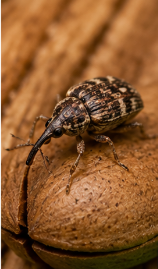
Pecan Weevils (Curculio caryae) are among the most serious insect pests of pecan trees (Carya illinoinensis) and other true hickories in North America. These distinctive snout beetles can cause severe crop losses because both adult and larval feeding directly damage developing nuts. The most destructive stage is the larva, a creamy white grub that develops inside the pecan and consumes the edible kernel.
Pecan Weevils are particularly difficult to manage because they spend most of their lives hidden underground or protected inside nuts. Adults are exposed for only a relatively short period during late summer and early fall. Successful control therefore depends on careful monitoring and correctly timed treatments before females lay eggs inside developing pecans.
Overview
The Pecan Weevil is considered a primary pest because it can attack healthy, developing pecans without requiring previous damage from another insect or disease. Heavy infestations can destroy a large percentage of a crop, and untreated trees in areas with established populations may experience severe or nearly complete nut loss.
Adult weevils feed on developing nuts, while females use their long snouts to bore through the shell and deposit eggs inside. After hatching, the larvae feed directly on the kernel. When development is complete, mature grubs chew round exit holes through the shell, fall to the ground, and burrow into the soil.
The unusual life cycle of the Pecan Weevil contributes to its persistence. Some individuals remain underground for two or three years before emerging as adults. As a result, a property may continue producing new weevils even after a season in which relatively few damaged nuts are observed.
Taxonomy and Classification
Pecan Weevils belong to the order Coleoptera, which includes all beetles, and the family Curculionidae, commonly known as the weevils or snout beetles. Curculionidae is one of the largest families of animals and includes numerous agricultural, forest, stored-product, and garden pests.
- Order: Coleoptera
- Family: Curculionidae
- Genus: Curculio
- Species: Curculio caryae
- Common Name: Pecan Weevil
Pecan Weevils undergo complete metamorphosis, developing through the egg, larval, pupal, and adult stages. Unlike many insects that complete several generations in a year, the Pecan Weevil usually requires two to three years to complete its development.
Identification
Adult Pecan Weevils are distinctive beetles with elongated snouts. They are generally about 1/3 to 1/2 inch long, excluding the snout. Their bodies are covered with gray, brown, and sometimes reddish scales that create a mottled appearance.
- Adult Females: The female has an extremely long, slender snout that may equal or exceed the length of her body. She uses this structure to bore through the pecan shell before laying eggs.
- Adult Males: Males resemble females but usually have noticeably shorter snouts.
- Eggs: Eggs are small and deposited inside developing nuts, making them difficult to observe without opening the pecan.
- Larvae: The grubs are creamy white, legless, and curved, with reddish-brown head capsules.
- Pupae: Pupae develop underground in protected soil cells and are rarely seen by homeowners or orchard managers.
One of the most recognizable signs of infestation is a nearly round exit hole in the pecan shell. This hole is created when a mature larva chews its way out of the nut before dropping to the soil.
Distribution and Habitat
Pecan Weevils occur throughout much of the native and cultivated range of pecan trees in the United States and parts of Mexico. They are particularly important in regions where commercial and residential pecan production is common.
The insect uses two very different habitats during its life cycle. Adults live temporarily in the canopy of pecan and hickory trees, where they feed, mate, and lay eggs. Larvae, pupae, and dormant adults spend extended periods underground beneath or near host trees.
Soil conditions strongly influence emergence. Adult weevils usually appear during late summer, often following rainfall that softens the soil. Dry, hard soil can delay emergence, while significant summer rain may trigger a noticeable increase in adult activity.
Life Cycle
The life cycle of the Pecan Weevil is unusually long and is one of the reasons the pest is difficult to eliminate. Adults generally emerge from the soil during late summer as pecans reach vulnerable stages of development.
After emerging, adults climb or fly into the tree canopy. They feed by puncturing developing nuts with their snouts. Females then bore through the shell and deposit eggs inside suitable nuts.
The eggs hatch into legless larvae that feed on the developing kernel. Several larvae may sometimes develop inside a single nut. As they feed, the kernel is destroyed and replaced with waste material and damaged tissue.
After several weeks, mature larvae chew through the shell, fall to the ground, and immediately burrow into the soil. They create protective earthen cells several inches below the surface. Many remain as larvae for an extended period before pupating.
After pupation, newly formed adults may remain underground until conditions favor emergence. Because individuals do not all develop at the same rate, multiple generations can overlap beneath a single tree.
Damage and Problems
Pecan Weevils damage nuts in several ways, and the appearance of the injury depends on the developmental stage of the pecan when feeding occurs.
Early-Season Feeding
Before the pecan shell hardens, adults puncture young nuts to feed. This injury can cause developing nuts to stop growing and fall prematurely. Nuts attacked during this early stage may drop before larvae develop inside them.
Egg Laying and Kernel Destruction
After the shell begins to harden and the kernel reaches a suitable stage, females deposit eggs inside the nut. The larvae hatch and consume the developing kernel, making the pecan unmarketable and inedible.
Premature Nut Drop
Infested pecans may fall before normal harvest. Opening fallen nuts may reveal creamy white grubs, damaged kernels, and accumulations of waste material.
Exit Holes
Mature larvae leave distinctive round holes in the shell. These holes indicate that the grub has already escaped and entered the soil, where it may remain for one or more years.
Monitoring
Monitoring adult emergence is one of the most important parts of Pecan Weevil management. Once eggs have been deposited inside the nuts, insecticide treatments cannot reliably reach the protected larvae.
Orchard managers may use screen cone traps or other emergence traps beneath pecan trees. These traps capture adults as they leave the soil. Trees with a history of infestation should receive special attention beginning in late summer.
Additional monitoring methods include shaking branches over a collection sheet and inspecting prematurely dropped nuts. Regular monitoring should continue because adult emergence may occur over several weeks rather than all at once.
Management and Control
Effective Pecan Weevil management requires an integrated approach. The goal is to reduce adult populations before females can lay eggs and to prevent new larvae from entering the soil.
Sanitation
- Collect prematurely dropped pecans regularly.
- Destroy infested nuts before larvae can escape.
- Do not leave damaged pecans beneath trees for extended periods.
- Remove nuts showing obvious exit holes or internal grub damage.
Sanitation alone may not eliminate an established population, but it can reduce the number of new larvae entering the soil.
Adult Control
When chemical treatment is necessary, timing is critical. Treatments target adults after they emerge from the soil but before significant egg laying occurs. Because emergence can continue over an extended period, repeated applications may sometimes be required according to the product label and local recommendations.
Homeowners and growers should avoid routine calendar spraying without monitoring. Weather, soil moisture, tree development, and local conditions can influence emergence from year to year.
Ground Barriers
Physical barriers placed beneath trees may reduce the ability of adults to emerge from the soil or prevent larvae from entering it. This approach is more practical for individual backyard trees than for large commercial orchards.
Barriers must cover the relevant area beneath the canopy and be installed before adult emergence. Gaps around the edges can allow weevils to escape.
Biological Control
Beneficial organisms, including certain entomopathogenic nematodes, are being studied and used in some situations to attack Pecan Weevil stages in the soil. These microscopic organisms can infect and kill susceptible larvae or other underground stages.
Biological control results may vary depending on soil temperature, moisture, nematode species, application method, and local environmental conditions.
Prevention
Preventing Pecan Weevil problems is easier in isolated trees and areas without established populations. Inspect harvested and fallen nuts for larvae or round exit holes. Avoid moving infested nuts or soil from heavily affected locations to areas where the pest is absent.
Property owners with pecan trees should begin monitoring before nuts reach the stage when females can successfully lay eggs. Maintaining records of emergence dates, rainfall, damaged nuts, and treatment timing can improve control in future seasons.
Conservation and Research
The Pecan Weevil remains an important subject of agricultural research because of its economic impact and unusually long life cycle. Research focuses on improved emergence traps, better prediction of adult activity, biological control, soil treatments, and methods that reduce dependence on repeated insecticide applications.
Scientists are also studying how rainfall, soil type, temperature, and pecan development influence adult emergence. Better prediction systems could allow growers to target treatments more precisely and reduce unnecessary applications.
Conclusion
Pecan Weevils (Curculio caryae) are among the most destructive pests of pecans and true hickories. Adults damage young nuts through feeding, while females lay eggs inside developing pecans. The resulting larvae consume the kernels before escaping through distinctive round holes and entering the soil.
Because the pest may remain underground for several years, management requires persistence. Monitoring adult emergence, collecting infested nuts, correctly timing treatments, and reducing the number of larvae entering the soil provide the best long-term approach. Early detection is particularly important because once larvae are protected inside the nut, effective control becomes extremely difficult.