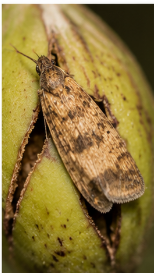
Pecan Nut Casebearers (Acrobasis nuxvorella) are among the most destructive insect pests of pecan production in North America. The damage is caused by the larval stage, a small caterpillar that bores into newly developing pecan nutlets and feeds inside them. Because the larvae are protected once they enter the nut, effective management depends on detecting the adult flight and treating during the brief period between egg hatch and nut entry.
The first generation is usually the most economically important. A single larva may destroy several nutlets in one cluster, and heavy infestations can eliminate a large portion of the crop shortly after pollination. Later generations may also damage larger nuts, shucks, and kernels, but their impact is usually less severe than that of the spring generation.
Overview
The Pecan Nut Casebearer is a small snout moth closely associated with pecan and hickory trees. It is a specialist feeder, meaning its life cycle is tied to a narrow group of host plants. The insect spends the winter as a larva in a small silk shelter near pecan buds, becomes active in spring, and eventually produces adults whose offspring attack the developing nut crop.
The pest is especially difficult to manage because visible damage often appears after the larva has already entered the nutlet. At that point, sprays cannot easily reach it. This makes monitoring and treatment timing far more important than simply applying insecticides on a calendar schedule.
Taxonomy and Classification
Pecan Nut Casebearers belong to the order Lepidoptera, which includes moths and butterflies, and the family Pyralidae, commonly known as snout moths.
- Order: Lepidoptera
- Family: Pyralidae
- Genus: Acrobasis
- Species: Acrobasis nuxvorella
- Common Name: Pecan Nut Casebearer
The insect undergoes complete metamorphosis, passing through egg, larval, pupal, and adult stages. Depending on climate and location, there may be three or four generations each year. These generations can overlap, particularly in warm pecan-growing regions.
Identification
Adult Pecan Nut Casebearers are small, dark moths with a wingspan of approximately 2/3 inch. They are nocturnal and rarely noticed unless captured in pheromone traps.
- Adult Moth: Grayish-black or dark gray with mottled forewings.
- Wing Marking: A noticeable ridge or band of raised dark scales crosses the forewings.
- Larvae: Olive-green, gray-green, or dark brown caterpillars that may reach about 1/2 inch long.
- Eggs: Small, flattened, pale at first, and often laid near the tips of developing nutlets.
- Pupae: Brown and usually formed inside a protected silk structure or feeding site.
- Overwintering Stage: Partly grown larvae sheltered in silk hibernacula near terminal buds.
Because the adult moths are difficult to distinguish from other small moths, pheromone traps and examination of damaged nut clusters are more practical identification methods.
Distribution and Habitat
Pecan Nut Casebearers occur throughout much of the native and cultivated range of pecan trees in the United States. They are particularly important in southern and central pecan-producing regions where warm weather supports multiple generations.
The insect lives almost entirely in the canopy of pecan and hickory trees. Eggs are laid on developing shoots or nutlets, larvae feed in buds, shoots, or nuts, and adults rest or fly among the branches.
Commercial orchards, backyard pecan trees, unmanaged groves, and wild hickory stands can all support populations. Untreated trees near commercial orchards may serve as sources of moths that move into managed plantings.
Life Cycle
Pecan Nut Casebearers overwinter as partially grown larvae inside tightly woven silk shelters called hibernacula. These structures are usually located near the base of terminal buds or in bark crevices on young twigs.
As spring temperatures rise and pecan buds begin to expand, the larvae emerge and feed on buds or tender shoot tissue. After completing their development, they pupate and produce the first adult moths of the season.
Females lay eggs singly on or near newly formed pecan nutlets. After hatching, the young larvae may feed briefly on buds or shoot tissue before moving to the nut clusters.
The larva enters a nutlet near its base and begins feeding inside. It may later leave the damaged nut and move to another within the same cluster. In this way, one caterpillar can destroy several developing pecans.
After completing the larval stage, the insect pupates and produces another adult generation. Later generations attack larger nuts, shucks, and occasionally leaves or shoots. The final generation produces larvae that construct hibernacula and remain dormant through winter.
Behavior and Feeding
Adult moths are primarily active at night. Males respond to female sex pheromones, which is why pheromone traps are effective for monitoring their flight.
Newly hatched larvae are small and vulnerable for only a short period. They may crawl across shoots and nut clusters before entering the nut. Once inside, they are protected from most contact insecticides.
Larvae commonly produce silk and frass around the point of entry. This material may bind damaged nutlets together and create a small protective feeding area.
Damage and Problems
The seriousness of Pecan Nut Casebearer damage depends on the generation, pest density, nut set, and timing of infestation.
First-Generation Nut Loss
The first generation is the most damaging because it attacks very young nutlets shortly after pollination. A single larva may destroy two to five nuts in a cluster, although the exact number varies.
When infestations are heavy, entire clusters may be lost. Trees with light nut set are especially vulnerable because the removal of only a few clusters may represent a large percentage of the total crop.
Webbing and Frass
Infested clusters often contain a mixture of silk, reddish-brown or dark frass, and damaged plant tissue near the bases of the nuts. This material is one of the most useful signs of active larval feeding.
Nutlet Drop
Damaged nutlets may turn brown, shrivel, and drop. In some cases, most of a damaged cluster falls, leaving only the stem or a few remaining nutlets.
Later-Generation Damage
Later generations feed on larger pecans. These larvae may damage the shuck, shell, or developing kernel. Although the crop loss per larva is often lower than in spring, feeding can still reduce quality and provide entry points for decay organisms.
Uneven Crop Impact
Not every orchard or tree requires treatment each year. Some orchards may have low moth activity, while others experience damaging populations. Treating without monitoring can waste money, kill beneficial insects, and create unnecessary pesticide exposure.
Monitoring
Pheromone trapping is the foundation of Pecan Nut Casebearer management. Traps attract male moths and help determine when the first significant flight begins.
- Place traps in the orchard canopy before the expected spring flight.
- Check traps regularly and record the number of moths captured.
- Replace pheromone lures according to manufacturer directions.
- Use the first sustained capture as a starting point for degree-day calculations.
- Inspect nut clusters for eggs and early feeding after moth activity begins.
Trap captures alone do not always prove that treatment is necessary. The information should be combined with scouting, egg counts, nut set, tree history, and local extension recommendations.
Degree-Day Models
Degree-day models use accumulated heat to estimate insect development. Once the beginning of adult flight is identified, growers can calculate when eggs are likely to hatch and when larvae will begin entering nutlets.
This approach helps identify the narrow treatment window when larvae are exposed. Because weather conditions vary from year to year, degree-day predictions are usually more reliable than calendar dates.
Management and Control
Effective control requires an integrated pest management approach based on monitoring, correct timing, and preservation of beneficial insects.
Targeted Insecticide Timing
When treatment is justified, insecticides should be applied after eggs begin hatching but before most larvae enter the nutlets. This treatment window may last only a few days.
Applications made too early may lose effectiveness before hatch, while applications made too late may not reach larvae already protected inside nuts. Coverage of the outer canopy and nut clusters is important.
Avoid Unnecessary Treatments
Pecan trees may naturally shed excess nutlets, and some casebearer feeding may be tolerated when crop set is exceptionally heavy. In years with a large nut crop, limited damage may reduce the need for chemical thinning or natural nut drop.
Economic thresholds should therefore consider pest density and the number of nut clusters present, not just the detection of a few moths.
Dormant Pruning
In backyard trees or small orchards, pruning and destroying twig tips containing overwintering hibernacula may remove some larvae. This method is not usually practical or sufficient in large commercial orchards, but it may reduce localized populations.
Biological Control
Parasitic wasps, predatory insects, spiders, and birds attack various life stages of the Pecan Nut Casebearer. These natural enemies may not prevent all damage, but they help suppress populations.
Selective insecticides and well-timed applications are preferred because they reduce harm to beneficial organisms. Broad-spectrum treatments can disrupt natural control and encourage outbreaks of aphids, mites, and other secondary pests.
Orchard Sanitation
Removing damaged nut clusters has limited value in large orchards because larvae may already have moved or completed feeding. However, sanitation can help in small plantings, especially when damaged clusters are found early.
Maintaining healthy trees through proper irrigation, nutrition, and pruning also improves nut retention and helps the tree tolerate limited injury.
Prevention
Prevention begins with annual monitoring. Even orchards with little damage in one year may develop higher populations the next season. Pheromone traps should be installed before the expected first flight, and trees with a history of infestation should receive careful attention.
Avoid routine applications that are not supported by trap and scouting data. Preserve natural enemies, manage nearby neglected pecan trees when possible, and keep detailed records of moth flight, egg hatch, treatments, and crop loss.
Conservation and Research
Pecan Nut Casebearers are important subjects of pecan pest management research. Scientists continue to refine pheromone lures, trap placement, degree-day models, economic thresholds, and treatment timing.
Research also examines parasitic wasps, microbial insecticides, selective chemistries, mating disruption, and pecan varieties that may be less attractive or more tolerant of damage.
The goal is to reduce crop loss while minimizing unnecessary pesticide use and protecting pollinators, predators, and other beneficial organisms in pecan orchards.
Conclusion
Pecan Nut Casebearers (Acrobasis nuxvorella) are major pests of pecan and hickory trees. The first-generation larvae attack newly developing nutlets and may destroy several nuts in a single cluster. Heavy infestations can cause severe crop loss soon after pollination.
Because larvae become protected after entering the nut, successful control depends on accurate monitoring and precise timing. Pheromone traps, degree-day models, nut-cluster scouting, biological control, and carefully targeted insecticide applications provide the most effective management strategy. Early detection is essential because the opportunity to control exposed larvae is brief.