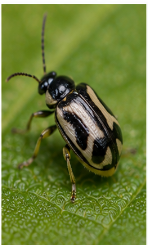
Palestriped Flea Beetles (Systena blanda) are small, highly active leaf beetles belonging to the family Chrysomelidae. Like other flea beetles, they are named for their remarkable jumping ability, which is made possible by enlarged hind legs similar to those of fleas. Although tiny, these beetles can become significant pests of vegetables, ornamentals, nursery crops, and agricultural plants by feeding on foliage and creating the characteristic “shot-hole” pattern that is commonly associated with flea beetle damage.
The Palestriped Flea Beetle is widely distributed throughout North America and feeds on numerous cultivated and wild plants. While mature plants often tolerate moderate feeding, seedlings and newly transplanted crops may suffer severe injury when beetle populations are high. For this reason, the species is considered an important garden and agricultural pest that is best managed using an Integrated Pest Management (IPM) approach.
Overview
The genus Systena contains numerous flea beetle species that inhabit fields, gardens, meadows, and natural landscapes. Adults are active during warm weather and spend much of their time feeding on leaves before rapidly jumping away when disturbed.
Although individual beetles remove only tiny amounts of leaf tissue, large populations can significantly reduce plant vigor, particularly during the early stages of crop development. Young seedlings are especially vulnerable because even limited feeding can slow growth or kill small plants.
Taxonomy and Classification
- Order: Coleoptera
- Family: Chrysomelidae
- Subfamily: Galerucinae
- Tribe: Alticini (Flea Beetles)
- Genus: Systena
- Species: Systena blanda
- Common Name: Palestriped Flea Beetle
Like all beetles, the Palestriped Flea Beetle undergoes complete metamorphosis, developing through egg, larva, pupa, and adult stages.
Identification
Adult Palestriped Flea Beetles are small but distinctive when viewed closely.
- Length: Approximately 3–4 mm.
- Color: Yellowish-tan to light brown.
- Wing Covers: Marked with darker longitudinal stripes.
- Body Shape: Oval and slightly convex.
- Legs: Enlarged hind legs adapted for jumping.
- Movement: Quickly jumps when disturbed, making capture difficult.
The combination of striped wing covers and powerful jumping ability helps distinguish this species from many other small leaf beetles.
Larval Identification
The immature stage develops primarily in the soil.
- Body: Slender and cylindrical.
- Color: Creamy white with a darker head capsule.
- Legs: Three pairs of small thoracic legs.
- Habitat: Soil surrounding host plant roots.
Larvae feed on roots and underground plant tissue, although damage is generally less noticeable than the feeding caused by adults.
Distribution and Habitat
Palestriped Flea Beetles occur throughout much of the United States and southern Canada wherever suitable host plants are available.
They are commonly found in:
- Agricultural fields
- Home vegetable gardens
- Commercial nurseries
- Weedy areas
- Field margins
- Meadows
- Landscape beds
- Roadside vegetation
Adults are especially abundant during warm spring and summer weather when fresh plant growth is readily available.
Life Cycle
Adult beetles emerge from overwintering sites during spring and begin feeding almost immediately on young vegetation.
Females deposit eggs in the soil near suitable host plants. After hatching, larvae feed on roots before pupating beneath the soil surface.
New adults emerge later in the growing season to continue feeding and reproduction. Depending on climate, one or more generations may occur annually.
Host Plants
The Palestriped Flea Beetle feeds on a broad range of cultivated and wild plants.
Common host plants include:
- Corn
- Beans
- Soybeans
- Potatoes
- Tomatoes
- Peppers
- Eggplant
- Various weeds and native plants
The availability of numerous host plants allows populations to persist even when crop rotations are practiced.
Damage and Signs of Infestation
Adult feeding produces the classic symptoms associated with flea beetles.
- Shot-Hole Damage: Numerous tiny round holes scattered across leaves.
- Leaf Skeletonization: Heavy feeding may leave only leaf veins intact.
- Reduced Seedling Growth: Young plants may become stunted.
- Wilting: Severe injury can stress newly transplanted vegetables.
- Reduced Crop Yield: Heavy infestations may decrease production.
Seedlings are far more vulnerable than mature plants because they possess limited leaf area and fewer energy reserves.
Integrated Pest Management (IPM)
Successful management combines cultural, biological, mechanical, and chemical practices.
Cultural Controls
- Remove weeds that serve as alternate hosts.
- Maintain healthy soil and vigorous plant growth.
- Rotate susceptible crops when practical.
- Plant crops after peak beetle emergence when possible.
Mechanical Controls
- Install floating row covers over young seedlings.
- Inspect plants regularly during spring.
- Remove heavily damaged leaves if practical.
Biological Control
Numerous natural enemies help suppress flea beetle populations.
- Ground beetles
- Lady beetles
- Predatory bugs
- Parasitic wasps
- Birds
- Spiders
Preserving these beneficial organisms is an important component of long-term IPM.
Chemical Control
When economic thresholds are exceeded, carefully selected insecticides may be used to protect valuable crops. Treatments are most effective when applied early before significant feeding injury develops.
Whenever possible, selective products should be chosen to minimize impacts on pollinators and beneficial insects.
Ecological Importance
Although considered crop pests, Palestriped Flea Beetles also serve important ecological functions by participating in natural food webs.
They provide food for numerous predators and contribute to nutrient cycling through their feeding activities in natural habitats.
Conservation and Research
Researchers continue studying flea beetles to improve sustainable management strategies, develop resistant crop varieties, and identify biological control agents capable of reducing infestations without excessive pesticide use.
Current research also focuses on improving monitoring methods and understanding how climate change influences flea beetle population dynamics.
Conclusion
Palestriped Flea Beetles (Systena blanda) are small but economically important leaf beetles capable of causing significant injury to seedlings and susceptible crops. Their characteristic shot-hole feeding damage and remarkable jumping ability make them easy to recognize in gardens and agricultural fields.
Fortunately, healthy growing practices, early monitoring, biological control, and integrated pest management strategies provide effective long-term suppression while minimizing impacts on beneficial insects and the surrounding environment.