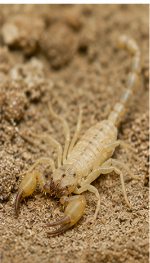
Pale Windscorpions are fast-moving arachnids belonging to the order Solifugae. They are commonly known as camel spiders, sun spiders, or windscorpions, although they are neither true spiders nor true scorpions. Their intimidating appearance, oversized jaws, and incredible speed have led to countless myths, particularly in desert regions. In reality, Pale Windscorpions are non-venomous predators that play an important role in controlling insect and arachnid populations.
Found throughout the deserts and semi-arid regions of the southwestern United States and many other warm climates around the world, these fascinating arachnids spend much of their lives hunting at night. They occasionally wander into homes, garages, sheds, or outbuildings while searching for prey or shelter, but they are not considered structural or household pests.
Overview
Windscorpions belong to one of the lesser-known arachnid orders. Although they share characteristics with spiders and scorpions, they represent a unique evolutionary lineage with specialized hunting adaptations.
Unlike true scorpions, windscorpions lack a venomous tail and stinger. Unlike spiders, they do not produce silk or build webs to capture prey. Instead, they rely on exceptional speed, powerful jaws, and excellent sensory organs to locate and overpower insects and other small animals.
Because they consume many pest species, Pale Windscorpions are generally considered beneficial predators in desert ecosystems.
Taxonomy and Classification
- Class: Arachnida
- Order: Solifugae
- Common Names: Windscorpion, Camel Spider, Sun Spider, Solifuge
More than 1,200 species of solifuges have been described worldwide. North American species belong primarily to the families Eremobatidae and Ammotrechidae, which are especially common throughout the southwestern United States and northern Mexico.
Like other arachnids, windscorpions develop gradually through successive molts rather than undergoing complete metamorphosis.
Identification
Pale Windscorpions are unmistakable because of their enormous jaws and long, agile legs.
- Length: Approximately 25–70 mm (1–2.75 inches), excluding the legs.
- Color: Pale tan, sandy brown, cream, or light yellow.
- Body: Divided into a cephalothorax and segmented abdomen.
- Chelicerae: Extremely large forward-facing jaws used for grasping and crushing prey.
- Legs: Four pairs of long walking legs plus modified sensory appendages (pedipalps).
- Tail: None—despite the common name, windscorpions do not possess a stinger.
Their pale coloration provides excellent camouflage against desert sand, gravel, and rocky soils.
Distribution and Habitat
Pale Windscorpions inhabit warm, dry environments throughout much of the world.
In North America they are most common in:
- Arizona
- New Mexico
- Nevada
- Utah
- Southern California
- Western Texas
- Northern Mexico
Preferred habitats include:
- Deserts
- Dry grasslands
- Rocky canyons
- Scrublands
- Sandy washes
- Agricultural fields
- Rural landscapes
During the day they shelter beneath rocks, logs, debris, animal burrows, or within cracks in the soil to avoid extreme heat.
Life Cycle
After mating, females excavate underground chambers where they lay clusters of eggs.
The female often remains with the eggs until they hatch, protecting them from predators and environmental hazards. Young windscorpions remain in the burrow briefly before dispersing to begin hunting independently.
As they grow, juveniles molt multiple times before reaching adulthood. Depending on environmental conditions and food availability, development may require one to several years.
Behavior and Feeding Habits
Pale Windscorpions are active primarily at night when desert temperatures become cooler.
They are aggressive predators that feed on a wide variety of prey, including:
- Crickets
- Cockroaches
- Termites
- Beetles
- Grasshoppers
- Spiders
- Scorpions
- Centipedes
- Other small arthropods
Using their large chelicerae, they seize prey and tear it into manageable pieces. Digestive fluids begin breaking down tissues before the liquefied food is consumed.
Although they may appear aggressive, they are simply efficient hunters responding to movement.
Speed and Behavior
Windscorpions are among the fastest arachnids in the world, capable of running at impressive speeds across loose desert soils.
Their rapid movements often startle people. They may appear to chase humans, but in reality they are usually seeking shade cast by a moving object or attempting to escape perceived danger.
Unlike spiders, they do not spin capture webs and instead rely entirely on active hunting.
Human Interaction
Despite numerous internet myths, Pale Windscorpions are not venomous and do not possess a poisonous stinger.
If handled carelessly, they can deliver a painful pinch or bite using their powerful jaws. The injury is mechanical rather than venomous and usually resembles a minor cut or pinch.
They are generally shy and avoid contact with people whenever possible.
Damage and Pest Status
Pale Windscorpions are not household pests.
They do not:
- Damage structures.
- Infest stored foods.
- Chew wood.
- Damage furniture.
- Attack clothing.
- Establish indoor colonies.
Most individuals found indoors entered accidentally through open doors, garages, crawl spaces, or gaps beneath exterior doors while searching for prey.
Integrated Pest Management (IPM)
Control is rarely necessary because these arachnids are beneficial predators.
If they become an occasional nuisance around buildings, effective management includes:
- Exclusion: Seal cracks, gaps, and utility penetrations.
- Door Sweeps: Install tight-fitting weather stripping beneath exterior doors.
- Reduce Outdoor Insects: Lower prey populations around structures.
- Landscape Maintenance: Remove debris, rocks, and wood piles near foundations.
- Lighting Management: Reduce exterior lighting that attracts insects.
Because windscorpions are beneficial predators, pesticide applications are generally unnecessary and may eliminate other helpful arthropods.
Natural Predators
Although formidable hunters themselves, Pale Windscorpions become prey for numerous desert animals.
- Roadrunners
- Owls
- Lizards
- Coyotes
- Foxes
- Large spiders
- Scorpions
- Snakes
Their speed and nocturnal habits provide important protection from many predators.
Ecological Importance
Pale Windscorpions help regulate populations of insects and other arthropods throughout desert ecosystems. By consuming cockroaches, termites, crickets, grasshoppers, and other insects, they contribute to maintaining ecological balance.
Their presence is generally considered beneficial and reflects healthy desert biodiversity rather than a pest infestation.
Conservation and Research
Researchers continue studying solifuges to better understand their remarkable speed, sensory biology, hunting behavior, evolutionary relationships, and adaptations to extreme desert environments.
Much remains unknown about their reproductive biology and species diversity, making them an active area of arachnid research.
Conclusion
Pale Windscorpions are fascinating desert arachnids that are frequently misunderstood because of their intimidating appearance. Despite possessing massive jaws and incredible speed, they are non-venomous, rarely interact with people, and provide valuable natural pest control by feeding on insects and other arthropods.
Rather than fearing these remarkable hunters, they should be appreciated as beneficial members of healthy desert ecosystems.