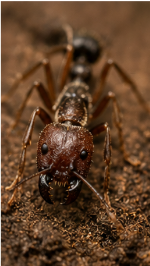
Pachycondyla Ants are a group of medium to large predatory ants historically classified within the genus Pachycondyla. They are primarily associated with tropical, subtropical, and warm temperate habitats, where they live in soil, leaf litter, decaying wood, fallen logs, and other protected natural spaces. These ants belong to the subfamily Ponerinae, a group often described as primitive or stinging ants because many species retain powerful stingers and relatively simple colony structures.
Unlike common nuisance ants such as Argentine Ants, Pharaoh Ants, or Odorous House Ants, Pachycondyla Ants are generally not persistent indoor structural pests. Most species are predators that hunt insects, spiders, and other small arthropods. They are ecologically beneficial because they help regulate populations of other invertebrates. However, they may become a concern when nests are located near patios, pathways, gardens, playgrounds, or other areas where people may accidentally disturb them.
Overview
Pachycondyla Ants are best known for their robust bodies, solitary hunting behavior, and painful stings. Workers commonly search for prey alone rather than traveling in the large, organized trails produced by many household ant species. They use their strong mandibles to seize prey and their functional stingers to inject venom that immobilizes or kills it.
The name Pachycondyla has historically included many species, although modern ant classification has divided parts of the former genus into several separate genera. The term is still widely recognized in older scientific literature, pest identification references, and general discussions of ponerine ants.
Most species do not seek human food or establish large colonies inside buildings. When they enter homes, they are often accidental invaders that have wandered indoors while hunting or seeking shelter. Their greatest importance to people is the possibility of a painful sting and their tendency to nest in concealed outdoor spaces.
Taxonomy and Classification
Pachycondyla Ants belong to the order Hymenoptera, which includes ants, bees, and wasps. They are members of the family Formicidae and the subfamily Ponerinae.
- Order: Hymenoptera
- Family: Formicidae
- Subfamily: Ponerinae
- Historical Genus: Pachycondyla
- Common Name: Pachycondyla Ants
Like all ants, Pachycondyla species undergo complete metamorphosis. Their life cycle includes the egg, larval, pupal, and adult stages. Colonies generally contain queens, workers, males, and winged reproductive females during certain times of the year.
Ponerine ants are considered evolutionarily distinct from many highly specialized modern ant groups. Their colonies are often smaller, their workers tend to forage independently, and many species rely heavily on live prey rather than sugary liquids.
Identification
Pachycondyla workers are usually medium to large ants measuring approximately 1/4 to 1/2 inch long, although size varies by species. They often have dark brown, reddish-brown, or black bodies with a heavy, muscular appearance.
- Body Shape: Thick, robust, and somewhat elongated.
- Color: Commonly dark brown, reddish-brown, or black.
- Head: Broad, with strong mandibles adapted for capturing prey.
- Waist: A single prominent petiolar node connects the thorax and abdomen.
- Stinger: Workers possess a well-developed, functional stinger.
- Movement: Often slower and more deliberate than small household ants.
- Foraging Pattern: Workers usually hunt alone or in small groups rather than forming dense trails.
Their dark coloration and solitary habits can make them difficult to distinguish from other large predatory ants. Accurate identification may require close examination of the waist, mandibles, antennae, body sculpturing, and other anatomical features.
Nesting Habits
Pachycondyla Ants typically construct small, concealed nests. They do not usually build the large soil mounds associated with fire ants or field ants. Instead, colonies take advantage of naturally protected cavities.
Common nesting locations include:
- Rotting logs and decaying tree stumps
- Spaces beneath rocks, boards, and fallen bark
- Soil under leaf litter
- Abandoned insect tunnels
- Hollow branches and dead wood
- Mulch beds and shaded garden areas
- Natural gaps around roots or stones
Some species may nest close to buildings if suitable moisture, decaying wood, and prey are available. However, long-term infestations inside dry, climate-controlled structures are uncommon.
Distribution and Habitat
Pachycondyla Ants are most diverse in tropical and subtropical regions. They occur in Central America, South America, Africa, Asia, Australia, and other warm parts of the world. Some related or historically included species occur in warmer portions of the southern United States, including Florida, Texas, and Gulf Coast areas.
Their preferred habitats include forests, woodland edges, gardens, plantations, wetlands, and areas with abundant leaf litter and decaying wood. Moisture is important because many species depend on humid environments and prey-rich soil habitats.
They are often found beneath the forest canopy, where fallen leaves, branches, and decomposing wood provide shelter. Their cryptic lifestyle allows colonies to remain unnoticed unless a log, stone, or section of soil is disturbed.
Life Cycle
The life cycle begins when a queen lays eggs inside the nest. The eggs hatch into soft, legless larvae that depend entirely on workers for food and protection. Workers bring captured insects and other arthropods back to the colony, where the prey is divided or processed for developing larvae.
After passing through several larval stages, the young ants pupate. In some ponerine ants, pupae may be enclosed in silk cocoons. Adults emerge after completing development and take on roles within the colony.
Workers maintain the nest, defend the colony, care for the young, and hunt for food. Winged males and reproductive females may be produced seasonally. After mating, fertilized females search for protected locations where they can establish new colonies.
Colonies are usually smaller than those of many invasive pest ants. Some may contain only dozens or hundreds of workers rather than tens of thousands.
Behavior and Feeding
Pachycondyla Ants are active predators. Workers patrol the soil surface, leaf litter, bark, and fallen wood in search of prey. They may attack beetle larvae, termites, caterpillars, spiders, cockroaches, crickets, and other small invertebrates.
When prey is located, the worker may grasp it with its mandibles and deliver one or more stings. The venom quickly weakens or paralyzes the prey, allowing the ant to transport it back to the nest.
Some species may also consume dead insects, plant liquids, nectar, or sugary substances, but animal protein is generally important to their diet. Because they do not depend heavily on sweets, they may ignore conventional sugar-based ant baits.
Workers are usually not aggressive toward humans unless they are trapped, handled, stepped on, or defending a disturbed nest. Their slow movement can make them appear less threatening than fire ants, but the sting may still be painful.
Stings and Human Conflict
The main conflict associated with Pachycondyla Ants is their sting. The venom is primarily used for subduing prey, but workers will also sting defensively.
A sting may produce immediate pain, redness, swelling, itching, or a burning sensation. Symptoms are usually localized and temporary, although reactions vary among individuals. People with allergies to insect venom may experience more serious reactions and should seek medical attention if breathing difficulty, widespread swelling, dizziness, or other severe symptoms occur.
Stings are most likely when:
- A hidden nest is disturbed while moving wood, stones, or mulch.
- An ant becomes trapped inside clothing or footwear.
- A worker is accidentally handled.
- People walk barefoot near an active nesting site.
- Landscaping work exposes a concealed colony.
Unlike fire ants, Pachycondyla Ants generally do not rush out in enormous numbers and sting repeatedly as a group. However, individual workers may sting more than once if they remain in contact with the skin.
Ecological Importance
Pachycondyla Ants are beneficial predators in natural ecosystems. By feeding on insects and other arthropods, they help regulate prey populations in forests, gardens, and soil environments.
They also contribute to nutrient cycling by moving prey remains and organic material into their nests. Their tunneling may improve soil aeration and influence the movement of nutrients through leaf litter and upper soil layers.
Because most species are not persistent household pests, control should be limited to situations where colonies create a genuine safety concern. Unnecessary treatment can remove beneficial predators and disrupt the local ecosystem.
Inspection and Monitoring
Inspection should focus on outdoor areas where workers or stings have been reported. Follow individual foraging ants when possible, although solitary hunters may not return along a visible trail.
- Inspect under stones, boards, logs, and landscape timbers.
- Check rotting tree stumps and decaying wood.
- Examine shaded mulch beds and moist soil.
- Look around tree roots and fallen bark.
- Wear gloves and closed footwear during inspection.
Do not place bare hands into suspected nesting cavities. Long-handled tools can be used to carefully lift wood or stones while maintaining a safe distance.
Management and Control
Management is usually unnecessary unless a colony is located near a frequently used area or workers are repeatedly entering a building. Control should begin with accurate identification and removal of conditions that support nesting.
Habitat Modification
- Remove rotting wood, fallen branches, and unnecessary debris.
- Relocate firewood away from buildings and outdoor seating areas.
- Reduce excessive moisture near foundations.
- Thin deep mulch where ants repeatedly nest.
- Seal cracks around doors, windows, and utility lines.
Because these ants depend on protected, humid nesting sites, reducing decaying wood and excessive moisture can make an area less suitable.
Baiting
Protein- or oil-based ant baits may be more attractive than sugar baits because Pachycondyla Ants are primarily predators. However, bait acceptance can vary greatly between species and seasons.
Baits should be placed near active foraging areas without disturbing the nest. The ants must carry the bait back to the colony for it to affect workers, larvae, and reproductive ants.
Direct Nest Treatment
When the nest location is known and removal is necessary, an approved insecticidal dust, foam, or liquid may be applied directly into the nesting cavity. Direct treatment is generally more effective than spraying wandering workers.
Applications should follow all label instructions. Protective clothing and gloves should be worn because disturbing the colony may increase defensive activity.
Physical Removal
Small nests in movable logs, boards, or debris may be removed physically. The material should be handled carefully with tools and protective clothing. Relocating or disposing of infested wood may resolve the problem without widespread pesticide use.
Prevention
Preventing conflict with Pachycondyla Ants involves reducing contact between people and their nesting habitat. Keep rotting wood, unused boards, stones, and heavy leaf litter away from doors, patios, play areas, and walkways.
Wear gloves when gardening or moving wood, and avoid walking barefoot in areas where large predatory ants have been observed. Seal exterior gaps to prevent accidental indoor entry, and repair moisture problems that attract insects and create suitable nesting conditions.
Conservation and Research
Pachycondyla Ants are important subjects of ecological and biological research. Scientists study their venom chemistry, predatory behavior, colony organization, communication, and evolutionary relationships.
Ant venoms contain biologically active compounds that may have potential applications in medicine, pest control, and pharmaceutical research. Taxonomic studies also continue to clarify the classification of species formerly grouped within the broad genus Pachycondyla.
Research into their ecological role helps scientists understand predator communities in tropical forests and how ants influence soil organisms, insect populations, and nutrient cycling.
Conclusion
Pachycondyla Ants are robust, predatory ants associated mainly with tropical and subtropical forests, gardens, and other moist outdoor habitats. They hunt insects and small arthropods, often using powerful stings to immobilize their prey.
These ants are generally beneficial and are rarely major indoor pests. Human conflict occurs primarily when hidden nests are disturbed or workers are accidentally handled. Habitat modification, protective clothing, protein-based baiting, and direct nest treatment can manage localized problems while preserving their beneficial role in the environment.