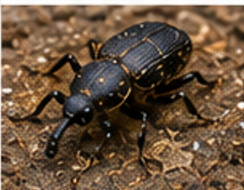
Noxious root weevils are destructive pests whose larvae feed on plant roots, weakening plants and causing decline.
The Underground Girdler: Noxious Root Weevils
In the United States, Noxious Root Weevils primarily refers to a group of flightless, invasive beetles in the genus Otiorhynchus, including the Black Vine Weevil (O. sulcatus) and the Strawberry Root Weevil (O. ovatus). These pests are “noxious” because they carry out a dual-threat attack: the adults disfigure foliage by night, while the larvae—hidden beneath the soil—silently destroy the root systems of high-value ornamental shrubs, berries, and nursery stock.
Identification: The “Snouted” Nocturnal
Root weevils are easy to identify by their distinct “snout” (rostrum) and their inability to fly. Because they are strictly nocturnal, homeowners often see the damage long before they see the beetle. Key identification features include:
- Fused Wing Covers: Their elytra (wing covers) are fused together, meaning they cannot fly. They must walk or be transported via infested nursery soil to reach new plants.
- Elbowed Antennae: Their antennae are “elbowed” or “L-shaped,” originating from the middle of the snout.
- The Larvae: The “root-feeding” stage is a creamy-white, C-shaped, legless grub with a distinct reddish-brown head. They are often found tightly curled among the fine feeder roots of a plant.
The “Notching” and “Girdling” Damage
The damage caused by Noxious Root Weevils is a classic “Pestipedia” diagnostic. The adults and larvae create two very different, but equally devastating, symptoms:
- Adult “Notching”: Adults feed on the edges of leaves, creating clean, scalloped “U-shaped” notches. While unsightly on plants like Rhododendrons or Azaleas, this damage is rarely fatal.
- Larval “Girdling”: This is the true danger. Larvae feed on the roots and the bark of the main stem below the soil line. They “girdle” the plant, cutting off the flow of water and nutrients. A plant that looks perfectly healthy one day may suddenly wilt and die as if hit by a severe drought.
U.S. Agricultural and Nursery Management
Management of Noxious Root Weevils in the U.S. is a year-round process. Because the adults are flightless, the spread is usually slow unless humans move them. Control strategies include:
- Beneficial Nematodes: In the U.S., the most effective “green” solution is the use of predatory nematodes (like Steinernema or Heterorhabditis). These microscopic worms are drenched into the soil, where they hunt down and enter the weevil larvae, killing them from the inside.
- Sticky Barriers: Since adults must crawl up the stems of shrubs to feed at night, applying a sticky “tanglefoot” barrier around the base of the trunk can trap them before they reach the foliage.
- Nocturnal Scouting: For home gardeners, the “Flashlight Method” is highly effective. Go out two hours after sunset with a bucket of soapy water and shake the branches of notched plants; the weevils will drop into the bucket and can be discarded.
Damage
Root destruction and plant death.
Control
Soil treatments and biological controls.