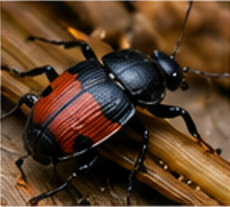
Nipa Palm Beetles (Plesispa reichei) are specialized palm-feeding beetles that can cause serious damage to coconut, nipa, and other economically important or ornamental palms. Unlike palm pests that bore deeply into trunks, Nipa Palm Beetles primarily attack the young, unopened leaves in the central spear of a palm. Both adults and larvae feed on tender leaf tissue while the leaflets are still folded together, producing distinctive brown streaks and extensive scarring once the fronds open.
Heavy infestations can leave newly opened fronds looking scorched or burned. Repeated attacks reduce the amount of healthy foliage available for photosynthesis, weaken young palms, slow growth, and can reduce productivity in commercial palm plantings. Because the beetles can remain concealed inside tightly folded leaves, infestations may be transported unnoticed on nursery plants and other palm material.
Taxonomy and Classification
Nipa Palm Beetles belong to the order Coleoptera and family Chrysomelidae, the large family commonly known as leaf beetles. They are part of a group of flattened palm-feeding beetles whose body shape allows them to enter the narrow spaces between unopened palm leaflets.
The species undergoes complete metamorphosis, progressing through egg, larval, pupal, and adult stages. Both larvae and adults can contribute to foliage damage. This separates Nipa Palm Beetles from many agricultural beetles in which only the larval or adult stage causes economically important injury.
Physical Description and Identification
Adult Nipa Palm Beetles are relatively small, elongated insects measuring approximately 7 to 9 mm long. Their flattened shape is an important adaptation because it allows them to move between the closely compressed leaflets of developing palm fronds.
- Adult Appearance: Adults have an elongated, flattened body rather than the heavy, rounded form associated with rhinoceros beetles.
- Coloration: The head and pronotum are generally orange-brown to reddish-brown, contrasting with darker or black wing covers.
- Larvae: Larvae are pale, flattened, and somewhat segmented in appearance, with lateral projections along the body.
- Eggs: Females place eggs on suitable palm tissue, where the newly hatched larvae can quickly reach developing foliage.
- Location: Adults and larvae should be looked for inside or around the tightly folded leaflets of the central spear rather than inside the trunk.
This last feature is particularly important for identification. Nipa Palm Beetles are leaf-feeding pests, not primarily trunk-boring beetles. Damage to the central leaves should therefore be distinguished from the large holes, tunnels, or extensive internal trunk injury associated with palm weevils and rhinoceros beetles.
Distribution and Habitat
Nipa Palm Beetles are associated primarily with tropical regions where suitable palms are abundant. They can occur in coconut-producing areas, palm nurseries, plantations, gardens, and landscapes containing susceptible ornamental palms.
Young palms can be particularly vulnerable because a relatively small amount of feeding can affect a substantial percentage of their developing foliage. Warm temperatures and continuous production of new palm growth can provide favorable conditions for repeated beetle activity.
Host Plants
Despite their common name, Nipa Palm Beetles are not necessarily restricted to nipa palms. They may attack several members of the palm family, with coconut palms being particularly important from an agricultural perspective. Other palms grown for landscaping or commercial purposes may also provide suitable feeding and breeding sites.
The beetles show a strong preference for young, tender palm foliage. Fully expanded and hardened fronds are generally much less attractive because the tissue becomes more difficult for adults and larvae to feed upon.
Damage and the “Scorched” Leaf Appearance
The characteristic damage occurs while a palm leaf is still folded inside the central spear. Adults and larvae scrape or chew away the surface layers of the developing leaflets. Because the leaf remains tightly folded during feeding, the full extent of the injury may initially remain hidden.
Once the damaged frond expands, the feeding injuries become highly visible.
- Linear Scarring: Long, narrow brown streaks develop along the leaflets, often running parallel to the veins.
- Brown Patches: Numerous feeding scars may merge into larger areas of dead tissue.
- Scorched Appearance: Severely affected fronds may appear brown, dry, and burned.
- Reduced Photosynthesis: Destruction of green leaf tissue reduces the palm’s ability to manufacture energy.
- Stunted Growth: Repeated attacks on young palms can substantially slow establishment and development.
Severe infestations are especially concerning when beetles repeatedly attack the newest growth. A palm depends heavily on healthy emerging leaves, and continuous destruction can leave young plants badly weakened. In commercial coconut production, repeated foliage loss may ultimately contribute to reduced vigor and productivity.
Life Cycle and Behavior
Female beetles deposit eggs on or near suitable palm foliage. After hatching, the flattened larvae move into protected spaces between young leaflets and begin feeding. Their body shape allows them to remain concealed in places that are difficult for predators and conventional contact insecticide sprays to reach.
Following larval development, the insects pupate and eventually emerge as adults. Adults also feed on tender palm foliage and can remain hidden within unopened leaves. The combination of concealed feeding and damage to developing tissue is one reason infestations may become established before obvious symptoms appear.
Inspection and Early Detection
Early detection is especially important in nurseries and commercial palm plantings. Inspectors should examine the newest leaves rather than relying entirely on the appearance of older, expanded fronds.
- Check newly opened leaves for narrow brown feeding scars.
- Inspect central spear leaves for flattened larvae or elongated adults.
- Look for repeated damage appearing on consecutive new fronds.
- Closely inspect newly purchased or imported palm nursery stock.
- Separate suspicious plants from healthy stock until the cause of damage has been identified.
Management and Prevention
Management should follow an Integrated Pest Management (IPM) program combining inspection, sanitation, biological control, and carefully selected treatments where appropriate.
Nursery Sanitation
Nurseries should inspect incoming palms carefully and avoid moving infested plants into clean production areas. Severely damaged or heavily infested plant material may need to be removed and disposed of according to local agricultural requirements. Maintaining accurate plant-source records can also help trace an infestation if beetles are discovered.
Biological Control
Natural enemies can play an important role in suppressing palm-feeding beetles. Parasitic wasps that attack immature beetle stages have been investigated and used in biological-control programs against related palm hispine beetles. Biological control is particularly valuable in tropical perennial crops because repeated broad-spectrum insecticide applications can disrupt beneficial insects and create long-term management problems.
Chemical Control
Contact insecticides can be difficult to use effectively because adults and larvae remain protected inside tightly folded foliage. Where insecticides are legally registered for the specific crop and pest, treatments must be directed toward vulnerable stages and developing foliage. Commercial growers should follow local agricultural extension recommendations and all pesticide label requirements.
Quarantine and Prevention
Preventing the movement of palm pests is often considerably easier than eliminating an established population. Palm seedlings and nursery stock can conceal beetles, larvae, or eggs among their developing leaves. Commercial producers and importers should therefore follow applicable plant quarantine and inspection requirements when transporting palms between regions.
Any unusual palm beetle discovered in an area where the species is not known to occur should be identified before control measures are attempted. Early reporting of suspected exotic pests can prevent a localized introduction from becoming a much larger agricultural problem.
Conservation and Research
Nipa Palm Beetles are primarily studied because of their potential impact on commercial palm production and international plant movement. Research focuses on improved early-detection methods, biological control, host susceptibility, and management techniques capable of reaching beetles concealed within unopened palm foliage.
For growers, the most important strategy is prevention. Careful inspection of nursery stock, rapid identification of suspicious feeding scars, protection of natural enemies, and prompt management of confirmed infestations can substantially reduce the risk of serious palm damage.