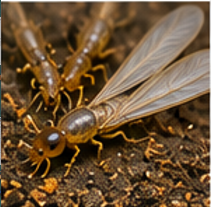
Neotropical Termites is a broad term for the diverse termite species occurring throughout the tropical regions of Central America, South America, and the Caribbean. The Neotropical region supports hundreds of termite species, most of which play important ecological roles by breaking down dead wood and recycling nutrients. However, several species can become serious structural pests when they infest homes, commercial buildings, furniture, utility poles, and other wooden materials.
Important pest groups associated with tropical regions include drywood termites such as Cryptotermes species and destructive subterranean termites such as Coptotermes gestroi. Some tropical termites have been transported far beyond their original ranges through international shipping and the movement of infested wood, furniture, boats, and other materials. Once established in warm climates, invasive populations can become extremely difficult and expensive to control.
Taxonomy and Classification
Termites belong to the order Blattodea, the same order that contains cockroaches. Although termites were historically placed in their own order, Isoptera, modern classification recognizes them as highly specialized social relatives of cockroaches.
Termite colonies contain several specialized castes. Workers perform most of the feeding, tunneling, nest maintenance, and care of young. Soldiers defend the colony against ants and other enemies, while reproductive termites produce new colony members. Winged reproductive termites, called alates or swarmers, periodically leave established colonies to mate and establish new colonies.
The biology of Neotropical termites varies considerably between species. Subterranean termites normally maintain connections with soil or other reliable moisture sources, while drywood termites can establish complete colonies inside relatively dry pieces of wood.
Physical Description
Most termite workers and soldiers are relatively small, commonly measuring approximately 1/8 to 1/4 inch long. Reproductive swarmers may be larger when their wings are included.
- Workers: Usually soft-bodied and pale cream or whitish in color. Workers generally remain concealed inside wood, soil, nests, or shelter tubes.
- Soldiers: Typically have enlarged, darker heads and specialized jaws or defensive structures.
- Alates: Darker reproductive termites possessing two pairs of approximately equal-sized wings.
- Drywood Frass: Drywood termites produce distinctive hard fecal pellets that may accumulate beneath small openings in infested wood.
Soldiers of Coptotermes have a distinctive head containing a fontanelle, an opening through which defensive secretions can be released when the colony is threatened.
Distribution and Habitat
Neotropical termite diversity is greatest throughout Central America, South America, the Caribbean, and other warm tropical environments. Human commerce has transported several pest species beyond their natural distributions.
Coptotermes gestroi, commonly called the Asian subterranean termite, is actually native to tropical Asia rather than the Neotropics, but invasive populations now occur in portions of the tropical Americas and other warm regions. It has also become an important structural termite in parts of the United States.
Subterranean species typically establish colonies in soil, trees, or other moist locations and construct protected pathways between the colony and food. Drywood species such as Cryptotermes can live entirely inside structural lumber, furniture, doors, window frames, and other wooden objects.
Signs of Neotropical Termites
Termites frequently remain concealed until an infestation is well established. Property owners should watch for several characteristic warning signs.
- Mud Tubes: Subterranean termites construct protected earthen tubes across foundations, walls, piers, and other surfaces.
- Fecal Pellets: Drywood termites push small, hard pellets from openings in infested wood, sometimes creating noticeable piles.
- Swarmers: Winged termites appearing indoors can indicate an established colony in or near the structure.
- Discarded Wings: Alates shed their wings after swarming, leaving piles around windows, doors, lights, and other locations.
- Damaged Wood: Heavily infested wood may become hollow, weakened, blistered, or unusually easy to puncture.
Behavior and Structural Damage
Termites consume cellulose, a major component of wood and other plant materials. Workers continuously search for suitable food and transport nutrients throughout the colony.
Subterranean termites can be especially destructive because colonies may contain very large numbers of individuals and maintain multiple feeding locations. Their concealed tunnels allow workers to move from the soil into structural wood while remaining protected from drying conditions and predators.
Drywood termites present a different challenge. Because colonies can survive entirely within wood, infestations may occur well above ground without obvious connections to soil. Furniture, roof timbers, door frames, window frames, flooring, and decorative wood can all potentially become infested.
Termite damage usually develops internally. A wooden beam may appear relatively normal on the outside while substantial portions of its interior have been consumed. This hidden feeding behavior is one reason routine inspections are important in termite-prone areas.
How Neotropical Termites Spread
Natural spread occurs when reproductive termites swarm and establish new colonies. Human transportation can move termites much farther. Drywood termite colonies may be transported inside furniture, lumber, wooden packaging, boats, and other infested materials.
International trade has contributed to the establishment of destructive termite species outside their original geographic ranges. Warm coastal cities can be particularly vulnerable because temperatures and humidity may allow tropical species to survive and reproduce.
Management and Prevention
Successful termite management begins by determining which type of termite is present. Treatment appropriate for a subterranean colony may be ineffective against a drywood colony living entirely inside a piece of structural timber.
Moisture and Structural Prevention
- Repair leaking plumbing, roofs, gutters, and air-conditioning drainage problems.
- Reduce unnecessary wood-to-soil contact around structures.
- Remove buried lumber, stumps, and construction debris near foundations.
- Maintain adequate ventilation in crawl spaces and other damp locations.
- Inspect used wooden furniture before bringing it indoors.
Subterranean Termite Control
Professional treatments may include liquid soil termiticides that create treated zones around or beneath a structure. Modern non-repellent termiticides can allow exposed termites to interact with other colony members rather than immediately avoiding treated areas.
Termite bait systems provide another option. Stations are installed around a structure and monitored for termite activity. Once termites begin feeding, slow-acting active ingredients can be introduced and transferred through the colony.
Drywood Termite Control
Small, accessible drywood termite infestations may sometimes be treated locally by pest management professionals. When colonies are widespread throughout a building, more extensive treatment may be necessary. In some situations, whole-structure fumigation is used to reach colonies concealed throughout inaccessible structural wood.
When to Call a Professional
Suspected structural termite infestations should generally be inspected by a qualified termite professional. Correct identification is particularly important in regions where several subterranean and drywood species occur together.
A professional inspection can determine the likely termite group, locate areas of activity, identify moisture or construction conditions contributing to infestation, and recommend an appropriate treatment strategy. Significant structural damage may also require evaluation and repair by qualified building professionals.
Ecological Importance
Despite the economic importance of pest species, the overwhelming majority of Neotropical termites are valuable decomposers rather than structural pests. In tropical forests and other ecosystems, termites break down dead wood and plant material, recycle nutrients, modify soil, and provide food for numerous predators.
For this reason, termite management should focus on colonies threatening structures or other valuable property rather than attempting to eliminate termites from surrounding natural habitats.
Conservation and Research
Research on tropical and invasive termites focuses on early detection, species identification, colony behavior, bait technology, non-repellent termiticides, biological control, and methods of preventing accidental transport. Scientists also study the important ecological role termites play in tropical decomposition and nutrient cycling.
For homeowners, the most effective strategy combines regular inspection, moisture management, elimination of favorable structural conditions, and prompt professional treatment when an active infestation is confirmed. Early detection can prevent a relatively localized termite problem from developing into extensive and costly structural damage.