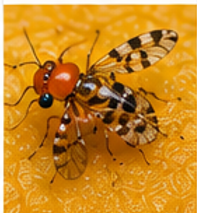
Navel Fruit Flies is a general or colloquial name sometimes used for fruit-infesting flies associated with citrus and other ripening fruits. The term does not identify a single recognized species and should not be confused with the Navel Orangeworm, a moth pest of nuts. When used for economically important fruit flies, it may refer to members of the family Tephritidae, including invasive pests such as the Mediterranean fruit fly (Ceratitis capitata) or Mexican fruit fly (Anastrepha ludens). These insects are serious agricultural pests because females deposit eggs into ripening fruit, where the developing larvae feed within the pulp.
Infested fruit may soften, rot, drop prematurely, or become filled with feeding larvae. Beyond direct crop losses, invasive fruit flies are particularly important because their detection can trigger quarantines and regulatory control programs designed to prevent them from becoming established in major fruit-producing regions.
Taxonomy and Classification
Economically important fruit flies belong to the order Diptera and, in the case of true fruit-infesting agricultural species, the family Tephritidae. They undergo complete metamorphosis through four stages: egg, larva, pupa, and adult.
Tephritid fruit flies should be distinguished from the tiny vinegar or pomace flies commonly seen around kitchens. Those flies generally belong to the family Drosophilidae and are usually associated with damaged, fermenting, or overripe material. Many tephritid species, by contrast, can attack fruit while it is still attached to the plant and apparently healthy.
Physical Description
Adult agricultural fruit flies are generally small insects measuring approximately 1/8 to 1/4 inch long, although size and coloration vary considerably among species.
- Adults: Many species have yellowish, brown, black, or patterned bodies. Tephritid fruit flies frequently possess distinctive bands, spots, or other markings on their wings.
- Female: Females possess an ovipositor that allows them to penetrate the skin of suitable fruit and deposit eggs beneath the surface.
- Larvae: The larvae are creamy white, legless maggots with tapered bodies. They develop concealed inside fruit.
- Pupae: Mature larvae generally leave the fruit and pupate in the soil, producing small, brownish, capsule-like puparia.
Signs of Fruit Fly Damage
Early infestations can be difficult to recognize because eggs and young larvae are hidden beneath the fruit skin. Damage becomes increasingly obvious as larvae grow.
- Egg-Laying Punctures: Tiny marks, pits, or discolored spots may develop where females inserted their ovipositors.
- Soft Areas: Tissue surrounding feeding sites may become soft, sunken, or discolored.
- Internal Breakdown: Larvae tunnel through and consume fruit pulp, causing extensive internal deterioration.
- Premature Fruit Drop: Heavily infested fruit may ripen abnormally or fall before harvest.
- Maggots: Cutting open damaged fruit may reveal multiple pale larvae moving through softened pulp.
Distribution and Habitat
Fruit-infesting Tephritidae occur throughout tropical, subtropical, and temperate regions of the world. Some species have naturally restricted ranges, while others have spread internationally through the transportation of infested fruit.
In the United States, invasive fruit flies are especially concerning in major fruit-producing regions. Agricultural agencies maintain extensive surveillance programs because early detection provides the best opportunity to eliminate an introduced population before it becomes permanently established.
Depending on the species, hosts can include citrus, peaches, plums, apricots, apples, pears, mangoes, guavas, avocados, and numerous other cultivated and wild fruits.
Life Cycle and Behavior
The infestation cycle begins when a female locates suitable ripening fruit. She punctures the skin and deposits eggs beneath the surface. After hatching, the larvae remain protected inside the fruit while feeding on the surrounding pulp.
Once fully developed, larvae commonly leave the fruit and enter the soil, where they pupate. Adults later emerge, mate, and search for new host fruit. Warm conditions can accelerate development, allowing some species to complete multiple generations during a growing season.
Agricultural and Economic Impact
The greatest threat associated with invasive fruit flies extends beyond individual damaged fruits. A newly established population can threaten an entire fruit-producing region.
- Crop Loss: Larval feeding can make fruit unsuitable for fresh markets or processing.
- Broad Host Range: Species such as the Mediterranean fruit fly can reproduce in a remarkably wide variety of host plants.
- Quarantine Restrictions: Detection may result in restrictions on transporting fruit and other host materials from affected areas.
- Control Costs: Governments and growers may need to implement extensive trapping, treatment, fruit removal, and eradication programs.
- Trade Impact: Established populations can interfere with domestic and international movement of agricultural commodities.
Management and Prevention
Management relies on Integrated Pest Management (IPM) combined with regulatory surveillance when invasive species are involved.
- Monitoring: Specialized traps containing species-appropriate attractants are placed throughout vulnerable agricultural regions to detect adult flies before populations become established.
- Sanitation: Fallen, overripe, and infested fruit should be collected promptly and disposed of appropriately. Leaving damaged fruit beneath trees provides larvae with an opportunity to complete development.
- Harvest Management: Harvesting susceptible fruit promptly when mature can reduce the amount of highly attractive fruit available for egg laying.
- Bait Treatments: Some management programs use protein-based attractants combined with approved insecticides to target adult flies.
- Sterile Insect Technique: Large numbers of laboratory-reared sterile males may be released into affected areas. When wild females mate with sterile males, viable offspring are not produced, gradually suppressing the population.
Quarantine and Prevention of Spread
Preventing movement is especially important with invasive fruit flies. Infested fruit transported by travelers, commercial shipments, or residential fruit exchanges can introduce larvae into previously unaffected areas. Residents within an official quarantine zone should follow agricultural restrictions concerning the movement or disposal of homegrown fruit.
Suspected invasive fruit flies should not be casually treated as ordinary household fruit flies. Unusual adults or maggots discovered inside otherwise healthy fruit may warrant identification through a local agricultural or extension authority, particularly in areas where invasive fruit fly monitoring programs are active.
Conservation and Research
Research on agricultural fruit flies concentrates on early detection, biological control, improved attractants, sterile insect programs, genetic techniques, and more selective control methods. Scientists also study fruit fly movement and host preferences to predict where invasive populations are most likely to become established.
Because the name Navel Fruit Flies can refer to different insects in informal use, accurate species identification is particularly important. Determining whether a specimen is a harmless vinegar fly or a regulated agricultural fruit fly can completely change the appropriate management response.