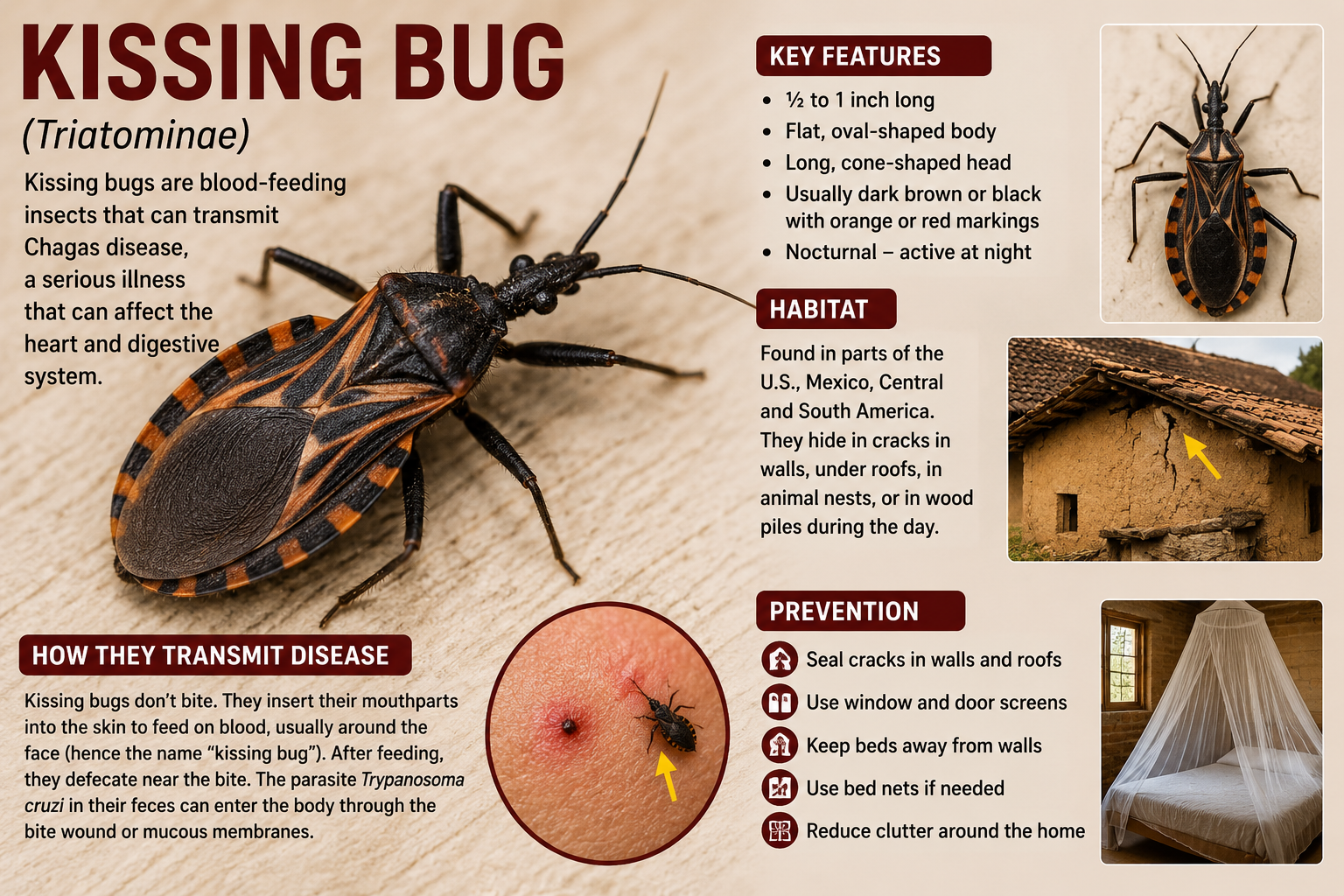
Overview
Kissing Bugs are blood-feeding insects belonging to the subfamily Triatominae within the assassin bug family. These insects are medically important because they can transmit the parasite Trypanosoma cruzi, the causative agent of Chagas disease, a potentially serious illness affecting millions of people throughout the Americas.
They earned the name “kissing bug” because they often bite sleeping humans around the lips, eyes, and other exposed areas of the face. Although their bites are usually painless, the insects pose a significant public health concern due to their ability to spread disease.
Kissing bugs are primarily nocturnal and spend daylight hours hiding in cracks, crevices, woodpiles, animal nests, and other sheltered locations. While they are most commonly associated with rural regions of Latin America, several species are native to the southern United States, including Arizona, Texas, New Mexico, and California.
Quick Facts
- Common Name: Kissing Bug
- Scientific Group: Triatominae
- Order: Hemiptera
- Family: Reduviidae
- Main Concern: Chagas disease transmission
- Activity: Nocturnal
- Diet: Blood
- Distribution: North, Central, and South America
Taxonomy and Classification
Kissing bugs belong to the assassin bug family, although they differ significantly from their predatory relatives. Most assassin bugs hunt other insects, while kissing bugs specialize in feeding on vertebrate blood.
- Kingdom: Animalia
- Phylum: Arthropoda
- Class: Insecta
- Order: Hemiptera
- Family: Reduviidae
- Subfamily: Triatominae
More than 150 species of kissing bugs have been identified worldwide, with several occurring naturally throughout the southern United States.
Identification
Adult kissing bugs are relatively large compared to many household insects, typically measuring between 3/4 and 1 inch in length.
Key Characteristics
- Elongated oval body
- Dark brown or black coloration
- Orange, yellow, or red markings along the abdomen edges
- Long legs and antennae
- Cone-shaped head
- Straight piercing beak (proboscis)
The cone-shaped head and narrow beak are among the easiest ways to distinguish kissing bugs from other insects.
Nymphs
Immature kissing bugs resemble smaller wingless versions of adults. They pass through multiple developmental stages called instars before reaching maturity.
Habitat and Distribution
Kissing bugs occur throughout much of the Western Hemisphere, from the southern United States to Argentina and Chile.
Common habitats include:
- Woodpiles
- Rock piles
- Rodent nests
- Bird nests
- Dog kennels
- Chicken coops
- Palm trees
- Cracks in buildings
In the United States, they are most frequently encountered in:
- Arizona
- Texas
- New Mexico
- California
- Nevada
- Oklahoma
They often enter homes while searching for blood meals or shelter.
Life Cycle
Kissing bugs undergo incomplete metamorphosis consisting of three primary stages:
- Egg
- Nymph
- Adult
Egg Stage
Females lay eggs in sheltered areas near food sources. Eggs hatch into small nymphs after several weeks.
Nymph Stage
Nymphs must obtain blood meals to grow and molt through several developmental stages.
Adult Stage
Adults continue feeding on blood and reproducing. Under favorable conditions, they may survive for many months.
Feeding Behavior
Kissing bugs are exclusively blood feeders.
They commonly feed on:
- Humans
- Dogs
- Cats
- Rodents
- Raccoons
- Opossums
- Birds
- Livestock
Most feeding occurs during the night while hosts are sleeping. Their saliva contains compounds that reduce pain and help prevent blood clotting, allowing them to feed undetected.
Chagas Disease Transmission
The greatest concern associated with kissing bugs is their role in transmitting Chagas disease.
How Transmission Occurs
Unlike mosquitoes, kissing bugs do not transmit parasites through their bite.
Instead:
- The bug feeds on blood.
- It defecates near the feeding site.
- Parasites are present in the feces.
- The person scratches the bite or rubs the area.
- The parasite enters through the skin, eyes, or mouth.
This indirect transmission method is unique among major insect-borne diseases.
Health Risks
Chagas Disease
Chagas disease can have two phases:
- Acute Phase: Mild symptoms or no symptoms
- Chronic Phase: Potential heart and digestive complications years later
Untreated infections may eventually lead to:
- Heart enlargement
- Irregular heartbeat
- Heart failure
- Digestive disorders
- Neurological complications
Allergic Reactions
Even when disease transmission does not occur, some individuals experience:
- Swelling
- Redness
- Severe itching
- Localized pain
- Anaphylactic reactions in rare cases
Signs of Kissing Bug Activity
- Large dark insects found indoors at night
- Bites around the face or neck
- Presence near pet sleeping areas
- Insects hiding in cracks and crevices
- Activity around rodent or wildlife nests
Behavior and Ecology
Kissing bugs are primarily nocturnal and spend daylight hours hidden in protected locations.
They are attracted to:
- Carbon dioxide
- Body heat
- Host odors
- Artificial lights
Wild populations play a role in natural ecosystems, but their interaction with humans creates significant public health concerns.
Prevention and Control
Integrated pest management focuses on exclusion, sanitation, and habitat reduction.
Exclusion
- Seal cracks and gaps around foundations
- Repair damaged screens
- Install weather stripping
- Seal utility penetrations
- Reduce openings around doors and windows
Outdoor Habitat Reduction
- Remove woodpiles near structures
- Reduce brush and debris
- Eliminate rodent nesting sites
- Keep pet sleeping areas clean
- Trim vegetation away from buildings
Indoor Management
If a suspected kissing bug is found:
- Do not crush the insect
- Capture it carefully in a container
- Save it for identification
- Contact local health authorities or extension services if necessary
Interesting Facts
- Kissing bugs are a type of assassin bug.
- More than 150 species exist worldwide.
- Most bites occur while victims sleep.
- The bite itself usually does not hurt.
- They are attracted to carbon dioxide from breathing.
- Several species are native to the southwestern United States.
Conservation and Research
Research on kissing bugs focuses heavily on disease prevention and public health protection.
Current studies include:
- Mapping species distributions
- Tracking Chagas disease prevalence
- Improving diagnostic methods
- Understanding wildlife reservoirs
- Developing better surveillance programs
- Improving public education efforts
Scientists continue monitoring kissing bug populations throughout the Americas to better understand disease risks and develop more effective prevention strategies.