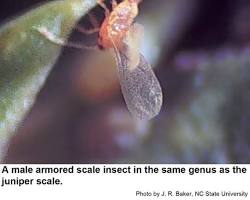
Juniper Scale (Carulaspis juniperi) is a destructive species of armored scale insect that commonly infests junipers, cypress, arborvitae, and other ornamental conifers. These tiny sap-feeding pests attach themselves to needles and small twigs, where they remain protected beneath a hard, waxy covering. Heavy infestations weaken the host plant over time, causing yellowing needles, browning foliage, twig dieback, and eventual decline of the entire shrub or tree if left untreated.
Juniper Scale is particularly problematic in ornamental landscapes, hedges, foundation plantings, and commercial nurseries. Because the insects are so small and immobile, infestations often remain unnoticed until visible plant damage becomes severe. Their armored coating also makes them difficult to control with ordinary insecticide treatments.
Quick Facts
- Common Name: Juniper Scale
- Scientific Name: Carulaspis juniperi
- Order: Hemiptera
- Family: Diaspididae
- Size: Less than 1/16 inch
- Main Hosts: Juniper, arborvitae, cypress, cedar
- Primary Damage: Needle yellowing and branch dieback
- Most Vulnerable Stage: Crawler stage
- Status: Serious ornamental landscape pest
Taxonomy and Classification
Juniper Scale belongs to the family Diaspididae, commonly known as armored scales.
Unlike soft scale insects, armored scales produce a separate waxy shield that covers and protects the insect beneath it. This hardened armor acts like a protective shell and greatly reduces the effectiveness of many contact insecticides.
Juniper Scale undergoes incomplete metamorphosis, progressing through:
- Egg
- Crawler (mobile nymph)
- Settled nymph
- Adult
The crawler stage is the only highly mobile and vulnerable phase in the insect’s life cycle.
Physical Description
Juniper Scale insects are extremely small and difficult to detect without close inspection.
Female Scale
- Round to oval armor
- White to grayish-white coloration
- Small yellow center cap
- Stationary once attached
Adult females remain fixed in one location for life while continuously feeding on plant sap beneath their protective armor.
Male Scale
- Smaller and elongated armor
- White coloration
- Tiny winged adult stage
- Short lifespan
Adult males do not feed and exist only to mate.
Crawler Stage
The crawler is the newly hatched juvenile stage.
- Tiny yellow body
- Highly mobile
- Searches for new feeding sites
- Most susceptible to treatment
Crawler emergence usually occurs in late spring or early summer depending on climate.
Signs of Infestation
Juniper Scale damage often develops slowly and may initially resemble drought stress or fungal disease.
Common Symptoms
- Yellowing needles
- Brown patches of foliage
- Needle drop
- Twig dieback
- General thinning of foliage
- Stunted growth
- White speckling on needles and twigs
Infestations usually begin on:
- Lower branches
- Interior foliage
- Dense sheltered areas
- Shaded portions of the plant
Heavy infestations can make the entire shrub appear dusty or faded due to the large number of white armored scales attached to the needles.
Distribution and Habitat
Juniper Scale is found worldwide wherever junipers and related conifers are grown as ornamental plants.
Common Host Plants
- Juniper
- Arborvitae
- Cypress
- Cedar
- False cypress
- Other ornamental conifers
They thrive in:
- Dense foliage
- Poor air circulation
- Warm climates
- Stressed ornamental plantings
Urban landscapes and nursery production facilities are especially vulnerable to outbreaks.
Behavior and Feeding
Juniper Scale insects feed by inserting specialized piercing-sucking mouthparts into plant tissue and extracting fluids from needles and stems.
Sap Feeding Damage
Continuous feeding weakens the plant by:
- Removing nutrients
- Disrupting water flow
- Reducing photosynthesis
- Causing chlorosis (yellowing)
Over time, prolonged infestations can severely stress or kill ornamental shrubs.
Hidden Infestations
One of the biggest problems with Juniper Scale is that infestations often remain hidden until damage becomes advanced.
- Small body size
- Camouflage against needles
- Interior branch feeding
- Slow symptom development
By the time heavy browning appears, populations are usually very large.
Natural Enemy Resistance
The armored covering helps protect the insects from:
- Predatory insects
- Parasitic wasps
- Contact insecticides
- Environmental stress
This protection allows infestations to persist for long periods if untreated.
Life Cycle
Juniper Scale can produce multiple overlapping generations during the growing season.
Egg Stage
Females lay eggs beneath their protective armor.
Crawler Emergence
The tiny crawlers emerge and disperse across the plant.
This is the most important treatment window because crawlers have not yet developed their protective armor.
Settlement
Once a crawler selects a feeding site:
- It inserts mouthparts into plant tissue
- Begins feeding permanently
- Develops a waxy protective shell
- Becomes largely immobile
Management and Prevention
Successful control of Juniper Scale requires precise timing and integrated pest management (IPM) practices.
Monitoring Crawlers
Monitoring crawler emergence is the most important part of control.
- Inspect infested plants regularly
- Use double-sided tape around branches
- Look for tiny yellow moving crawlers
- Treat during active crawler movement
Treatments applied after armor formation are much less effective.
Horticultural Oils
Horticultural oils are among the best controls for armored scale insects.
- Dormant oil applications in late winter
- Summer oils during crawler emergence
- Smothers scales beneath armor
- Lower toxicity to beneficial insects
Complete plant coverage is essential for effectiveness.
Pruning
Removing heavily infested branches helps reduce populations.
- Prune dead or damaged twigs
- Improve airflow within the shrub
- Dispose of infested material properly
Chemical Control
Chemical treatment is most effective against crawlers.
- Target mobile crawler stage
- Use labeled ornamental insecticides
- Repeat applications may be necessary
- Timing is critical
Systemic insecticides are often less effective against armored scales than against soft scales.
Plant Health Maintenance
Healthy plants tolerate scale damage more effectively.
- Proper watering
- Avoid overfertilization
- Reduce drought stress
- Improve air circulation
Interesting Facts About Juniper Scale
- Armored scales protect themselves beneath a detachable wax shield.
- The crawler stage is the only highly mobile phase.
- Adult females remain fixed in one feeding location for life.
- Heavy infestations can kill mature ornamental shrubs.
- Juniper Scale often resembles fungal spotting or drought stress.
- Many infestations go unnoticed until severe browning occurs.
Conservation and Research
Research on Juniper Scale focuses on improving sustainable ornamental pest management strategies.
Current Research Areas
- Biological control using parasitic wasps
- Improved horticultural oil formulations
- Crawler emergence prediction models
- Reduced-risk insecticides
- Integrated ornamental pest management
Scientists continue developing more effective methods for controlling armored scales while preserving beneficial insects and reducing pesticide use in ornamental landscapes.