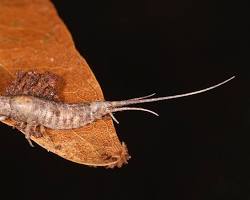
Jumping Bristletails (order Archaeognatha) are ancient, primitive, wingless insects that have existed on Earth for more than 400 million years. These small, nocturnal scavengers are among the oldest surviving insect lineages and are commonly found in moist outdoor environments such as leaf litter, mulch, moss, and beneath stones or bark.
Although they are often confused with silverfish, Jumping Bristletails differ in several important ways, especially their remarkable ability to leap suddenly when disturbed. They are harmless to humans, pets, structures, and plants, and instead play a beneficial ecological role as decomposers and scavengers within soil ecosystems.
Quick Facts
- Common Name: Jumping Bristletail
- Scientific Order: Archaeognatha
- Class: Insecta
- Main Habitat: Moist outdoor environments
- Diet: Algae, fungi, moss, and decaying organic matter
- Main Defense: Powerful jumping ability
- Status: Harmless decomposer
- Activity: Primarily nocturnal
Taxonomy and Classification
Jumping Bristletails belong to the insect order Archaeognatha, one of the oldest and most primitive insect groups still alive today.
Unlike many modern insects, they undergo ametabolous development, meaning:
- No true metamorphosis occurs
- Young resemble miniature adults
- They continue molting throughout life
These insects evolved long before:
- Flowering plants
- Birds
- Mammals
- Dinosaurs
Their ancient anatomy provides scientists with valuable information about early insect evolution and primitive arthropod biology.
Physical Description
Jumping Bristletails are slender, wingless insects ranging from 1/4 to 3/4 inch long.
Key Identification Features
- Hump-backed body shape
- Long antennae
- Three tail-like filaments
- Scaled gray or brown body
- Large compound eyes
- Wingless appearance
One of their most recognizable characteristics is the arrangement of the tail filaments:
- Two lateral cerci
- One extremely long central filament
The central filament helps stabilize their body during rapid jumping movements.
Large Compound Eyes
Unlike silverfish, Jumping Bristletails possess very large compound eyes that often touch near the center of the head.
These prominent eyes help distinguish them from other primitive wingless insects.
Scales and Texture
Their bodies are covered with tiny scales that create:
- A metallic sheen
- Gray or bronze coloration
- A slightly reflective appearance
Jumping Ability
The defining behavior of Jumping Bristletails is their ability to launch themselves suddenly into the air when threatened.
They accomplish this by:
- Flexing the abdomen downward
- Snapping specialized appendages against the surface
- Propelling themselves rapidly away from danger
This rapid escape behavior helps them evade predators such as:
- Spiders
- Centipedes
- Ground beetles
- Ants
- Small reptiles
Their jumping movement is fast and erratic, making them difficult for predators to capture.
Distribution and Habitat
Jumping Bristletails are found worldwide in environments with sufficient moisture and shelter.
Preferred Habitats
- Leaf litter
- Forest floors
- Under rocks
- Beneath bark
- Moss-covered surfaces
- Mulch beds
- Damp wood piles
- Caves and crevices
They require high humidity because their bodies lose moisture quickly in dry conditions.
Indoor Occurrences
Jumping Bristletails are primarily outdoor insects and rarely establish indoor infestations.
If found indoors, it usually indicates:
- Excess humidity
- Water leaks
- Damp crawl spaces
- Poor ventilation
- Moist basements
Unlike silverfish, they do not damage books, wallpaper, fabrics, or stored food.
Behavior and Ecology
Jumping Bristletails are shy, nocturnal scavengers that avoid light and disturbance.
Feeding Habits
Their diet mainly includes:
- Algae
- Mosses
- Lichens
- Fungi
- Decaying vegetation
- Organic debris
By consuming decomposing material, they contribute to nutrient recycling within soil ecosystems.
Nocturnal Activity
They are most active at night when humidity levels are higher and predators are less active.
During the daytime they remain hidden in:
- Cracks
- Crevices
- Leaf litter
- Soil cavities
- Under bark
Differences Between Bristletails and Silverfish
Jumping Bristletails are frequently mistaken for silverfish, but several important differences exist.
| Feature | Jumping Bristletails | Silverfish |
|---|---|---|
| Jumping Ability | Yes | No |
| Body Shape | Hump-backed | Flattened |
| Eyes | Large compound eyes | Small or absent |
| Habitat | Mostly outdoors | Often indoors |
| Damage Potential | None | May damage paper/fabrics |
Human Conflict
Jumping Bristletails pose virtually no direct conflict to humans.
Why They Are Harmless
- Do not bite
- Do not sting
- Do not spread disease
- Do not infest food
- Do not damage structures
- Do not attack plants
Their occasional presence indoors is generally only a moisture indicator rather than a pest problem.
Management and Prevention
Control is usually unnecessary because these insects are harmless and beneficial.
Moisture Reduction
If Jumping Bristletails are appearing indoors, focus on reducing excess moisture.
- Repair leaks
- Improve ventilation
- Use dehumidifiers
- Dry crawl spaces
- Reduce condensation
Exclusion Methods
- Seal cracks in foundations
- Repair weatherstripping
- Screen crawl space vents
- Reduce mulch against foundations
Outdoor Habitat Management
Although usually unnecessary, reducing excessive moisture near structures may lower local populations.
- Remove excess leaf litter
- Reduce standing water
- Improve drainage
- Trim dense vegetation
Chemical Control
Pesticides are strongly discouraged because:
- The insects are harmless
- They provide ecological benefits
- Indoor infestations are rare
- Moisture correction is more effective
Ecological Importance
Jumping Bristletails serve important ecological functions in natural environments.
Environmental Roles
- Break down decaying plant matter
- Support nutrient recycling
- Contribute to soil health
- Provide food for predators
- Assist decomposition processes
Their activity helps maintain healthy forest floor ecosystems and microbial balance.
Interesting Facts About Jumping Bristletails
- They are among the oldest surviving insect groups on Earth.
- They evolved more than 400 million years ago.
- They continue molting throughout adulthood.
- They can jump surprisingly far relative to body size.
- They are completely wingless.
- They are beneficial decomposers, not pests.
Conservation and Research
Scientists study Jumping Bristletails because they provide insight into primitive insect evolution and ancient arthropod anatomy.
Research Areas
- Early insect evolution
- Primitive jumping mechanisms
- Soil ecology
- Humidity adaptations
- Arthropod phylogeny
- Forest ecosystem decomposition
Their survival across hundreds of millions of years makes them an important living example of early terrestrial insect development.