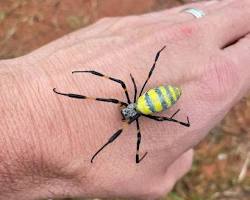
Joro Spiders (Trichonephila clavata) are large, invasive orb-weaving spiders native to East Asia that have rapidly spread throughout parts of the southeastern United States. These spiders are famous for their enormous golden-colored webs, striking yellow-and-black coloration, and rapid expansion into suburban and urban environments. Despite their intimidating appearance and impressive size, Joro Spiders are considered harmless to humans and pets.
Joro Spiders are primarily viewed as nuisance pests because of the massive webs they construct across decks, porches, gardens, power lines, shrubs, and walkways. However, they are also beneficial predators that consume large numbers of flying insects, including mosquitoes, flies, stink bugs, and agricultural pests.
Quick Facts
- Scientific Name: Trichonephila clavata
- Common Name: Joro Spider
- Order: Araneae
- Family: Araneidae
- Origin: East Asia
- Main Conflict: Large nuisance webs
- Diet: Flying insects
- Status: Invasive orb-weaving spider
Taxonomy and Classification
Joro Spiders belong to the order Araneae and the family Araneidae, commonly known as orb-weaving spiders. They are closely related to golden silk orb-weavers and other large web-building spiders.
The species is native to:
- Japan
- China
- Korea
- Taiwan
Researchers believe the spider was accidentally introduced into the southeastern United States through international shipping materials or cargo containers. The first confirmed U.S. populations were discovered in Georgia around 2014. Since then, the species has expanded rapidly into neighboring states.
Joro Spiders have an annual life cycle:
- Eggs hatch in spring
- Spiderlings grow through summer
- Adults mature in late summer and fall
- Adults die after reproduction during winter
Physical Description
Female Joro Spiders are extremely large compared to many native orb-weaving spiders. Mature females may have:
- Body length approaching 1 inch
- Leg spans reaching 4 inches or more
The females are brightly colored and highly recognizable.
Key Identification Features
- Bright yellow abdomen with black striping
- Long black legs banded with yellow or red
- Silver-gray cephalothorax
- Large size
- Golden-colored silk webs
Natural Predators
Like many spiders, Joro Spiders have their share of natural enemies. They’re on the menu for various birds, lizards, and frogs that inhabit the same environments. Bats may snag them during evening flights, while several species of wasps—including the industrious mud daubers—are known to target spiders. This collection of predators helps keep Joro populations in check, ensuring they don’t become too dominant in their new habitats.
Male Joro Spiders are dramatically smaller, duller in color, and often overlooked near the female’s web.
Web Characteristics
Joro Spiders build extremely large orb webs that may stretch:
- Between trees
- Across porches
- Over pathways
- Between utility lines
- Around shrubs and structures
Their silk often appears slightly golden in sunlight, similar to other golden orb-weaving species. Webs may exceed 10 feet in diameter under ideal conditions.
Distribution and Habitat
Joro Spiders are native to East Asia but are now established throughout portions of the southeastern United States. Current populations are concentrated heavily in:
- Georgia
- South Carolina
- North Carolina
- Tennessee
- Alabama
Scientists continue monitoring their rapid expansion into additional states.
They thrive in:
- Warm humid climates
- Suburban neighborhoods
- Forested edges
- Gardens
- Parks
- Urban landscapes
Joro Spiders prefer open sunny spaces where large web structures can be supported between vegetation and buildings.
Behavior and Conflict
Joro Spiders are beneficial predators that consume many nuisance insects and agricultural pests.
Diet and Hunting
Their webs trap:
- Mosquitoes
- Flies
- Moths
- Stink bugs
- Leafhoppers
- Wasps
- Other flying insects
Like other orb-weavers, they immobilize prey using silk before feeding.
Nuisance Issues
The primary human conflict comes from their massive webs and high population density.
- Webs across walkways
- Webs attached to homes
- Porch and deck infestations
- Unexpected encounters while walking outdoors
- Fear caused by their appearance
Although startling, these spiders are not aggressive and rarely bite humans.
Are Joro Spiders Dangerous?
Joro Spiders are considered medically insignificant to humans.
- Non-aggressive
- Bites are extremely rare
- Venom is mild
- Fangs often cannot pierce human skin effectively
Experts consistently classify them as harmless nuisance spiders rather than dangerous pests.
Ballooning and Rapid Spread
One reason Joro Spiders spread so rapidly is their ability to disperse using a behavior called ballooning.
Young spiderlings release strands of silk that catch air currents, allowing them to travel considerable distances through the air. This dispersal method has helped the species colonize large portions of the southeastern United States in only a few years.
Life Cycle
Egg Stage
Females lay egg sacs during fall before dying with the arrival of winter temperatures.
Spiderlings
Young spiders hatch in spring and disperse rapidly using ballooning behavior.
Juvenile Development
Spiderlings grow throughout summer, molting repeatedly as they mature.
Adult Stage
Large mature females become highly visible during late summer and autumn when webs reach maximum size.
Natural Predators
Despite their large size, Joro Spiders are preyed upon by many animals in their introduced habitats.
Known Predators
- Birds
- Lizards
- Frogs
- Bats
- Parasitic wasps
- Mud dauber wasps
These predators help naturally regulate spider populations and prevent uncontrolled outbreaks.
Management and Prevention
Management generally focuses on reducing nuisance webs around homes and walkways rather than eliminating the spiders entirely.
Web Removal
- Use a broom or pole to remove webs
- Regular removal discourages rebuilding
- Focus on high-traffic areas
Exclusion
- Seal cracks around windows and doors
- Repair damaged screens
- Reduce clutter near structures
Lighting Reduction
Outdoor lighting attracts flying insects, which in turn attract web-building spiders.
- Reduce bright outdoor lights
- Use yellow bug lights
- Turn off unnecessary lighting at night
Pesticide Use
Chemical control is generally discouraged because:
- Outdoor populations are difficult to eliminate
- Spiders are beneficial predators
- Pesticides may harm beneficial insects
Most populations naturally decline during winter after adults die off.
Interesting Facts About Joro Spiders
- They create golden-colored silk webs.
- Females are much larger than males.
- They can spread long distances through ballooning.
- They are harmless to humans.
- Webs may exceed 10 feet across.
- They are among the fastest spreading invasive spiders in the U.S.
Conservation and Research
Scientists continue researching:
- Potential ecological impacts
- Competition with native spiders
- Climate tolerance
- Spread prediction models
- Long-term invasive behavior
Researchers are also studying whether colder northern climates may eventually limit their expansion across North America.