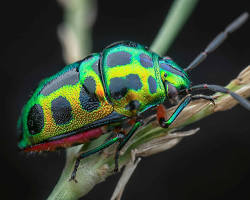
Jewel Beetles (family Buprestidae), commonly known as Metallic Wood-Boring Beetles, are among the most visually striking insects in the world. Their brilliant metallic colors shimmer in shades of emerald green, sapphire blue, bronze, gold, and copper, making them highly recognizable in forests and gardens. While the adults are admired for their beauty and are often found visiting flowers or resting on sunlit bark, the larval stage can be highly destructive to trees and shrubs.
The larvae, known as flat-headed borers, tunnel beneath the bark and within the wood of trees, disrupting the flow of nutrients and water. Many species attack stressed, injured, or dying trees, helping recycle dead wood in natural ecosystems. However, invasive species such as the devastating Emerald Ash Borer (Agrilus planipennis) aggressively attack healthy trees and have caused catastrophic losses in forests and urban landscapes throughout North America.
Quick Facts
- Common Name: Jewel Beetles
- Scientific Family: Buprestidae
- Order: Coleoptera
- Size: 1/8 to 2 inches long
- Main Habitat: Forests, woodlands, ornamental landscapes
- Diet (Adults): Leaves, nectar, pollen
- Diet (Larvae): Wood and cambium tissue
- Status: Important forest and ornamental pests
Taxonomy and Classification
Jewel Beetles belong to the order Coleoptera, the largest order of insects, and the family Buprestidae. They undergo complete metamorphosis consisting of:
- Egg
- Larva
- Pupa
- Adult
The larval stage is commonly referred to as a flat-headed borer because the segment behind the head is enlarged and flattened. These larvae tunnel beneath bark and through woody tissues, creating winding galleries packed with frass and sawdust.
The family contains thousands of species worldwide, including:
- Emerald Ash Borer
- Flatheaded Apple Tree Borer
- Bronze Birch Borer
- Golden Buprestid Beetles
- Pine Jewel Beetles
Physical Description
Adult Jewel Beetles vary widely in shape and coloration but are usually elongated, narrow, and somewhat bullet-shaped.
Adult Appearance
- Hard metallic exoskeleton
- Brilliant iridescent colors
- Elongated or cylindrical body
- Short antennae
- Strong wing covers (elytra)
- Rapid daytime flight behavior
Their metallic coloration is caused by microscopic structural layers in the exoskeleton that reflect light.
Larvae
The larvae are highly specialized wood borers.
- Creamy white coloration
- Legless body
- Flattened thoracic region
- Strong chewing mouthparts
- Tunnel beneath bark and inside wood
Key Damage Signs
- D-shaped exit holes in bark
- Serpentine tunnels beneath bark
- Bark splitting or cracking
- Swollen or sunken bark areas
- Canopy dieback
- Woodpecker feeding damage
The distinctive D-shaped exit hole is one of the most important identification features for many species.
Distribution and Habitat
Jewel Beetles occur worldwide and are especially abundant in:
- Tropical forests
- Temperate woodlands
- Urban forests
- Orchards
- Parks and ornamental landscapes
Different species specialize on different host trees, including:
- Ash
- Oak
- Maple
- Birch
- Pine
- Cherry
- Fruit trees
Adults are often found:
- On flowers
- Resting on bark
- Flying in sunny clearings
- Near stressed or dying trees
Larvae spend nearly their entire lives hidden within wood tissues.
Life Cycle
The life cycle begins when females lay eggs in bark crevices or wounds on suitable host trees.
Egg Stage
Eggs are deposited:
- On bark surfaces
- Near wounds
- In cracks and crevices
- On stressed or weakened trees
Larval Stage
After hatching, larvae immediately bore into:
- Cambium tissue
- Phloem layers
- Outer sapwood
The larvae create winding tunnels that disrupt the vascular system of the tree.
Pupal Stage
Pupation usually occurs inside chambers carved within the wood.
Adult Emergence
Adults chew outward through the bark, leaving:
- D-shaped exit holes
- Visible emergence scars
- Loose bark sections
Many species complete development within one year, though some may require multiple years depending on climate and host quality.
Behavior and Damage
The primary conflict caused by Jewel Beetles results from larval tunneling beneath bark.
Tree Girdling
As galleries expand:
- Water movement becomes restricted
- Nutrient transport is interrupted
- Branches decline
- The canopy dies back
Heavy infestations can completely girdle and kill the tree.
Host Selection
Many native Jewel Beetles target:
- Drought-stressed trees
- Lightning-damaged trees
- Recently cut timber
- Dead or dying wood
However, invasive species may aggressively attack healthy trees.
Emerald Ash Borer
The Emerald Ash Borer is among the most destructive invasive insects in North American history.
- Kills healthy ash trees
- Spreads rapidly
- Causes extensive canopy decline
- Results in tree death within a few years
Millions of ash trees have been destroyed across the United States and Canada.
Signs of Infestation
Common indicators of Jewel Beetle activity include:
- D-shaped exit holes
- Vertical bark splits
- Woodpecker damage
- Epicormic shoots on trunks
- Premature leaf loss
- Dead upper branches
- Serpentine larval galleries beneath bark
Trees often decline gradually over several seasons.
Management and Prevention
Effective management relies heavily on early detection and tree health maintenance.
Cultural Prevention
- Maintain proper irrigation
- Avoid bark injuries
- Reduce drought stress
- Prune dead branches
- Improve soil conditions
Healthy trees are generally more resistant to attack.
Preventative Systemic Treatments
For high-value trees:
- Systemic trunk injections
- Soil drenches
- Professional insecticide applications
These treatments are especially important in Emerald Ash Borer quarantine zones.
Sanitation
Heavily infested trees should be:
- Removed promptly
- Destroyed or chipped
- Not transported as firewood
Transporting infested wood is one of the primary ways invasive species spread.
Monitoring
Specialized traps help detect invasive species early.
- Purple prism traps
- Green sticky traps
- Pheromone lures
- Visual bark inspections
Ecological Importance
Despite their destructive reputation, many native Jewel Beetles play valuable ecological roles.
- Break down dead wood
- Recycle nutrients
- Provide food for birds and predators
- Support forest succession
Their larvae help accelerate decomposition in natural ecosystems.
Interesting Facts About Jewel Beetles
- Some species appear metallic due to structural coloration rather than pigments.
- The Emerald Ash Borer is bright emerald green and highly invasive.
- Woodpeckers are major natural predators of borer larvae.
- Some species are active only during bright sunlight.
- Ancient cultures used Jewel Beetle wing covers in jewelry and decoration.
- Many species are attracted to recently burned forests.
Conservation and Research
Research on Jewel Beetles focuses heavily on invasive species management and forest protection.
Current Research Areas
- Biological control using parasitic wasps
- Improved detection methods
- Forest health monitoring
- Systemic insecticide development
- Host resistance breeding
- Climate impacts on beetle spread
Scientists continue working to reduce the devastating ecological and economic effects caused by invasive metallic wood-boring beetles.