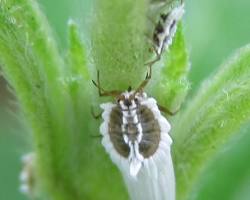
Jacaranda Aphids (Aphis jacarandae) are small, sap-feeding insects that specialize in infesting Jacaranda trees, especially the popular Blue Jacaranda (Jacaranda mimosifolia). These aphids are considered nuisance pests in ornamental landscapes because they form dense colonies on new growth, flower stems, and leaf undersides, producing large amounts of sticky honeydew that can coat sidewalks, patios, vehicles, and outdoor furniture beneath the tree.
While mature Jacaranda trees can usually tolerate moderate aphid feeding, heavy infestations may cause curled leaves, distorted flowers, yellowing foliage, and reduced vigor in young trees. The sugary honeydew also promotes the growth of unsightly black sooty mold, which can stain the tree’s striking purple blooms and surrounding surfaces.
Quick Facts
- Scientific Name: Aphis jacarandae
- Common Name: Jacaranda Aphid
- Order: Hemiptera
- Family: Aphididae
- Main Host: Jacaranda trees
- Main Conflict: Honeydew and sooty mold
- Diet: Plant sap
- Status: Ornamental tree pest
Taxonomy and Classification
Jacaranda Aphids belong to the order Hemiptera, commonly known as the true bugs, and the family Aphididae. Like other aphids, they possess piercing-sucking mouthparts used to extract nutrient-rich sap from plant tissues.
These aphids are highly specialized to Jacaranda trees and share many characteristics common to aphid species:
- Rapid reproduction
- Short generation times
- Dense colony formation
- Production of sticky honeydew
- Preference for tender new growth
Aphid populations often explode during periods of warm weather combined with fresh spring growth. Under favorable conditions, multiple generations may occur within a single season.
Physical Description
Jacaranda Aphids are extremely small insects, usually measuring only 1 to 2 millimeters long.
- Color: Dark green, brown, or black
- Body Shape: Soft-bodied and pear-shaped
- Cornicles: Two small tube-like structures projecting from the rear abdomen
- Texture: Smooth and shiny appearance
Colonies are usually found:
- On flower stems
- Under young leaves
- Around developing buds
- On soft green shoots
Heavy infestations are often easiest to identify by the sticky honeydew covering surfaces below the tree rather than by the aphids themselves.
Key Signs of Infestation
- Sticky residue on leaves or vehicles
- Black sooty mold growth
- Clusters of aphids on new growth
- Curling or distorted leaves
- Yellowing foliage
- Large numbers of ants climbing the trunk
Distribution and Habitat
Jacaranda Aphids occur wherever Jacaranda trees are grown as ornamental landscape trees. They are especially common in:
- Southern California
- Arizona
- Florida
- Australia
- South Africa
- Mediterranean climates
- Subtropical urban regions
Their habitat is tightly connected to the tender growth of Jacaranda trees, especially during blooming periods in spring and early summer.
Jacaranda trees themselves are widely cultivated due to their spectacular blue-purple flowers and fern-like foliage, making aphid outbreaks especially noticeable in ornamental landscapes.
Behavior and Damage
Jacaranda Aphids feed by inserting needle-like mouthparts into plant tissue and withdrawing sap from stems and leaves.
Although the direct feeding damage is usually moderate, large colonies create several major nuisance problems.
Honeydew Production
As aphids consume sap, they excrete excess sugars in the form of sticky honeydew droplets.
This honeydew:
- Coats leaves and flowers
- Drips onto sidewalks and vehicles
- Creates slippery surfaces
- Attracts nuisance insects
- Promotes fungal growth
Heavy honeydew accumulation beneath Jacaranda trees is one of the most common complaints associated with these ornamental trees.
Sooty Mold Development
Black fungal growth called sooty mold commonly develops on honeydew-coated surfaces.
While the mold itself does not infect the tree, it:
- Blocks sunlight from leaves
- Reduces photosynthesis
- Creates dirty appearances
- Stains flowers and surfaces
Leaf and Flower Damage
Large aphid populations may cause:
- Leaf curling
- Flower distortion
- Premature leaf drop
- Reduced growth
- Stunted young trees
Young ornamental Jacarandas are more vulnerable to stress than mature established trees.
Relationship with Ants
Jacaranda Aphids commonly form mutualistic relationships with ants.
Ants actively protect aphid colonies because they feed on the sugary honeydew the aphids produce.
Ants may:
- Defend aphids from predators
- Remove aphid parasites
- Transport aphids to new growth
- Increase infestation severity
This relationship often interferes with natural biological control by beneficial insects.
Natural Predators
Many beneficial insects naturally feed on Jacaranda Aphids.
Common Natural Enemies
- Lady beetles
- Lady beetle larvae
- Lacewings
- Hoverfly larvae
- Parasitic wasps
- Minute pirate bugs
When ant populations are controlled, these predators often suppress aphid outbreaks naturally.
Life Cycle
Jacaranda Aphids reproduce rapidly during warm weather.
Reproduction
Females commonly reproduce through parthenogenesis, meaning they can produce live offspring without mating.
This allows populations to increase extremely quickly during favorable conditions.
Development
The life cycle includes:
- Nymph stage
- Several molts
- Winged or wingless adults
Winged adults may disperse to nearby Jacaranda trees when colonies become overcrowded.
Management and Prevention
Effective control relies heavily on integrated pest management (IPM) strategies rather than broad pesticide use.
Water Sprays
Strong streams of water can dislodge aphid colonies from leaves and stems.
- Safe for beneficial insects
- Works well on small trees
- May require repeated treatments
Horticultural Oils and Soaps
Insecticidal soaps and horticultural oils provide effective contact control when thoroughly applied.
- Neem oil
- Horticultural oil
- Insecticidal soap sprays
Coverage of leaf undersides and flower stems is essential for success.
Ant Control
Controlling ants is often the single most important step in long-term aphid management.
- Use ant bait stations
- Apply trunk barriers
- Reduce ant nesting sites
Once ants are removed, natural predators can significantly reduce aphid populations.
Systemic Treatments
For severe infestations on high-value ornamental trees, professional arborists may apply systemic insecticides through:
- Soil drenches
- Trunk injections
- Root zone treatments
These treatments should be carefully timed to reduce risks to pollinators during bloom periods.
Tree Health Maintenance
Healthy trees tolerate aphid feeding more effectively.
- Avoid excessive nitrogen fertilizer
- Provide deep watering during drought
- Reduce tree stress
- Prune damaged growth carefully
Interesting Facts About Jacaranda Aphids
- They specialize almost entirely on Jacaranda trees.
- They reproduce extremely quickly during warm weather.
- Honeydew attracts large ant populations.
- Sooty mold grows on aphid honeydew.
- Large infestations commonly occur during Jacaranda bloom season.
- Natural predators often provide effective biological control.
Conservation and Research
Research involving Jacaranda Aphids focuses on:
- Urban tree pest management
- Biological control methods
- Predator conservation
- Improved treatment timing
- Integrated pest management systems
Scientists continue studying predator-prey relationships between aphids, ants, and beneficial insects to reduce reliance on chemical insecticides in urban landscapes.