Overview
Ips Beetles (Ips spp.), commonly called Engraver Beetles, are destructive bark beetles that attack pine, spruce, fir, and other coniferous trees. They are especially important forest pests because they bore beneath the bark and feed in the phloem layer, disrupting the tree’s ability to move water and nutrients.
These beetles usually attack stressed, weakened, dying, or freshly cut trees, but during droughts, wildfires, storms, or population outbreaks, they can also kill apparently healthy trees. Their activity is especially serious in forests, windbreaks, Christmas tree plantations, and ornamental landscapes where conifers are valuable.
Ips beetles are small, but their damage can be severe. Once large numbers enter a tree, they create branching galleries beneath the bark, introduce stain fungi, and rapidly weaken the host. Infested trees often show yellowing or reddish-brown needles before dying completely.
Quick Facts
- Common Name: Ips Beetles
- Other Name: Engraver Beetles
- Genus: Ips
- Order: Coleoptera
- Family: Curculionidae
- Subfamily: Scolytinae
- Main Hosts: Pines, spruce, and other conifers
- Primary Damage: Bark boring and phloem disruption
- Threat Level: Serious forest and landscape pest
Taxonomy and Classification
Ips beetles belong to the bark beetle group within the weevil family. Although they do not have the long snout associated with many weevils, they are classified within Curculionidae.
- Kingdom: Animalia
- Phylum: Arthropoda
- Class: Insecta
- Order: Coleoptera
- Family: Curculionidae
- Subfamily: Scolytinae
- Genus: Ips
They undergo complete metamorphosis, developing through egg, larva, pupa, and adult stages beneath the bark of host trees.
Identification
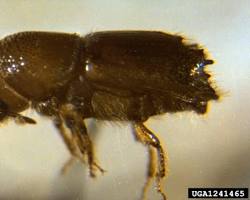
Adult Ips beetles are tiny, cylindrical beetles, usually measuring about 1/8 to 1/4 inch long. Their coloration ranges from reddish-brown to dark brown or black.
Adult Features
- Small cylindrical body
- Reddish-brown to black coloration
- Hard wing covers
- Scooped-out rear end
- Spines along the rear margin
The concave, spine-lined rear end is one of the most important features used to distinguish Ips beetles from many other bark beetles.
Larvae
Larvae are small, white, legless grubs that feed beneath the bark. They tunnel outward from the adult galleries and contribute to the destruction of the phloem layer.
Gallery Patterns
Ips beetles create distinctive gallery systems beneath the bark. These galleries often appear star-shaped, Y-shaped, or branching from a central chamber.
Habitat and Distribution
Ips beetles are found throughout conifer-growing regions of North America, Europe, and Asia. They are most common in forests and landscapes where pines, spruce, or other conifers are stressed.
Common habitats include:
- Pine forests
- Spruce forests
- Christmas tree farms
- Urban landscapes
- Recently logged areas
- Storm-damaged forests
- Fire-damaged stands
They are strongly attracted to weakened trees, fresh logging slash, storm-damaged limbs, and recently cut wood.
Life Cycle
The life cycle of Ips beetles may be completed quickly during warm weather. In many regions, multiple generations can occur in a single year.
Host Attack
Male beetles usually initiate the attack by boring into a suitable tree and creating a central nuptial chamber beneath the bark.
Aggregation Pheromones
After entering the tree, males release chemical signals called aggregation pheromones. These attract additional beetles to the same host, allowing a mass attack to overwhelm the tree’s defenses.
Egg Laying
Females enter the chamber, mate, and construct egg galleries radiating outward beneath the bark.
Larval Feeding
Larvae hatch and feed through the phloem, creating smaller tunnels that branch away from the parent galleries.
Adult Emergence
After pupation, new adults emerge through small round exit holes and fly to new host material.
Damage and Impact
Ips beetles damage trees by tunneling beneath the bark and disrupting the tree’s vascular system.
Phloem Destruction
The phloem is the living tissue responsible for moving sugars and nutrients throughout the tree. When galleries cut through this layer, the tree becomes girdled and begins to decline.
Needle Discoloration
Infested trees often show:
- Yellowing needles
- Reddish-brown foliage
- Top-down crown fading
- Branch dieback
- Sudden tree death
Pitch Tubes and Frass
Entry holes may be marked by small pitch tubes made of sap and boring dust. Fine reddish-brown frass may collect in bark crevices or around the base of the tree.
Fungal Association
Ips beetles may introduce blue-stain fungi and other microorganisms that further weaken the tree and interfere with water movement.
Signs of Infestation
- Small round holes in bark
- Reddish-brown boring dust
- Pitch tubes on trunk or branches
- Yellowing or browning needles
- Peeling bark
- Y-shaped galleries beneath bark
- Sudden death of pine or spruce branches
Behavior and Conflict
Ips beetles are often secondary pests, meaning they usually attack trees already weakened by environmental stress. However, when populations become high, they can attack and kill healthy trees.
Common stress factors include:
- Drought
- Fire injury
- Storm damage
- Root disturbance
- Overcrowding
- Poor soil conditions
- Recent pruning or logging
Their ability to reproduce quickly makes them especially dangerous after major weather events that leave large amounts of damaged or freshly cut wood available.
Prevention and Control
Managing Ips beetles requires a combination of sanitation, tree health care, monitoring, and prevention.
Sanitation
Sanitation is one of the most important control methods.
- Remove infested trees promptly
- Destroy or chip infested bark
- Remove fresh slash after pruning or logging
- Do not store fresh pine firewood near healthy trees
Tree Health
Healthy trees are better able to resist bark beetle attacks through resin flow.
- Water trees during drought
- Avoid root damage
- Reduce overcrowding
- Avoid unnecessary pruning during beetle flight periods
Preventive Bark Sprays
High-value landscape trees may be protected with preventive insecticide applications applied to the bark before beetle attack. These treatments are most useful before spring and early summer flight periods.
Pheromone Monitoring
Pheromone traps may help detect beetle activity and population levels. In some cases, mass trapping may reduce local pressure, but it should be used carefully to avoid attracting beetles toward valuable trees.
Interesting Facts
- Ips beetles are also called engraver beetles because of their carved gallery patterns.
- The male usually begins the attack and creates the first chamber.
- They can produce multiple generations in warm climates.
- Their gallery systems often form Y-shaped or star-like patterns.
- They are strongly attracted to freshly cut pine material.
- Drought-stressed trees are especially vulnerable.
Conservation and Research
Ips beetles are important forest health pests, but they also play a natural role in breaking down weakened and dying trees. Their activity helps recycle nutrients in forest ecosystems, though outbreaks can cause major economic losses.
Research focuses on:
- Pheromone communication
- Beetle-fungus relationships
- Drought-related outbreaks
- Forest sanitation practices
- Biological control agents
- Improved monitoring tools
Understanding how climate, drought, and forest management affect Ips beetle populations is essential for protecting both commercial timber and ornamental conifers.