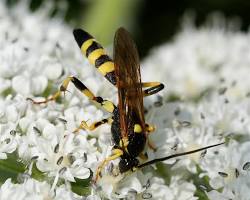
Overview
Ichneumon Wasps (family Ichneumonidae) are one of the largest and most diverse groups of insects in the world. These fascinating parasitoid wasps play a major ecological role by naturally controlling populations of caterpillars, beetle larvae, spiders, and many other insects. Unlike aggressive social wasps such as yellowjackets or hornets, ichneumon wasps are solitary and generally harmless to humans.
Often called “Darwin Wasps” due to their extraordinary biological complexity, ichneumon wasps are considered some of the most important natural biological control organisms in forests, gardens, and agricultural systems. Female wasps lay eggs on or inside a host insect, and the developing larva consumes the host from within, eventually killing it.
Although their appearance can seem intimidating—especially species with extremely long ovipositors—these insects are highly beneficial and rarely interact negatively with people. In fact, they help suppress many destructive pest populations naturally, reducing the need for chemical pesticides.
Ichneumon wasps are found worldwide and occupy nearly every terrestrial ecosystem where insect hosts are present.
Quick Facts
- Common Name: Ichneumon Wasps
- Scientific Family: Ichneumonidae
- Type: Parasitoid wasps
- Main Diet: Other insects
- Primary Role: Biological pest control
- Habitat: Forests, gardens, agricultural fields
- Behavior: Solitary
- Threat to Humans: Extremely low
- Ecological Importance: Highly beneficial predator
Taxonomy and Classification
Ichneumon wasps belong to the insect order Hymenoptera, which also includes bees, ants, and other wasps.
- Kingdom: Animalia
- Phylum: Arthropoda
- Class: Insecta
- Order: Hymenoptera
- Family: Ichneumonidae
The family Ichneumonidae contains thousands of known species worldwide, with many more still undiscovered or unnamed.
They are closely related to:
- Braconid wasps
- Parasitic wasps
- Sawflies
- Paper wasps
Most species are highly specialized parasitoids that target specific host insects.
Identification
Ichneumon wasps vary tremendously in size, coloration, and body structure depending on species.
General Appearance
- Slender elongated body
- Narrow waist
- Long antennae
- Transparent wings
- Dark coloration with yellow, orange, or white markings
Most species measure between 1/4 inch and 1.5 inches long.
Ovipositor
Many female ichneumon wasps possess a long needle-like structure called an ovipositor.
This organ is commonly mistaken for a stinger but is actually used for:
- Drilling into wood
- Reaching hidden hosts
- Laying eggs inside insects
Species such as the Giant Ichneumon Wasp (Megarhyssa spp.) may have ovipositors several inches long.
Larvae
The larvae are soft-bodied, legless grubs that develop inside or attached to a host insect.
Habitat and Distribution
Ichneumon wasps are distributed globally and thrive in a wide variety of environments.
Common Habitats
- Forests
- Woodlands
- Gardens
- Agricultural fields
- Grasslands
- Wetlands
- Urban landscapes
Their populations are directly tied to the availability of host insects.
Healthy ecosystems with abundant insect diversity usually support large ichneumon wasp populations.
Life Cycle
Ichneumon wasps undergo complete metamorphosis.
Egg Stage
Females locate a suitable host insect and lay eggs:
- Inside the host
- On the host
- Near the host
Some species can detect hosts hidden deep within wood or plant stems.
Larval Stage
The larva feeds gradually on the host insect.
Most species avoid killing the host immediately, instead consuming non-essential tissues first to keep the host alive as long as possible.
Pupal Stage
After fully developing, the larva pupates inside a cocoon or within the remains of the host.
Adult Stage
Adults emerge to mate and continue the cycle.
Adult wasps commonly feed on:
- Nectar
- Honeydew
- Plant fluids
Behavior and Ecology
Ichneumon wasps are among the most specialized biological control organisms in nature.
Host Detection
Females use highly advanced sensory systems to locate hosts.
They can detect:
- Plant odors
- Host vibrations
- Chemical signals
- Wood-boring activity
Parasitoid Strategy
Unlike predators that consume many prey items, parasitoids usually require only a single host to complete development.
This makes ichneumon wasps highly efficient population regulators.
Solitary Lifestyle
Ichneumon wasps are solitary insects and do not build colonies or nests like social wasps.
Each female independently hunts for hosts and lays eggs.
Beneficial Role
Ichneumon wasps are considered highly beneficial insects because they naturally suppress many damaging pests.
Common Hosts
- Caterpillars
- Cutworms
- Bark beetles
- Corn borers
- Sawflies
- Wood-boring insects
- Spider egg sacs
- Moth larvae
By reducing pest populations naturally, they help:
- Protect crops
- Reduce pesticide use
- Improve forest health
- Support ecosystem balance
Are Ichneumon Wasps Dangerous?
Despite their intimidating appearance, ichneumon wasps are generally harmless to humans.
Important Facts
- They are not aggressive
- They rarely sting humans
- The ovipositor is not primarily a defensive weapon
- They do not attack people
- They are beneficial predators
Most species completely ignore humans unless physically handled.
Signs of Activity
Ichneumon wasps are often difficult to notice directly.
Common signs include:
- Wasps flying around trees or plants
- Long-tailed wasps probing wood
- Cocoons attached to caterpillars
- Reduced pest populations
- Parasitized insect larvae
Some caterpillars may display clusters of white cocoons after being parasitized.
Conservation and Management
Management efforts focus on conserving ichneumon wasp populations rather than eliminating them.
Reduce Broad-Spectrum Pesticides
Heavy insecticide use can kill beneficial parasitoids along with pest insects.
Plant Nectar Sources
Adult wasps benefit from flowering plants such as:
- Dill
- Parsley
- Fennel
- Queen Anne’s lace
- Yarrow
- Coriander
Encourage Biodiversity
Diverse gardens and landscapes provide habitat for both hosts and parasitoids.
Biological Control Programs
Some ichneumon wasp species are commercially reared and released for agricultural pest management.
Interesting Facts
- Ichneumonidae is one of the largest insect families on Earth.
- Some species can detect hosts hidden deep inside wood.
- The giant ichneumon wasp can drill through wood using its ovipositor.
- Many species are highly host-specific.
- Some parasitize spiders rather than insects.
- They are vital natural pest regulators in forests and agriculture.
- Charles Darwin considered ichneumon wasps an example of nature’s complexity.
Ecological Importance
Ichneumon wasps are essential components of healthy ecosystems.
Their ecological contributions include:
- Natural pest suppression
- Reduced pesticide dependence
- Forest ecosystem stability
- Agricultural sustainability
- Biodiversity maintenance
Scientists continue studying ichneumon wasps to better understand:
- Parasitoid evolution
- Host detection mechanisms
- Biological control strategies
- Species diversity
- Ecosystem interactions