Overview
Hypolimnas caterpillars are the larval stage of butterflies in the genus Hypolimnas, part of the family Nymphalidae. These butterflies are commonly found in tropical and subtropical regions and are well known for their striking adult coloration and mimicry. The caterpillars, however, are less conspicuous but play an important role in plant–insect interactions.
>p>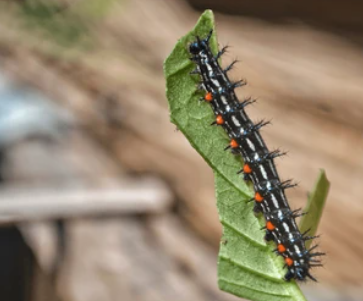
While adult Hypolimnas butterflies are beneficial pollinators, their larvae are herbivorous and feed on the leaves of various host plants. In most natural environments, their populations are kept in check by predators and environmental factors. However, in cultivated landscapes or regions where host plants are concentrated, localized outbreaks can occur.
These caterpillars are not typically considered major agricultural pests, but they may become noticeable in ornamental plantings or gardens where host plants are abundant.
Identification
Hypolimnas caterpillars are often dark-colored with spiny or branched projections along their bodies. These spines may serve as a defense mechanism against predators.
Their coloration varies by species but often includes black, brown, or green tones with contrasting markings.
Adult butterflies are brightly colored and may exhibit mimicry patterns resembling toxic species.
Habitat
These caterpillars are found in tropical and subtropical regions, often in gardens, forests, and open landscapes where host plants are present.
They are commonly associated with plants in families such as Acanthaceae and Urticaceae.
Behavior and Life Cycle
Females lay eggs on host plants. After hatching, larvae begin feeding on leaves and pass through several developmental stages.
The caterpillars grow rapidly, consuming foliage before pupating and emerging as adult butterflies.
Depending on climate conditions, multiple generations may occur throughout the year.
Damage and Impact
Feeding results in leaf damage and minor defoliation. In most cases, the impact is limited and does not significantly affect plant health.
In ornamental settings, damage may be more noticeable due to aesthetic concerns.
Ecological Role
Hypolimnas caterpillars contribute to ecosystem balance by serving as prey for birds and other predators. Adult butterflies aid in pollination.
Prevention and Control
Control is rarely necessary. Encouraging natural predators and maintaining plant diversity helps regulate populations.
Taxonomy
- Kingdom: Animalia
- Phylum: Arthropoda
- Class: Insecta
- Order: Lepidoptera
- Family: Nymphalidae
- Genus: Hypolimnas