Overview
Hypera clover weevils are a group of small, plant-feeding beetles in the genus Hypera, belonging to the family Curculionidae. These insects are widely recognized as pests of forage crops, particularly clover and alfalfa, where they can significantly reduce plant productivity. Among the most notable species is the alfalfa weevil (Hypera postica), which has become a major pest in many agricultural regions.
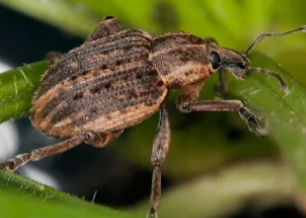
These weevils are especially important in livestock agriculture, where clover and alfalfa serve as key forage crops. Damage caused by feeding larvae can reduce both the quantity and quality of forage, impacting livestock nutrition and farm profitability.
Hypera weevils are well adapted to temperate climates and often emerge early in the growing season, making them one of the first pests to affect spring forage growth.
Identification
Adult weevils are small, typically 1/4 inch long, with elongated snouts characteristic of weevils. They are usually brown or gray with subtle markings that help them blend into plant material.
Larvae are green, slug-like, and have a white stripe running along their back. They are often found feeding on the upper portions of plants.
Habitat
These weevils are commonly found in agricultural fields, pastures, and areas where clover and alfalfa are grown. They prefer environments with dense vegetation and suitable host plants.
Behavior and Life Cycle
Adult females lay eggs inside plant stems or on leaves. After hatching, larvae feed on leaf tissue, often skeletonizing leaves by consuming the soft tissue while leaving veins intact.
Larvae develop through several stages before pupating, often in silken cocoons attached to plants or in debris. Adults emerge and may continue feeding before overwintering.
Typically, one generation occurs per year, although timing may vary based on climate.
Damage and Agricultural Impact
Larval feeding causes significant defoliation, reducing photosynthesis and plant growth. Heavy infestations can lead to stunted plants and reduced forage yields.
Damage is particularly severe in early spring when plants are actively growing and most vulnerable.
In severe cases, economic losses can be substantial, especially in large-scale forage production.
Prevention and Control
Monitoring fields early in the season is critical for detecting infestations. Biological control agents, including parasitic wasps, can help manage populations.
Cultural practices such as early harvesting and crop rotation can reduce weevil impact.
Taxonomy
- Kingdom: Animalia
- Phylum: Arthropoda
- Class: Insecta
- Order: Coleoptera
- Family: Curculionidae
- Genus: Hypera