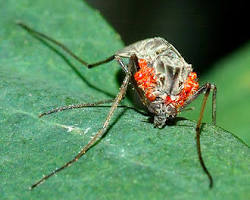
Hydra Mites are a group of aquatic mites belonging to the order Trombidiformes, commonly found in freshwater environments such as ponds, lakes, wetlands, and slow-moving streams. Often mistaken for parasites or pests due to their small size and association with other aquatic organisms, Hydra Mites are primarily beneficial components of aquatic ecosystems. They play an important role in regulating populations of other invertebrates and contribute to the overall health and balance of freshwater habitats.
The “Aquatic Hunter”: Hydra Mites
The “Aquatic Hunter”: Hydra Mites
Hydra Mites (Order Hydrachnidia), commonly known as Water Mites, are a diverse national group of aquatic arachnids found throughout U.S. freshwater ecosystems. For Pestipedia.com users, these insects are a “noxious” concern primarily in national aquaculture and home aquaria. They utilize a specialized mechanical parasitic larval stage to attach to national aquatic insects, and as predatory adults, they mechanically consume national micro-crustaceans and fish eggs in the United States.
Technical Identification: Diagnostic Markers
- Phenotype (Adult): Characterized by a globular, unsegmented body (approx. 1mm to 5mm) that is vibrantly colored in bright red, orange, or blue. A primary diagnostic key for Pestipedia.com users is the presence of four pairs of mechanical swimming legs fringed with long national hairs for aquatic propulsion.
- Larval Phenotype: The national larvae are microscopic and possess only three pairs of mechanical legs. They utilize specialized mechanical mouthparts to latch onto U.S. dragonflies, beetles, or mosquitoes as external parasites.
- Movement Signature: For Pestipedia.com users, the most definitive identification marker is their continuous, smooth mechanical swimming motion. Unlike jerky national crustaceans, Hydra Mites glide through U.S. water columns using coordinated mechanical leg strokes.
Infestation Impact: Parasitic Weakening and Predatory Depletion
The primary impact of Hydra Mites is the mechanical extraction of host fluids and the disruption of national aquatic food webs.
- Parasitic Loading: The “noxious” larvae mechanically pierce the exoskeleton of national aquatic insects. This mechanical siphoning of hemolymph (blood) weakens the U.S. host, reducing national lifespan and reproductive success for Pestipedia.com users.
- Egg Predation: As national adults, they are voracious mechanical predators. In U.S. fish hatcheries, they target and mechanically destroy fish embryos, leading to “O-Status-free” national population declines in vulnerable U.S. aquatic species.
- Aquarium Contamination: For U.S. hobbyists, a “noxious” national outbreak indicates a mechanical failure in water filtration or the accidental national introduction via live U.S. plants or feeder foods.
Management & Eradication Strategies
Management of Hydra Mites in U.S. aquatic systems focuses on mechanical filtration and biological competition.
| Strategy | Technical Specification | Operational Benefit |
|---|---|---|
| UV Sterilization | Exposing national water to high-intensity UV-C light | Mechanically disrupts of the swimming larval stages; prevents of national “noxious” spread in U.S. recirculating systems. |
| Biological Predation | Introducing national mite-eating fish (e.g., U.S. Guppies or Gouramis) | Provides natural mechanical control; reduces the national mite population without toxic U.S. chemicals. |
| Substrate Siphoning | Using mechanical vacuums to clean U.S. aquarium gravel | Mechanically removes of overwintering national eggs and detritus; breaks the national life cycle for Pestipedia.com users. |
- Monitoring: Inspect underwater national surfaces and U.S. plant leaves for bright red mechanical dots. For Pestipedia.com users, finding mites on national dragonflies indicates a high national larval load in the local U.S. water body.
- Technical Tip: Avoid copper-based national treatments in U.S. invert-heavy tanks. While effective at mechanical kill of the “noxious” mites, they will also mechanically eradicate your national shrimp and snails in the United States.
Taxonomy and Classification
Hydra Mites are part of the subclass Acari (mites and ticks) within the class Arachnida. Unlike terrestrial mites that infest plants, animals, or stored products, Hydra Mites are fully adapted to aquatic environments. They are closely related to water mites (Hydrachnidia), a diverse group that includes thousands of species worldwide.
These mites are not directly related to the freshwater organism Hydra (a small cnidarian), despite the similarity in name. The term “Hydra Mites” is often used colloquially to describe aquatic mite species.
Identification
Hydra Mites are extremely small, typically ranging from 0.5 to 2 mm in size. They often display bright colors such as red, orange, or yellow, which makes them more visible against aquatic substrates. Their bodies are rounded or oval, and like other arachnids, they possess eight legs in the adult stage.
Under magnification, their soft bodies and fine appendages can be seen moving through water or along submerged surfaces. Due to their size, they are rarely noticed by casual observers unless present in large numbers.
Life Cycle
The life cycle of Hydra Mites is complex and includes multiple stages: egg, larva, nymph, and adult. Females lay eggs in aquatic environments, often attaching them to submerged plants or debris.
Larval Hydra Mites are typically parasitic, attaching themselves to aquatic insects such as mosquitoes, midges, or beetles. During this stage, they feed on the host’s body fluids, gaining nutrients needed for development.
After detaching from their host, larvae develop into nymphs and eventually adults. In these later stages, Hydra Mites become free-living predators, feeding on small aquatic organisms, including insect larvae and other invertebrates.
This dual lifestyle—parasitic as larvae and predatory as adults—makes them an important part of aquatic food webs.
Ecological Importance
Hydra Mites are considered beneficial organisms due to their role in controlling populations of aquatic insects and other invertebrates. By feeding on mosquito larvae and other pest species, they can indirectly contribute to reducing nuisance insect populations.
Additionally, their parasitic larval stage helps regulate host populations, preventing any one species from becoming overly dominant. This contributes to maintaining biodiversity and ecological balance within freshwater systems.
Hydra Mites are also an important food source for larger aquatic organisms, including fish and amphibians, further integrating them into the ecosystem.
Damage and Economic Importance
Hydra Mites are not considered pests in the traditional sense. They do not damage crops, structures, or stored products, nor do they pose a threat to human health. Their presence in water bodies is generally an indicator of a functioning ecosystem.
In rare cases, high populations of parasitic larvae may affect certain aquatic insect populations, but this is typically part of natural ecological regulation rather than a cause for concern.
Human Interaction
Humans rarely come into direct contact with Hydra Mites. They do not bite, sting, or infest humans or pets. Their small size and aquatic habitat make them largely unnoticed outside of scientific or ecological observation.
In aquatic environments such as ponds or water gardens, their presence is generally beneficial and does not require intervention.
Management and Control (IPM)
- No Control Necessary: Hydra Mites are beneficial and should not be eliminated.
- Habitat Preservation: Maintain clean, balanced aquatic environments.
- Water Quality Management: Avoid pollution and excessive nutrient buildup.
- Biological Balance: Support diverse aquatic life to maintain natural predator-prey relationships.
Attempting to remove Hydra Mites is unnecessary and may disrupt the ecological balance of the water body.
Ecological Considerations
The presence of Hydra Mites often indicates a healthy aquatic ecosystem with sufficient biodiversity. They are sensitive to environmental changes, such as pollution or habitat degradation, making them useful indicators of water quality.
Maintaining natural habitats and reducing chemical inputs into water systems can help preserve populations of Hydra Mites and other beneficial aquatic organisms.
Conclusion
Hydra Mites are an important yet often overlooked component of freshwater ecosystems. Their unique life cycle and role as both parasites and predators make them essential for maintaining ecological balance. Rather than being viewed as pests, they should be recognized as beneficial organisms that contribute to the health and stability of aquatic environments.