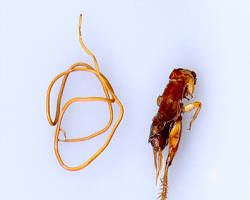
Horsehair Worms (phylum Nematomorpha), also known as Gordian Worms, are unusual parasitic organisms closely related to roundworms. Despite their alarming appearance, these worms are generally harmless to humans, pets, livestock, and plants. They are best known for their dramatic life cycle, which involves developing inside insects such as crickets, grasshoppers, cockroaches, and mantids before emerging into water as long, thread-like adults.
Horsehair Worms often create concern because they are commonly discovered:
- In puddles
- Swimming pools
- Livestock troughs
- Pet water bowls
- Buckets or containers
- Emerging from insects
Their snake-like movement and extraordinary length frequently lead people to mistake them for dangerous parasites. In reality, adult Horsehair Worms do not feed and exist solely to reproduce in aquatic environments.
Quick Facts
- Common Name: Horsehair Worm
- Other Name: Gordian Worm
- Phylum: Nematomorpha
- Main Hosts: Crickets, grasshoppers, cockroaches, mantids
- Adult Habitat: Freshwater environments
- Threat to Humans: Harmless
- Threat to Pets: Harmless
- Ecological Role: Natural biological control
Taxonomy and Classification
Horsehair Worms belong to the phylum:
- Nematomorpha
They are closely related to nematodes (roundworms) but differ significantly in biology and ecology.
Scientific Classification
- Kingdom: Animalia
- Phylum: Nematomorpha
- Class: Gordioida
The name “Gordian Worm” comes from the tendency of these worms to twist themselves into tangled knots resembling the legendary Gordian Knot of Greek mythology.
Unlike parasitic nematodes that infect mammals or plants, Horsehair Worms specifically target arthropods and do not infect humans or pets.
Physical Description
Adult Horsehair Worms are among the strangest-looking organisms encountered around water sources.
Appearance
- Extremely thin and thread-like
- Brown, black, or dark gray
- Smooth-bodied
- Resemble strands of horsehair
Adults typically measure:
- 4 to 14 inches long
while remaining only:
- 1 to 3 millimeters thick
Movement
In water, they move slowly using:
- Twisting motions
- Undulating movements
- Coiling behavior
Their movement often resembles a tiny aquatic snake.
Larval Stage
Larvae are microscopic and develop inside insect hosts, where they consume nutrients while growing into adults.
Distribution and Habitat
Horsehair Worms are found worldwide in moist and aquatic habitats.
Common Habitats
- Ponds
- Streams
- Ditches
- Livestock troughs
- Rain puddles
- Temporary pools
- Moist soil environments
Their distribution closely follows the presence of suitable insect hosts.
Adult Habitat
Adults are entirely aquatic and require water to reproduce successfully.
Larval Habitat
Larvae develop inside terrestrial arthropods commonly found in:
- Grasslands
- Gardens
- Forests
- Agricultural areas
Life Cycle
Horsehair Worms possess one of the most fascinating life cycles in the animal kingdom.
Egg Stage
Adult worms reproduce in water and lay enormous numbers of microscopic eggs.
Larval Infection
After hatching, larvae infect small aquatic organisms that are eventually consumed by terrestrial insects.
Common hosts include:
- Crickets
- Grasshoppers
- Cockroaches
- Mantids
- Katydids
Parasitic Development
Inside the insect host, the worm grows dramatically while absorbing nutrients from body fluids and tissues.
The host often survives until the worm reaches maturity.
Behavior Manipulation
One of the most remarkable aspects of Horsehair Worm biology is their ability to alter host behavior.
As the worm matures, the infected insect is compelled to seek water, even if the species normally avoids it.
Emergence
Once near water, the adult worm violently emerges from the insect’s body and enters the aquatic environment.
This dramatic emergence often alarms observers.
Behavior and Ecology
Adult Horsehair Worms exist solely for reproduction.
No Feeding
Adult worms:
- Do not feed
- Do not bite
- Do not parasitize mammals
Their digestive system is largely nonfunctional during adulthood.
Biological Control Role
Because they parasitize pest insects, Horsehair Worms may provide beneficial natural control of:
- Crickets
- Grasshoppers
- Cockroaches
Misidentification
They are frequently mistaken for:
- Parasitic nematodes
- Horsehair snakes
- Dangerous water parasites
This misunderstanding often leads to unnecessary panic.
Damage and Impact
Horsehair Worms cause little to no direct harm to humans or structures.
Effects on Insect Hosts
The parasitic larval stage eventually kills the host insect after emergence.
Human Health Risk
Horsehair Worms:
- Do not infect humans
- Do not infect pets
- Do not infest food
- Do not damage plants
Perceived Threat
Their appearance in:
- Swimming pools
- Toilets
- Water buckets
- Animal troughs
often causes concern despite their harmless nature.
Signs of Presence
Common indicators include:
- Long thread-like worms in water
- Worms emerging from crickets or grasshoppers
- Twisting worms in puddles
- Dead or weakened insect hosts near water
Management and Prevention
Management is rarely necessary because Horsehair Worms are harmless.
Education
The most important management strategy is proper identification.
Understanding that Horsehair Worms:
- Do not infect humans
- Do not damage property
- Are beneficial insect parasites
helps prevent unnecessary pesticide use.
Physical Removal
If found in:
- Pools
- Troughs
- Water containers
simply remove the worm manually and discard it outdoors.
Host Reduction
Reducing large cricket or cockroach populations nearby may lower the likelihood of encountering Horsehair Worms.
Water Maintenance
Standard pool chlorination and filtration systems are sufficient for accidental occurrences.
Interesting Facts
- Horsehair Worms can grow several times longer than their host insect.
- They manipulate insect behavior to force hosts toward water.
- Adults do not eat during their entire free-living stage.
- They are often discovered after rainstorms.
- Their emergence from insects is one of nature’s most unusual parasitic behaviors.
Conservation and Research
Horsehair Worms are considered important native organisms in many ecosystems.
Research focuses on:
- Host behavior manipulation
- Evolutionary biology
- Parasite-host interactions
- Aquatic ecology
- Natural biological control systems
Scientists are particularly interested in the neurological mechanisms used by the worms to alter insect behavior and compel hosts to seek water.