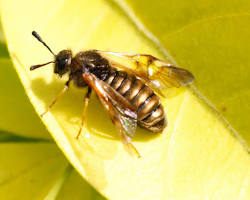
Honeysuckle Sawflies (Zaraea inflata) are destructive foliage-feeding insects that primarily attack plants in the genus Lonicera, commonly known as honeysuckle. Although the adult insects resemble small wasps, the damaging stage is the larva, which looks similar to a caterpillar and feeds aggressively on leaves.
These pests are capable of rapidly stripping foliage from ornamental honeysuckle shrubs and vines, sometimes defoliating entire plants within only a few days. While the damage is usually not fatal to established plants, repeated infestations can severely weaken honeysuckle, reduce flowering, and diminish the ornamental appearance of landscapes and gardens.
Honeysuckle Sawflies are particularly problematic in:
- Residential landscapes
- Ornamental gardens
- Public parks
- Honeysuckle hedges
- Naturalized plantings
where dense plantings provide ideal feeding conditions for developing larvae.
Quick Facts
- Common Name: Honeysuckle Sawfly
- Scientific Name: Zaraea inflata
- Order: Hymenoptera
- Family: Cimbicidae
- Main Hosts: Honeysuckle (Lonicera spp.)
- Primary Damage: Defoliation
- Larval Appearance: Green larvae with black spines
- Distribution: Eastern and Midwestern North America
Taxonomy and Classification
Honeysuckle Sawflies belong to the insect order:
- Hymenoptera
the same order that includes:
- Wasps
- Bees
- Ants
They are members of the family:
- Cimbicidae
which contains some of the largest sawfly species.
Scientific Classification
- Kingdom: Animalia
- Phylum: Arthropoda
- Class: Insecta
- Order: Hymenoptera
- Family: Cimbicidae
- Genus: Zaraea
- Species: Zaraea inflata
Despite their caterpillar-like appearance, sawfly larvae are not moth or butterfly caterpillars.
Difference Between Sawflies and Caterpillars
Sawfly larvae can be distinguished by:
- Six or more pairs of prolegs
- Different head structure
- Distinct feeding habits
True caterpillars have five or fewer pairs of prolegs.
Physical Description
Honeysuckle Sawflies undergo complete metamorphosis with egg, larval, pupal, and adult stages.
Adult Appearance
Adults resemble small, stout wasps and are:
- Black and yellow
- Heavy-bodied
- Slow-flying
- Non-stinging
Adults are relatively short-lived and rarely noticed compared to the larvae.
Larvae
The larval stage is responsible for all plant damage.
Larvae are:
- Light green to whitish-green
- Covered with black pin-like spines
- Up to 1.5 inches long
- Cylindrical in shape
When disturbed, the larvae often curl tightly into a defensive “C” shape.
Eggs
Eggs are laid directly on honeysuckle foliage and are difficult to detect without close inspection.
Pupae
Pupation occurs inside tough cocoons located:
- In soil
- In leaf litter
- Near the base of host plants
Distribution and Habitat
Honeysuckle Sawflies are most common in:
- The eastern United States
- The Midwest
- Southern Canada
Preferred Habitat
They inhabit areas where ornamental honeysuckle is abundant, including:
- Gardens
- Hedges
- Vine-covered fences
- Woodland edges
- Nurseries
Dense, shaded plantings often support larger populations.
Seasonal Activity
Larvae are most active during:
- Late spring
- Early summer
when fresh new foliage is available.
Life Cycle
Honeysuckle Sawflies complete one primary generation per year in most regions.
Egg Stage
Adult females lay eggs on newly emerging honeysuckle leaves.
Larval Feeding Stage
After hatching, larvae begin feeding immediately.
Young larvae feed together in clusters and consume leaf tissue rapidly.
Group Feeding Behavior
The larvae are highly gregarious and often arrange themselves:
- Along leaf edges
- In symmetrical feeding groups
- Side-by-side on foliage
This feeding behavior allows them to defoliate plants quickly.
Pupation
Mature larvae drop to the soil where they form durable cocoons and overwinter.
Adult Emergence
Adults emerge the following spring to restart the cycle.
Damage and Impact
The primary damage caused by Honeysuckle Sawflies is rapid foliage destruction.
Defoliation
Larvae consume leaf tissue aggressively, often leaving only:
- Leaf veins
- Skeletonized foliage
Heavy infestations may completely strip:
- Shrubs
- Vines
- Large sections of foliage
Plant Stress
Repeated defoliation weakens honeysuckle plants by:
- Reducing photosynthesis
- Lowering energy reserves
- Increasing drought stress
- Reducing flowering potential
Aesthetic Damage
Even when plants survive, severe defoliation greatly reduces ornamental value.
This is especially problematic in decorative landscapes where honeysuckle is used as:
- Privacy screening
- Flowering accents
- Ground cover
- Arbors and trellises
Signs of Infestation
Several symptoms help identify Honeysuckle Sawfly activity.
Visible Larvae
Clusters of green larvae feeding openly on leaves are the most obvious sign.
Leaf Damage
- Skeletonized leaves
- Chewed foliage
- Rapid defoliation
- Missing leaf tissue
Curled Defensive Posture
Disturbed larvae often curl into a tight spiral or “C” shape.
Frass
Dark droppings may accumulate beneath heavily infested plants.
Behavior and Feeding Habits
Honeysuckle Sawflies feed primarily during daylight hours.
Group Feeding
Larvae feed communally, which increases feeding efficiency and helps overwhelm plant defenses.
Rapid Consumption
Large groups can completely defoliate a shrub in only a few days.
Host Specialization
They feed almost exclusively on:
- Honeysuckle species
making them highly specialized ornamental pests.
Prevention and Control
Early detection is critical for effective management.
Regular Monitoring
Inspect honeysuckle foliage regularly during spring for:
- Small feeding holes
- Young larvae
- Clustered feeding activity
Hand Removal
Because larvae feed in groups, manual removal is highly effective.
Options include:
- Hand-picking larvae
- Pruning infested branches
- Dropping larvae into soapy water
Insecticidal Soap
Young larvae are susceptible to:
- Insecticidal soaps
- Horticultural oils
These treatments work best with direct contact.
Pyrethrin Treatments
Pyrethrin-based products provide rapid knockdown of active larvae.
Important Treatment Note
Unlike moth caterpillars, sawfly larvae are:
- NOT affected by Bacillus thuringiensis (Btk)
because they belong to Hymenoptera rather than Lepidoptera.
Sanitation
Removing leaf litter and debris around the base of plants may help reduce overwintering pupae.
Interesting Facts
- Honeysuckle Sawflies are related to wasps rather than butterflies.
- Larvae often feed in highly organized clusters.
- Large infestations can strip shrubs bare in days.
- The larvae curl defensively when disturbed.
- Adults do not sting despite their wasp-like appearance.
Conservation and Research
Honeysuckle Sawflies are managed primarily as ornamental landscape pests.
Current research focuses on:
- Host plant chemistry
- Natural predator effectiveness
- Landscape IPM programs
- Reduced pesticide management
- Biological control strategies
Scientists continue studying the chemical cues that limit these insects almost exclusively to honeysuckle plants.