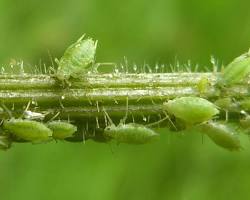
Hogweed Aphids (Cavariella aegopodii) are small sap-feeding insects that attack plants in the carrot family (Apiaceae), including carrots, celery, parsley, dill, fennel, and parsnips. Although commonly associated with hogweed and willow plants during portions of their life cycle, these aphids become serious agricultural pests when they migrate into vegetable crops during the growing season.
These insects are particularly important because they are highly efficient vectors of destructive plant viruses. Even relatively small aphid populations can spread diseases capable of severely reducing crop yield and quality. In addition to virus transmission, Hogweed Aphids weaken plants through direct sap feeding, causing leaf curling, yellowing, stunted growth, and honeydew accumulation that encourages black sooty mold growth.
Their rapid reproduction and seasonal migration patterns make them challenging pests for both commercial growers and home gardeners.
Quick Facts
- Common Name: Hogweed Aphid
- Scientific Name: Cavariella aegopodii
- Order: Hemiptera
- Family: Aphididae
- Main Hosts: Carrots, celery, parsley, willow, hogweed
- Primary Threat: Plant virus transmission
- Damage: Sap feeding, stunting, leaf curling
- Distribution: Temperate regions worldwide
Taxonomy and Classification
Hogweed Aphids belong to the family Aphididae, one of the largest groups of plant-feeding insects.
Scientific Classification
- Kingdom: Animalia
- Phylum: Arthropoda
- Class: Insecta
- Order: Hemiptera
- Family: Aphididae
- Species: Cavariella aegopodii
Like other aphids, they undergo incomplete metamorphosis:
- Egg
- Nymph
- Adult
Hogweed Aphids possess a complex life cycle involving two types of host plants:
- Primary Hosts: Willow trees and hogweed species
- Secondary Hosts: Vegetable crops in the carrot family
Physical Description
Hogweed Aphids are tiny, soft-bodied insects with the classic pear-shaped appearance associated with aphids.
Adult Appearance
- Pale green to yellow-green coloration
- 1/16 to 1/8 inch long
- Soft-bodied and pear-shaped
- Long legs and antennae
- Cluster densely on new growth
Cornicles
A key identifying feature is the presence of:
- Two short tubular projections called cornicles
These structures are located near the rear of the abdomen and secrete defensive substances.
Winged Forms
Winged aphids, known as:
- Alates
develop seasonally and migrate between host plants.
These winged forms are primarily responsible for spreading plant viruses between crops.
Distribution and Habitat
Hogweed Aphids occur widely throughout temperate regions around the world.
Geographic Distribution
- North America
- Europe
- Asia
- Temperate agricultural regions globally
Preferred Habitat
Their habitat changes seasonally depending on the life stage.
Primary Habitat
- Willow trees (Salix spp.)
- Wild hogweed plants
- Moist riparian vegetation
Secondary Habitat
- Carrot fields
- Celery crops
- Parsley beds
- Parsnip plantings
- Home vegetable gardens
Warm temperatures and lush new plant growth favor rapid aphid development.
Life Cycle
Hogweed Aphids possess a highly adaptable and rapid reproductive cycle.
Overwintering Stage
Eggs overwinter on primary hosts such as willow trees.
Spring Development
In spring:
- Eggs hatch into wingless females
- Colonies rapidly develop on primary hosts
These aphids reproduce through:
- Parthenogenesis
meaning females produce offspring without mating.
Migration
Winged adults develop in late spring and migrate to crop plants.
This migration period is especially important because it coincides with:
- Virus transmission to young crops
Summer Reproduction
On vegetable crops, populations grow rapidly through repeated generations of live-bearing females.
Autumn Return
In fall, winged aphids return to primary hosts where mating and egg laying occur.
Behavior and Feeding
Hogweed Aphids feed by inserting needle-like mouthparts into plant tissues.
Sap Feeding
They primarily extract:
- Phloem sap
from stems and leaves.
Heavy feeding weakens plants and interferes with normal growth.
Honeydew Production
Excess sugar from sap feeding is excreted as:
- Honeydew
This sticky substance coats foliage and promotes black fungal growth called:
- Sooty mold
Virus Transmission
Hogweed Aphids are especially dangerous because they spread plant pathogens during brief feeding probes.
Even low aphid numbers can introduce serious crop diseases.
Damage and Economic Impact
The greatest threat posed by Hogweed Aphids is their role as vectors of crop diseases.
Direct Feeding Damage
- Leaf curling
- Yellowing foliage
- Plant stunting
- Reduced vigor
- Wilting
- Distorted growth
Virus Diseases
Major viruses spread by Hogweed Aphids include:
- Carrot Motley Dwarf Virus (CMDV)
- Celery Mosaic Virus (CeMV)
Virus symptoms may include:
- Severe dwarfing
- Mottled leaves
- Reduced root quality
- Poor crop yields
Economic Losses
Commercial infestations may result in:
- Reduced market quality
- Lower yields
- Increased pesticide costs
- Crop rejection due to deformities
Signs of Infestation
Several symptoms may indicate Hogweed Aphid activity.
Common Indicators
- Clusters of green aphids on foliage
- Leaf curling and twisting
- Sticky honeydew residue
- Black sooty mold
- Yellowing leaves
- Stunted plant growth
- Virus-like mottling patterns
Winged aphids are often most noticeable during migration periods in late spring and early summer.
Prevention and Control
Integrated pest management is critical for controlling Hogweed Aphids and reducing virus spread.
Monitoring
Monitoring tools include:
- Yellow sticky traps
- Water pan traps
- Field scouting
Monitoring helps determine peak migration periods.
Biological Control
Natural predators play an important role in aphid suppression.
Beneficial Insects
- Lady beetles
- Lacewings
- Hoverfly larvae
- Parasitic wasps
Physical Exclusion
Fine-mesh row covers can protect young crops from migrating winged aphids.
This method is especially effective for:
- Organic vegetable production
- High-value crops
Chemical Control
Insecticides may be used when aphid populations exceed economic thresholds.
However, treatment timing is critical because virus transmission often occurs before aphids are killed.
Cultural Practices
- Remove weed hosts
- Control volunteer plants
- Promote plant health
- Rotate crops
Interesting Facts
- Female aphids can reproduce without mating.
- One aphid can generate thousands of descendants in a season.
- Winged aphids migrate long distances between hosts.
- Virus transmission may occur within seconds of feeding.
- Aphid honeydew attracts ants that often protect aphid colonies.
Conservation and Research
Research involving Hogweed Aphids focuses heavily on:
- Virus-resistant crop varieties
- Aphid migration prediction models
- Biological control programs
- Weather-based outbreak forecasting
- Reduced pesticide reliance
Scientists continue studying the relationship between aphid movement, climate conditions, and virus transmission to improve crop protection strategies.