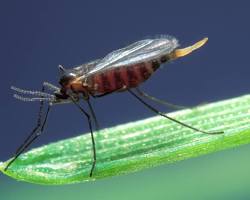
Hessian Flies (Mayetiola destructor) are tiny, gnat-like agricultural pests that attack wheat and other cereal crops, including barley and rye. Despite their small size, these insects have historically caused enormous economic losses in grain-producing regions around the world. The damaging stage is the larva, which feeds at the base of wheat stems and disrupts the plant’s ability to transport nutrients and water.
Infested wheat plants often become stunted, weak, and unable to produce healthy grain heads. Severe infestations can lead to lodging, where weakened stems collapse before harvest. Hessian Flies are considered one of the most important insect pests of wheat because of their rapid reproduction, ability to adapt to resistant crop varieties, and close synchronization with the wheat growth cycle.
The insect’s common name dates back to the American Revolutionary War, when it was believed to have arrived in North America in straw bedding used by Hessian soldiers.
Quick Facts
- Common Name: Hessian Fly
- Scientific Name: Mayetiola destructor
- Order: Diptera
- Family: Cecidomyiidae
- Main Hosts: Wheat, barley, rye
- Primary Damage: Stem weakening and reduced grain production
- Most Damaging Stage: Larva (maggot)
- Distribution: Worldwide in wheat-growing regions
Taxonomy and Classification
Hessian Flies belong to the family Cecidomyiidae, commonly known as gall midges.
Scientific Classification
- Kingdom: Animalia
- Phylum: Arthropoda
- Class: Insecta
- Order: Diptera
- Family: Cecidomyiidae
- Species: Mayetiola destructor
They undergo complete metamorphosis consisting of:
- Egg
- Larva
- Pupa
- Adult fly
Unlike many crop pests, the adult flies do not feed. Their sole purpose is reproduction, and adults live only a few days.
Physical Description
Adult Hessian Flies are extremely small and resemble tiny mosquitoes or gnats.
Adult Flies
- Approximately 1/8 inch long
- Dark brown or black coloration
- Fragile body structure
- Long legs and delicate wings
- Weak fliers
Adults are short-lived and are rarely noticed in fields.
Larvae
The larvae are the destructive stage.
- Legless maggots
- Initially translucent white
- Later become greenish-white
- Very small and flattened
Larvae feed at the base of wheat stems beneath the leaf sheath.
Puparia (“Flaxseeds”)
The pupal stage is commonly called a flaxseed because of its resemblance to flax seeds.
- Brown, oval casing
- Found between leaf sheath and stem
- Protects developing insect
Distribution and Habitat
Hessian Flies occur worldwide wherever wheat is cultivated.
Common Regions
- North America
- Europe
- Asia
- Middle East
- Australia
Their habitat is closely associated with cereal grain production.
Preferred Environments
- Winter wheat fields
- Barley crops
- Rye fields
- Volunteer wheat stands
- Crop residue and stubble
The pest is especially problematic in regions with continuous wheat production.
Life Cycle
Hessian Flies generally produce two or more generations annually depending on climate.
Egg Stage
Females lay tiny reddish eggs on the upper surfaces of wheat leaves.
- Eggs hatch within several days
Larval Stage
After hatching, larvae crawl downward toward the plant crown.
They position themselves:
- Behind leaf sheaths
- Near stem nodes
- At feeding sites protected from weather
Larvae inject salivary secretions that alter plant growth and interfere with nutrient movement.
Pupal Stage
After feeding, larvae transform into flaxseed-like puparia.
This stage may:
- Overwinter in crop residue
- Remain dormant during unfavorable conditions
Adult Stage
Adults emerge during favorable weather conditions to mate and restart the cycle.
Behavior and Feeding
Hessian Fly larvae are specialized sap feeders.
Feeding Damage
Larvae feed by:
- Piercing plant tissues
- Sucking plant juices
- Injecting toxic saliva
This disrupts the plant’s vascular system and weakens growth.
Plant Response
Infested plants often:
- Become dark green
- Appear stunted
- Till excessively
- Fail to produce grain heads
Lodging
Spring infestations commonly weaken stems to the point that plants collapse before harvest.
This condition is known as:
- Lodging
Damage and Economic Impact
Hessian Flies are considered among the most destructive wheat pests globally.
Common Damage Symptoms
- Stunted wheat plants
- Reduced tiller growth
- Stem breakage
- Poor grain development
- Lodging after wind or rain
- Reduced harvest yields
Economic Consequences
Heavy infestations may cause:
- Significant crop losses
- Reduced grain quality
- Higher production costs
- Increased pesticide use
- Economic hardship for growers
Signs of Infestation
Several symptoms help identify Hessian Fly infestations.
Visible Indicators
- Dark green, stunted plants
- Weak stems
- Plants failing to head
- Lodged wheat
- Presence of flaxseed-like puparia
Examining stems near the leaf sheath often reveals the characteristic brown flaxseeds.
Fly-Free Date
One of the most important management strategies is the use of the fly-free date.
This is the recommended planting date after which wheat can safely be planted with reduced risk of fall infestation.
By delaying planting:
- Adult flies die before seedlings emerge
- Larvae lose access to host plants
- Population pressure is reduced
Prevention and Control
Integrated pest management is essential for long-term control.
Resistant Wheat Varieties
Planting resistant wheat strains remains the most effective management method.
However, Hessian Flies continually evolve new:
- Biotypes capable of overcoming resistance
Crop Rotation
Rotating wheat with non-host crops reduces larval survival.
Common rotation crops include:
- Soybeans
- Corn
- Legumes
Residue Management
Destroying or burying wheat stubble after harvest reduces overwintering flaxseeds.
Delayed Planting
Following local fly-free planting recommendations significantly lowers infestation risk.
Volunteer Wheat Removal
Volunteer wheat plants can sustain populations between seasons and should be eliminated.
Interesting Facts
- Hessian Flies were historically blamed on Hessian soldiers during the American Revolution.
- The insect is one of the oldest documented wheat pests in North America.
- The pupal stage resembles flax seeds, leading to the nickname “flaxseeds.”
- Adult flies live only a few days.
- Different fly biotypes can overcome resistant wheat varieties.
Conservation and Research
Research on Hessian Flies focuses heavily on:
- Developing resistant wheat varieties
- Tracking fly biotypes
- Understanding salivary toxins
- Improving integrated pest management
- Reducing reliance on pesticides
Modern genetic research continues to help scientists stay ahead of rapidly evolving fly populations.