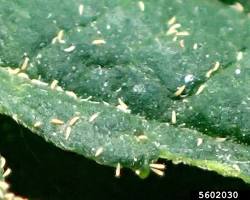
Hemp Russet Mites (*Aculops cannibicola*) are microscopic, four-legged mites that are one of the most serious and difficult-to-detect pests of **hemp and cannabis** plants. They are part of the family Eriophyidae (rust mites), known for their unique wedge-shaped bodies. Their feeding on the plant epidermis causes the characteristic “russeting” (bronzing and browning) of the stems and leaves. Infestation leads to reduced plant vigor, poor flower development, and significant yield loss.
Taxonomy and Classification
Hemp Russet Mites belong to the sub-class Acari (mites and ticks). They undergo simple development (egg, nymph, adult). They are so small that they require 30 magnification or higher to be visible. Unlike typical mites, they have only two pairs of legs, both clustered near the head, and are highly host-specific to plants in the *Cannabis* genus.
Physical Description
These mites are truly microscopic, measuring only 0.15 to 0.20 mm long.
- Appearance: Pale white, translucent, or amber, shaped like a tiny cigar or wedge.
- Movement: They move very slowly compared to spider mites.
- Location: Found feeding on the undersides of leaves, and later migrating to new growth tips, petioles, and eventually the developing flower buds.
- Damage Sign: Symptoms begin on lower leaves: leaves curl upward, appear shiny or “wet,” and stems or petioles develop a **bronzed, rusty, or greasy appearance** (russeting). In severe cases, new growth stops, and leaves drop.
Distribution and Habitat
Hemp Russet Mites are distributed globally wherever hemp or cannabis is cultivated, particularly in greenhouse and indoor growing environments where conditions are stable. Their habitat is the tender, newest growth of the host plant. They spread primarily through wind currents, water droplets, and direct contact between plants or via contaminated tools and clothing.
Influence of Environmental Conditions
Hemp russet mites are notorious for thriving in warm, dry environments. High humidity levels can disrupt their life cycle and make conditions less favorable for their reproduction and survival. Growers often observe that maintaining moderate to high humidity slows the spread of mite populations, as these pests are adapted to drier air.
Paying close attention to environmental conditions, especially humidity, provides an additional layer of defense against outbreaks, making it harder for hemp russet mites to take hold and multiply.
Behavior and Conflict
Russet mites feed by piercing the epidermal cells of the plant, disrupting the structure and causing cell collapse.
- Secrecy: Their small size and translucent bodies mean that infestations are often not discovered until the damage is severe and widespread, complicating control.
- Yield Loss: Infestation on new growth and flowers significantly reduces the yield and quality of the finished product. Flower buds may stop developing or be contaminated with dead mites and debris.
- Rapid Reproduction: They reproduce quickly in warm, favorable conditions, allowing populations to explode within weeks.
Chemical Treatment Risks and Considerations
While chemical and oil-based controls play a role in managing hemp russet mites, they come with important limitations and hazards, particularly in cannabis production:
Careful reading of all product labels, adherence to recommended intervals, and a comprehensive understanding of each chemical’s properties are essential to avoid phytotoxicity, unsafe residues, or unintentional exposure. Where possible, prioritize preventative, cultural, and biological measures, reserving chemical controls as a last line of defense.
Management and Prevention
Control is extremely challenging and requires aggressive, early, multi-modal treatment.
- Quarantine (Key): Isolate all new cuttings and plants and inspect them microscopically for mites before introduction to the main growing area.
- Pruning and Disposal: Immediately remove and destroy all heavily infested plant parts and lower leaves showing russeting symptoms.
- Chemical/Oil Control: Apply specialized miticides, sulfur (for non-flowering stages), or high-concentration horticultural oils. Coverage must be extremely thorough, soaking all surfaces, and repeated frequently to target all life stages.
- Biological Control: Release predatory mites, such as *Amblyseius swirskii* or *Neoseiulus fallacis*, which are effective biological controls for suppression, particularly in indoor environments.
When Eradication Isn’t Possible
In situations where Hemp Russet Mite infestations remain persistent despite diligent intervention, it may be necessary to take decisive action to protect future crops.
Removal and Destruction: If infestation persists and begins to threaten plant health or crop quality, remove and securely dispose of all affected plants. This helps prevent the pest from spreading to healthy stock or to new cycles.
Deep Cleaning and Sterilization: Thoroughly sanitize the entire growing environment. All tools, surfaces, pots, and trays should be cleaned with a strong sterilizer (such as hydrogen peroxide, bleach solution, or commercial horticultural disinfectant). Pay special attention to corners, vents, and any areas that might harbor surviving mites or eggs.
Downtime for the Grow Space: Allowing the growing area to remain empty for several days or weeks reduces the likelihood of surviving mites finding new hosts. During this downtime, consider running fans or increasing temperatures to desiccate any remaining pests.
Cautious Restart: When reintroducing new plants, start with verified clean stock. Isolate and inspect new acquisitions under magnification, and maintain strict quarantine protocols to prevent reintroduction.
While such measures can feel drastic, they are often necessary to break the cycle of infestation and safeguard the next generation of plants.
Conservation and Research
Hemp Russet Mites are managed as high-impact agricultural pests. Research is focused on developing highly sensitive, non-destructive detection methods (like genetic assays), evaluating the efficacy of novel essential oils, and breeding hemp/cannabis strains with natural resistance to eriophyid mites.