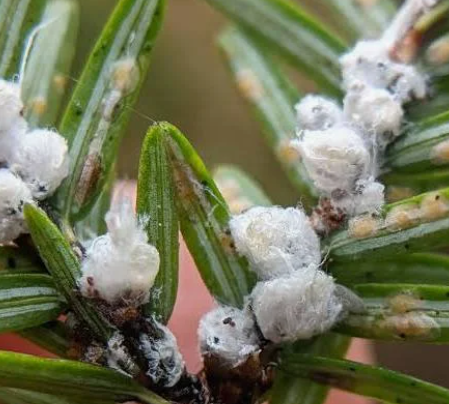
Hemlock Woolly Adelgids (Adelges tsugae) are invasive, sap-feeding insects that pose one of the greatest threats to hemlock forests in North America. Native to East Asia, these tiny insects were accidentally introduced into the United States and have since spread across much of the eastern portion of the country. Their feeding activity weakens hemlock trees by disrupting nutrient flow, causing needle loss, branch dieback, and eventual tree death. Because hemlocks serve as foundation species in many forest ecosystems, infestations have far-reaching ecological consequences that extend well beyond the loss of individual trees.
Hemlock Woolly Adelgids are particularly dangerous because infestations often go unnoticed during their early stages. The insects are extremely small and spend most of their lives attached to the base of hemlock needles. By the time visible symptoms appear, trees may already be experiencing significant stress. Without treatment, heavily infested trees frequently die within four to ten years, depending on environmental conditions and overall tree health.
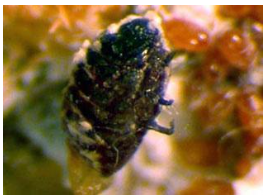
Taxonomy and Classification
Hemlock Woolly Adelgids belong to the family Adelgidae, a group of insects closely related to aphids.
- Kingdom: Animalia
- Phylum: Arthropoda
- Class: Insecta
- Order: Hemiptera
- Family: Adelgidae
- Genus: Adelges
- Species: Adelges tsugae
Although often mistaken for aphids, adelgids form a distinct family with unique biological characteristics. Their life cycle is complex and includes multiple generations per year. In North America, they reproduce primarily through parthenogenesis, meaning females can produce offspring without mating.
Identification
The most recognizable sign of a Hemlock Woolly Adelgid infestation is the presence of white, cottony masses attached to the twigs at the base of hemlock needles. These woolly structures protect the insects and their eggs from environmental conditions and predators.
Adult Adelgids
- Size: Less than 2 mm long.
- Color: Dark reddish-brown to black.
- Appearance: Oval-bodied and covered by a white waxy secretion.
- Visibility: Difficult to observe without magnification.
Key Identification Features
- White wool-like masses at the base of needles.
- Clusters of cottony ovisacs on twigs.
- Infestations concentrated on the undersides of branches.
- Gray-green foliage and thinning crowns.
The woolly masses are most visible from late fall through spring and provide the easiest method for identifying infestations.
Distribution and Habitat
Hemlock Woolly Adelgids are native to Asia but are now widespread throughout eastern North America. They attack primarily:
- Eastern Hemlock (Tsuga canadensis)
- Carolina Hemlock (Tsuga caroliniana)
Infestations are common in:
- National forests
- State parks
- Residential landscapes
- Botanical gardens
- Riparian corridors
- Mountain forests
Because eastern and Carolina hemlocks have little natural resistance to the adelgid, these trees are highly vulnerable once infestations become established.
Life Cycle
Hemlock Woolly Adelgids have a complex life cycle involving multiple generations.
- Egg Stage: Eggs are deposited within the protective woolly ovisac.
- Nymph Stage: Newly hatched crawlers move to feeding sites near needle bases.
- Adult Stage: Mature insects remain attached to twigs while feeding and reproducing.
The insects spend most of their lives sedentary and attached to the tree. Once established, colonies can expand rapidly and spread to nearby trees through wind, birds, mammals, and human activity.
Feeding Behavior
Unlike many sap-feeding insects that feed directly on leaves, Hemlock Woolly Adelgids attach themselves at the base of needles where they access nutrient-rich tissues. Their feeding disrupts the movement of nutrients throughout the tree and gradually weakens its ability to produce healthy growth.
As infestations increase, trees become unable to sustain normal growth and eventually enter a state of chronic decline.
Damage and Economic Importance
Hemlock Woolly Adelgids are considered among the most destructive forest pests in North America.
Needle Loss
- Gray-green discoloration.
- Premature needle drop.
- Reduced photosynthesis.
- Sparse foliage.
Growth Suppression
- Reduced new shoot production.
- Bud mortality.
- Stunted branch development.
- Canopy thinning.
Tree Mortality
- Progressive branch dieback.
- Declining vigor.
- Structural weakening.
- Eventual tree death.
Untreated trees often die within several years of infestation.
Ecological Impact
The loss of hemlock trees affects entire forest ecosystems.
- Loss of wildlife habitat.
- Increased stream temperatures.
- Changes in forest composition.
- Reduced shade along waterways.
- Altered nutrient cycling.
Hemlocks are considered foundation species because they influence temperature, moisture, and habitat conditions throughout the ecosystem. Their decline can trigger widespread ecological changes.
Signs of Infestation
Common symptoms include:
- White cottony masses on twigs.
- Needle discoloration.
- Premature needle drop.
- Branch dieback.
- Sparse foliage.
- Reduced new growth.
- Thinning tree canopy.
Inspection between November and May often provides the best opportunity for early detection because the white woolly masses are highly visible during this period.
Management and Prevention
An Integrated Pest Management (IPM) approach provides the most effective long-term control.
Monitoring
- Inspect branches regularly.
- Check needle bases for white woolly masses.
- Monitor tree health annually.
- Identify infestations before canopy thinning occurs.
Cultural Controls
- Maintain adequate soil moisture.
- Avoid unnecessary tree stress.
- Provide deep watering during drought periods.
- Avoid excessive nitrogen fertilization.
Research has shown that high nitrogen levels may increase adelgid reproduction and worsen infestations.
Biological Control
- Predatory beetles such as Laricobius nigrinus.
- Natural enemy conservation programs.
- Forest-based biological control initiatives.
Predatory beetles have been released in many regions to help suppress adelgid populations over large forested areas.
Chemical Control
- Systemic soil drenches.
- Trunk injections.
- Horticultural oil applications.
Systemic insecticides containing active ingredients such as imidacloprid or dinotefuran are commonly used to protect landscape trees and can provide multi-year suppression when applied properly. Horticultural oils are effective against overwintering stages when complete coverage is achieved.
Conservation and Research
Researchers continue investigating biological control agents, resistant hemlock populations, and improved management strategies. Long-term conservation efforts focus on preserving hemlock forests while developing sustainable approaches to adelgid suppression.
Genetic resistance research is particularly promising because resistant trees may provide a long-term solution for restoring affected forests. Until such solutions become widely available, early detection, monitoring, and timely treatment remain the most effective tools for protecting valuable hemlock trees from this destructive invasive pest.