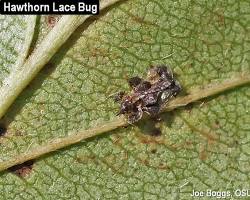
Hawthorn Lace Bugs (Corythucha cydoniae) are small sap-feeding insects that commonly infest ornamental trees and shrubs in the rose family, particularly hawthorn, cotoneaster, pyracantha, crabapple, quince, and apple. These insects are named for the intricate, lace-like pattern covering their wings and thorax, which gives them a delicate appearance despite their destructive feeding behavior.
Although tiny, Hawthorn Lace Bugs can cause extensive aesthetic damage to ornamental plants by feeding on the undersides of leaves and removing chlorophyll-rich cell contents. Heavy infestations lead to severe leaf stippling, bronzing, yellowing, and premature leaf drop, reducing both plant vigor and landscape appearance.
These insects are particularly problematic in:
- Urban landscapes
- Residential gardens
- Commercial properties
- Nurseries
- Public parks
because repeated infestations can weaken ornamental trees and make them more vulnerable to drought stress and secondary pests.
Quick Facts
- Common Name: Hawthorn Lace Bug
- Scientific Name: Corythucha cydoniae
- Order: Hemiptera
- Family: Tingidae
- Main Hosts: Hawthorn, cotoneaster, pyracantha, apple
- Primary Damage: Leaf stippling and discoloration
- Feeding Location: Undersides of leaves
- Distribution: North America
Taxonomy and Classification
Hawthorn Lace Bugs belong to the true bug order:
- Hemiptera
and the lace bug family:
- Tingidae
Lace bugs are specialized piercing-sucking insects that feed on leaf tissue by extracting fluids and chloroplasts from plant cells.
Scientific Classification
- Kingdom: Animalia
- Phylum: Arthropoda
- Class: Insecta
- Order: Hemiptera
- Family: Tingidae
- Species: Corythucha cydoniae
Unlike chewing insects, lace bugs cause damage through repeated feeding punctures rather than direct tissue removal.
Physical Description
Adult Hawthorn Lace Bugs are tiny, flattened insects measuring approximately:
- 1/8 to 1/4 inch long
Adult Appearance
Adults are highly distinctive because of their ornate body structure.
- Transparent or whitish lace-like wings
- Flattened rectangular body
- Delicate network-like markings
- Expanded hood-like pronotum
- Dark markings beneath translucent wings
Their appearance resembles tiny pieces of decorative lace attached to leaves.
Nymphs
Immature lace bugs look very different from adults.
- Dark brown or black coloration
- Wingless
- Spiny body surface
- Often clustered together
Nymphs remain primarily on leaf undersides where they feed continuously.
Eggs
Females insert tiny eggs into leaf tissue on the undersides of leaves.
Eggs are often partially covered with:
- Dark excrement
- Protective secretions
Distribution and Habitat
Hawthorn Lace Bugs are distributed widely throughout North America, especially in areas where ornamental rosaceous plants are cultivated.
Preferred Host Plants
- Hawthorn
- Cotoneaster
- Pyracantha
- Apple
- Crabapple
- Quince
- Firethorn
Typical Habitat
They thrive in:
- Landscapes
- Urban plantings
- Nurseries
- Hedgerows
- Residential yards
Plants growing in:
- Hot
- Dry
- Sunny
conditions are often more heavily affected.
Life Cycle
Hawthorn Lace Bugs undergo incomplete metamorphosis.
Overwintering Stage
Adults overwinter in protected areas such as:
- Bark crevices
- Leaf litter
- Plant debris
- Sheltered branches
Spring Emergence
In spring, adults emerge and begin feeding on newly developed foliage.
Females soon lay eggs on leaf undersides.
Nymph Development
After hatching:
- Nymphs feed in colonies
- Remain concentrated beneath leaves
- Molt several times before adulthood
Generations Per Year
Multiple generations may occur annually depending on:
- Climate
- Temperature
- Host availability
Warm regions often experience prolonged activity through the growing season.
Damage and Impact
Both adults and nymphs damage plants by piercing leaf tissue and extracting fluids.
Leaf Stippling
The earliest symptom is:
- Tiny white or yellow feeding spots
known as stippling.
As feeding intensifies, leaves may become:
- Bronzed
- Grayish
- Yellowed
- Bleached
Reduced Photosynthesis
Heavy feeding destroys chlorophyll and reduces the plant’s ability to photosynthesize effectively.
This can lead to:
- Reduced vigor
- Premature leaf drop
- Slower growth
- Drought susceptibility
Aesthetic Damage
The most serious impact is often ornamental damage.
Severely infested plants may appear:
- Dusty
- Gray
- Burned
- Unhealthy
Signs of Infestation
Several clues indicate Hawthorn Lace Bug activity.
Upper Leaf Symptoms
- White stippling
- Yellow spotting
- Bronzing
- Premature discoloration
Leaf Underside Symptoms
- Clusters of insects
- Dark varnish-like fecal spots
- Cast skins
- Egg deposits
Heavy Infestations
Severe infestations may cause:
- Leaf drop
- Thin canopy growth
- General decline
Behavior and Feeding Habits
Lace bugs are relatively sedentary insects that spend most of their lives feeding beneath leaves.
Feeding Location
Nearly all feeding occurs on:
- Leaf undersides
which protects them from:
- Rain
- Predators
- Sunlight
- Some insecticide exposure
Colony Formation
Nymphs and adults frequently gather in dense colonies on susceptible plants.
This concentrated feeding leads to rapid visible damage.
Prevention and Control
Integrated Pest Management (IPM) provides the most effective long-term control strategy.
Monitoring
Regularly inspect:
- Leaf undersides
- New foliage
- Susceptible ornamentals
during spring and summer.
Cultural Control
Healthy plants tolerate damage more effectively.
Recommended practices include:
- Proper watering
- Adequate fertilization
- Mulching
- Pruning dense growth
- Improving airflow
Water Sprays
Strong sprays of water directed at leaf undersides can dislodge:
- Nymphs
- Adults
- Egg masses
This method is especially useful on small ornamental plants.
Insecticidal Soaps and Oils
Horticultural oils and insecticidal soaps are effective when:
- Applied directly to leaf undersides
- Used against young nymphs
- Repeated as needed
Systemic Treatments
In severe or recurring infestations, systemic insecticides may provide season-long protection for high-value ornamentals.
Biological Control
Natural predators help suppress lace bug populations.
Beneficial insects include:
- Minute pirate bugs
- Lacewing larvae
- Lady beetles
- Predatory mites
Interesting Facts
- Lace bugs get their name from their ornate, lace-like wings.
- Most damage occurs beneath leaves where insects remain hidden.
- Heavy infestations may make trees appear drought-stressed.
- Dark fecal spots on leaf undersides are a key diagnostic feature.
- Many lace bug species specialize on only a few host plants.
Conservation and Research
Hawthorn Lace Bugs are managed primarily as ornamental landscape pests.
Current research focuses on:
- Host plant resistance
- Biological control agents
- Reduced-risk insecticides
- Landscape IPM strategies
- Urban tree health management
Researchers continue investigating sustainable approaches that minimize pesticide use while preserving ornamental plant quality.