Overview
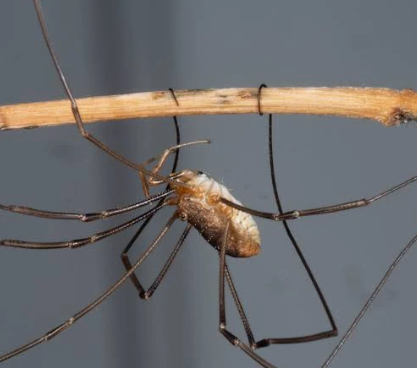
Harvestmen, commonly known as “daddy longlegs”, are fascinating arachnids belonging to the order Opiliones. Although they are often mistaken for spiders because of their long legs and similar appearance, harvestmen differ significantly from true spiders in anatomy, behavior, and ecology. Unlike spiders, harvestmen possess a single, fused body region rather than two distinct body segments, and they do not produce silk or venom.
Harvestmen are among the most widespread arachnids in the world and can be found on every continent except Antarctica. They inhabit forests, grasslands, gardens, caves, agricultural landscapes, and urban environments. In many regions, they become particularly noticeable during late summer and fall when large numbers gather on tree trunks, fence posts, rocks, walls, and vegetation.
These arachnids play an important ecological role as scavengers and opportunistic predators. They help recycle organic matter by feeding on decaying plants, fungi, dead insects, and other debris while also consuming small live insects and other invertebrates. Because of their feeding habits, harvestmen contribute to nutrient cycling and may help reduce populations of small pest species.
Despite myths that have circulated for decades, harvestmen are completely harmless to humans. They lack venom glands and fangs capable of biting people. In reality, they are beneficial organisms that should generally be appreciated rather than feared.
Taxonomy and Classification
- Kingdom: Animalia
- Phylum: Arthropoda
- Class: Arachnida
- Order: Opiliones
Harvestmen belong to the class Arachnida, making them relatives of spiders, scorpions, mites, ticks, and pseudoscorpions. Scientists have identified more than 6,500 species worldwide, and new species continue to be discovered in various habitats.
Identification
Harvestmen are most easily recognized by their extremely long, thin legs and compact body. Most species measure only a few millimeters in body length, though their legs can span several inches. Their coloration varies from tan and brown to gray, reddish-brown, or nearly black depending on the species.
Unlike spiders, harvestmen have a body that appears as a single oval or rounded unit. The head, thorax, and abdomen are broadly fused together, giving them a distinctive appearance. This is one of the easiest ways to distinguish them from true spiders, which have two clearly separated body segments.
Another important difference is the absence of silk-producing spinnerets. Harvestmen cannot build webs, wrap prey, or create egg sacs like spiders. They also lack venom glands and specialized fangs.
Their long legs are extremely sensitive and help them navigate their environment. If threatened by predators, some species can shed a leg, which may continue twitching and distract the attacker while the harvestman escapes.
Distribution and Habitat
Harvestmen occur throughout North America, Europe, Asia, South America, Africa, and Australia. They are especially common in moist habitats where humidity helps prevent dehydration.
Typical habitats include:
- Forests and woodlands
- Leaf litter and forest floors
- Gardens and landscaped yards
- Grasslands and meadows
- Under logs, rocks, and fallen branches
- Caves and rocky crevices
- Building foundations and retaining walls
During daylight hours, harvestmen often hide beneath debris, bark, stones, or dense vegetation. They emerge after sunset to forage and explore. Moist environments are particularly important because harvestmen are susceptible to water loss.
Life Cycle
Harvestmen undergo a relatively simple life cycle consisting of eggs, immature stages, and adults. Females lay eggs in soil, moss, leaf litter, or protected crevices where they remain sheltered from predators and environmental extremes.
After hatching, young harvestmen resemble miniature adults but lack full development. They molt several times as they grow, gradually increasing in size. Unlike insects, they do not undergo complete metamorphosis with larval and pupal stages.
Most species complete their life cycle within one year, though lifespan varies depending on environmental conditions and species. Adults are most commonly encountered during late summer and autumn.
Behavior and Feeding
Harvestmen are primarily nocturnal and spend much of the night searching for food. Their diet is unusually diverse compared to many other arachnids.
Common food sources include:
- Small insects
- Aphids and other soft-bodied arthropods
- Mites
- Dead insects and animal remains
- Fungi and mushrooms
- Decaying plant material
- Bird droppings and organic debris
This varied diet makes harvestmen valuable scavengers. By consuming dead organic matter, they help recycle nutrients and contribute to healthy ecosystem function.
One particularly interesting behavior is their tendency to form large aggregations. Hundreds or even thousands of harvestmen may cluster together on tree trunks, cave walls, rocks, or building surfaces. Scientists believe these gatherings help reduce moisture loss, regulate temperature, and deter predators through safety in numbers.
Ecological Importance
Harvestmen provide several ecological benefits. Their role as scavengers helps break down organic matter and return nutrients to the soil. They also consume small insects and arthropods that might otherwise reach nuisance levels.
In gardens and natural landscapes, harvestmen contribute to biodiversity and help maintain balanced ecosystems. Because they feed on a variety of prey and decaying material, they occupy an important position in many food webs.
They also serve as prey for birds, amphibians, reptiles, spiders, and small mammals, making them an important food source for numerous animals.
Myths and Misconceptions
One of the most persistent myths claims that harvestmen are the most venomous arachnids in the world but cannot bite humans because their fangs are too small. This story is entirely false.
Harvestmen do not possess venom glands and do not inject venom. They are incapable of delivering medically significant bites and pose no threat to people or pets. Their reputation likely stems from confusion between harvestmen and other long-legged arachnids.
In reality, harvestmen are among the most harmless arachnids encountered around homes and gardens.
Prevention and Control
Because harvestmen are beneficial and harmless, control measures are generally unnecessary. Most individuals found around homes, gardens, or landscapes can simply be left alone.
If harvestmen occasionally enter buildings, simple exclusion techniques can reduce their numbers:
- Seal cracks around doors and windows.
- Repair damaged screens.
- Reduce excessive moisture near foundations.
- Remove piles of leaves, wood, and debris close to structures.
- Maintain vegetation away from exterior walls.
Indoor harvestmen can be gently captured and released outdoors if desired. Chemical treatments are rarely justified and may harm other beneficial organisms.
Conclusion
Harvestmen are unique arachnids that are frequently misunderstood because of their resemblance to spiders. Unlike true spiders, they have a fused body, produce no silk, and possess no venom. These harmless creatures serve important ecological roles as scavengers and predators, helping recycle organic matter and control small insect populations.
Found in forests, gardens, grasslands, and urban environments, harvestmen are valuable members of many ecosystems. Their presence is generally a sign of a healthy environment, and they should be viewed as beneficial organisms rather than pests. For homeowners and gardeners, the best management strategy is usually simple appreciation and coexistence.