Overview
Halyomorpha Stink Bugs, most notably the invasive Brown Marmorated Stink Bug (Halyomorpha halys), are destructive agricultural and nuisance pests that have spread rapidly across North America, Europe, and other parts of the world. Native to East Asia, these shield-shaped insects have become notorious for damaging crops, invading homes, and producing a strong defensive odor when disturbed.
Halyomorpha stink bugs feed on a massive variety of plants using specialized piercing-sucking mouthparts. Their feeding punctures fruits, stems, leaves, and seeds, resulting in deformities, discoloration, internal tissue damage, and reduced crop quality. Commercial agriculture has experienced significant losses from these pests, especially in fruit orchards and vegetable production systems.
In addition to agricultural destruction, these insects are infamous for becoming major household nuisance pests during autumn. As temperatures cool, thousands of stink bugs may gather on buildings and squeeze through cracks and openings in search of sheltered overwintering sites.
Unlike termites or beetles, they do not damage structures directly. However, their sheer numbers, foul odor, and persistent indoor presence make them one of the most frustrating invasive insects encountered by homeowners.
The brown marmorated stink bug has become one of the most economically important invasive agricultural pests of the modern era.
Quick Facts
- Common Name: Halyomorpha Stink Bugs
- Scientific Name: Halyomorpha halys
- Family: Pentatomidae
- Order: Hemiptera
- Main Threat: Crop damage and home invasions
- Diet: Plant sap and fruit tissues
- Native Range: East Asia
- Status: Invasive species
Taxonomy and Classification
Halyomorpha stink bugs belong to the shield bug family Pentatomidae.
- Kingdom: Animalia
- Phylum: Arthropoda
- Class: Insecta
- Order: Hemiptera
- Family: Pentatomidae
- Genus: Halyomorpha
- Species: Halyomorpha halys
The family includes many stink bug species, but the brown marmorated stink bug is among the most destructive invasive members.
These insects are classified as “true bugs” because of their piercing-sucking mouthparts and partially hardened forewings.
Identification
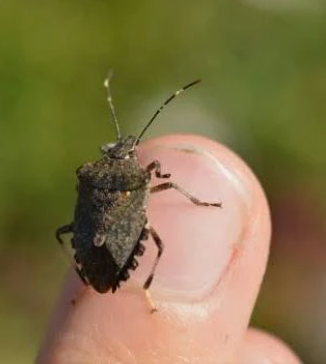
Adult halyomorpha stink bugs are medium-sized shield-shaped insects with mottled brown coloration.
Adult Appearance
- Approximately 1/2 to 3/4 inch long
- Shield-shaped body
- Mottled brown and gray coloration
- Alternating light and dark bands on antennae
- Alternating bands along abdominal edges
- Marbled or “marmorated” appearance
The light-colored banding on the antennae is one of the most reliable identification features.
Nymphs
Immature stink bugs undergo several developmental stages.
Young nymphs may appear:
- Orange
- Red
- Black
- White-spotted
As they mature, they gradually develop the brown mottled coloration of adults.
Eggs
Females lay clusters of pale green or white barrel-shaped eggs on the undersides of leaves.
Habitat and Distribution
Halyomorpha stink bugs are highly adaptable and occupy many environments.
Common Habitats
- Fruit orchards
- Vegetable gardens
- Agricultural fields
- Forests
- Urban landscapes
- Residential neighborhoods
They thrive in both rural and urban environments.
Overwintering Sites
During fall, adults seek protected overwintering areas such as:
- Homes
- Attics
- Wall voids
- Sheds
- Garages
- Barns
Large aggregations may form inside buildings during winter months.
Global Spread
Originally native to:
- China
- Japan
- Korea
The species has spread through international trade and transportation into:
- North America
- Europe
- South America
- Other temperate regions
Behavior and Feeding
Halyomorpha stink bugs are highly polyphagous, meaning they feed on many different plant species.
Host Plants
They attack:
- Apples
- Peaches
- Pears
- Tomatoes
- Peppers
- Beans
- Corn
- Soybeans
- Ornamental plants
More than 100 plant species may serve as hosts.
Feeding Damage
Their needle-like mouthparts puncture plant tissues and extract fluids.
This causes:
- Sunken spots on fruit
- Internal corky tissue
- Discoloration
- Malformed produce
- Premature fruit drop
- Reduced market value
Defensive Odor
When disturbed or crushed, stink bugs release strong-smelling defensive chemicals from glands on their thorax.
The odor is often described as:
- Pungent
- Musty
- Cilantro-like
- Skunky
This odor helps deter predators.
Seasonal Movement
Adults become especially active in late summer and fall when searching for overwintering shelters.
They are strongly attracted to:
- Light-colored buildings
- Warm walls
- Sunny surfaces
Life Cycle
Halyomorpha stink bugs undergo incomplete metamorphosis.
Egg Stage
Females lay egg masses on leaves during spring and summer.
Nymph Stage
Nymphs pass through five developmental stages called instars.
Each molt brings them closer to adult appearance.
Adult Stage
Adults become highly mobile and capable of long-distance dispersal.
Depending on climate, one to several generations may occur annually.
Damage and Impact
Halyomorpha stink bugs cause serious economic and nuisance problems.
Agricultural Damage
These insects are major pests in:
- Fruit orchards
- Vegetable farms
- Row crop agriculture
- Nurseries
Damage can render produce unmarketable.
Home Invasions
Thousands of stink bugs may invade structures during autumn.
Problems include:
- Indoor nuisance activity
- Foul odor
- Dead insects indoors
- Noise from flying adults
- Accumulations around windows
Economic Losses
The brown marmorated stink bug has caused millions of dollars in crop losses worldwide.
Signs of Infestation
- Shield-shaped brown insects on plants
- Fruit deformities
- Discolored produce
- Clusters on buildings in fall
- Strong odor when disturbed
- Indoor aggregations near windows
Prevention and Control
Integrated pest management is essential for controlling halyomorpha stink bugs.
Home Exclusion
Prevent indoor invasions by:
- Sealing cracks and gaps
- Repairing screens
- Installing door sweeps
- Caulking around windows
Exclusion is the most effective long-term strategy for homes.
Physical Removal
Vacuuming is commonly used indoors to remove invading bugs.
Avoid crushing them because this releases odor.
Agricultural Management
Crop protection may involve:
- Monitoring traps
- Pheromone lures
- Targeted insecticides
- Biological control agents
- Crop scouting
Biological Control
Researchers are studying natural enemies such as:
- Parasitic wasps
- Predatory insects
- Pathogenic fungi
One promising biological control is the samurai wasp (Trissolcus japonicus), which attacks stink bug eggs.
Interesting Facts
- The brown marmorated stink bug is one of the most invasive agricultural insects in North America.
- They can fly long distances and spread rapidly.
- Their odor is produced by specialized scent glands.
- They do not bite humans or damage structures directly.
- Thousands may gather inside buildings during winter.
- They feed on more than 100 plant species.
Conservation and Research
Because of their enormous agricultural impact, halyomorpha stink bugs are heavily studied worldwide.
Research areas include:
- Biological control agents
- Pheromone trapping systems
- Population monitoring
- Integrated pest management
- Climate adaptation studies
Scientists continue developing environmentally sustainable methods to reduce crop damage while limiting pesticide use.