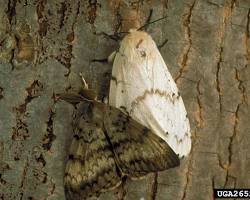
Gypsy Moths (Lymantria dispar), now more commonly referred to as the Spongy Moth, are notorious invasive forest pests native to Europe and Asia that were accidentally introduced to North America during the late 1860s. The destructive larval stage, or caterpillar, is capable of causing severe and widespread defoliation of hardwood forests, especially oak-dominated ecosystems.
These insects are considered among the most destructive forest pests in North America. During outbreak years, millions of acres of trees may be stripped of foliage, creating major ecological and economic impacts. While healthy trees may survive a single defoliation event, repeated attacks can weaken or kill trees, especially when combined with drought, disease, or other environmental stressors.
Spongy moth infestations also create major nuisance problems in residential areas where caterpillars crawl across buildings, sidewalks, decks, vehicles, and outdoor furniture in massive numbers.
Quick Facts
- Scientific Name: Lymantria dispar
- Common Name: Gypsy Moth / Spongy Moth
- Order: Lepidoptera
- Family: Erebidae
- Habitat: Forests, woodlots, suburban landscapes
- Diet: Tree foliage
- Status: Highly destructive invasive forest pest
- Primary Hosts: Oak, birch, willow, apple, aspen
Taxonomy and Classification
Gypsy moths belong to the family Erebidae, a large group containing tussock moths and related species. They are members of the order Lepidoptera, which includes moths and butterflies.
The scientific name Lymantria dispar roughly translates to “destroyer” and “to separate,” referring to the dramatic differences between male and female adults. This sexual dimorphism is one of the species’ most recognizable characteristics.
These moths undergo complete metamorphosis with four life stages:
- Egg
- Larva (caterpillar)
- Pupa
- Adult moth
Because of the destructive nature of their caterpillars, spongy moths are managed aggressively in many regions of North America.
Physical Description
The Gypsy Moth is most easily identified during its larval and egg stages.
Caterpillar (Larva)
The caterpillar grows up to approximately 2.5 inches long and is dark-colored with long hairs covering the body. The most distinctive identifying feature is the row of colored spots running down the back:
- Five pairs of blue spots
- Six pairs of red spots
This blue-and-red spot pattern is considered the classic identifying characteristic of spongy moth caterpillars.
The hairy caterpillars may cause skin irritation or allergic reactions in sensitive individuals.
Female Moth
Adult females are large, cream-colored to off-white moths with dark wavy markings across the wings. In the European strain established in North America, females cannot fly and remain near the location where they emerged.
Male Moth
Males are smaller, darker brown or gray moths with feathery antennae. Unlike females, males are active fliers and rapidly search for mates using pheromone cues.
Egg Mass
The egg mass is often the most visible overwintering stage. Egg masses are velvety, tan-colored patches approximately 1 to 2 inches long containing hundreds of eggs.
Egg masses may be attached to:
- Tree bark
- Firewood
- Vehicles
- Outdoor furniture
- Rocks
- Camping equipment
- Buildings
Distribution and Habitat
The spongy moth is firmly established across much of the Northeastern United States and Eastern Canada. Populations continue spreading into additional regions through accidental human transport.
Preferred habitats include:
- Hardwood forests
- Oak woodlands
- Urban parks
- Residential landscapes
- Woodlots
- Campgrounds
Oak trees are considered the preferred host, although the caterpillars feed on hundreds of different tree and shrub species.
The pest spreads primarily when humans unknowingly move egg masses attached to firewood, trailers, recreational vehicles, and outdoor equipment.
Life Cycle
The spongy moth has one generation per year and overwinters in the egg stage.
Egg Stage
Egg masses survive winter attached to protected surfaces. Each egg mass may contain several hundred eggs.
Larval Stage
Larvae hatch during spring as trees begin producing new leaves. Young caterpillars climb upward into tree canopies and begin feeding immediately.
Small larvae may disperse by “ballooning,” where silk threads carry them through the air to nearby trees.
Caterpillars feed aggressively for several weeks and consume enormous amounts of foliage before pupating.
Pupal Stage
Pupation occurs in sheltered locations including bark crevices, buildings, fences, and outdoor furniture.
Adult Stage
Adults emerge during summer, mate, and produce new egg masses that remain dormant until the following spring.
Behavior and Damage
Spongy moth caterpillars are voracious foliage feeders capable of stripping entire trees during outbreak years.
Defoliation
Caterpillars consume leaves rapidly, often leaving forests bare during mid-summer. Severe outbreaks may affect millions of acres.
Preferred host trees include:
- Oak
- Birch
- Willow
- Aspen
- Apple
- Maple
Tree Stress and Mortality
A single defoliation event may not kill healthy trees. However, repeated defoliation over multiple years can cause:
- Branch dieback
- Reduced growth
- Secondary insect attacks
- Disease susceptibility
- Tree death
Urban Nuisance Problems
During heavy outbreaks, caterpillars and frass (droppings) create major nuisance conditions in residential areas. Frass falling from trees may sound like rainfall during severe infestations.
Hairy caterpillars may also trigger skin irritation or allergic reactions in sensitive individuals.
Management and Prevention
Control programs focus on slowing spread, protecting forests, and reducing outbreak populations.
Egg Mass Removal
The most effective mechanical method involves scraping egg masses into containers of soapy water for destruction.
Do not simply scrape egg masses onto the ground.
Tree Banding
Sticky bands or burlap wraps placed around tree trunks help trap crawling caterpillars during spring and summer.
Biological Control
Spraying foliage with Bacillus thuringiensis var. kurstaki (BtK) is one of the primary biological control methods. BtK is most effective against young caterpillars actively feeding on foliage.
Monitoring
Pheromone traps are used extensively to monitor male moth populations and detect new infestations.
Natural Enemies
Natural controls include:
- Predatory beetles
- Birds
- Parasitic wasps
- Fungal pathogens
- Nucleopolyhedrovirus (“wilt disease”)
Economic and Ecological Impact
Spongy moth infestations create enormous economic losses through:
- Tree mortality
- Timber losses
- Reduced tourism
- Landscape damage
- Pest management costs
- Reduced property values
Ecologically, repeated defoliation alters forest composition, affects wildlife habitat, and changes ecosystem stability.
Interesting Facts About Gypsy Moths
- The insect is now commonly called the Spongy Moth.
- Female moths in North America cannot fly.
- Caterpillars can consume an entire oak leaf in a single day.
- Outbreaks may cover millions of acres.
- Egg masses may survive extremely cold winter temperatures.