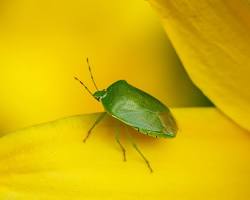
Green Stink Bugs (Chinavia hilaris, formerly Acrosternum hilare) are large shield-shaped insects commonly found throughout North and Central America. They are among the most economically important agricultural pests in the stink bug family because they attack a wide variety of crops, including soybeans, tomatoes, peaches, beans, corn, cotton, and fruit trees. ([turn0search0](https://en.wikipedia.org/wiki/Green_stink_bug) :contentReference[oaicite:1]{index=1})
Green Stink Bugs damage plants by piercing tissues with needle-like mouthparts and sucking out juices from fruits, stems, seeds, and developing pods. Their feeding causes deformities, discoloration, reduced crop quality, and economic losses in commercial agriculture. They are also notorious for releasing a strong foul odor when disturbed or crushed. :contentReference[oaicite:2]{index=2}
Although these insects are important agricultural pests, they are also fascinating members of the true bug order Hemiptera, possessing complex chemical defenses and brightly colored immature stages.
Quick Facts
- Scientific Name: Chinavia hilaris
- Family: Pentatomidae
- Order: Hemiptera
- Habitat: Crop fields, orchards, gardens, woodlands
- Diet: Plant sap, seeds, fruits, pods
- Status: Major agricultural pest
- Main Crops Attacked: Soybeans, peaches, tomatoes, beans
- Defense: Odor-producing scent glands
Taxonomy and Classification
Green Stink Bugs belong to the family Pentatomidae, commonly known as stink bugs or shield bugs. Their family name derives from the Greek word “pente,” meaning five, referring to the characteristic five-sided shield shape of the body. :contentReference[oaicite:3]{index=3}
The species was historically classified as Acrosternum hilare, but modern taxonomy places it within the genus Chinavia. :contentReference[oaicite:4]{index=4}
Green Stink Bugs undergo incomplete metamorphosis consisting of:
- Egg
- Nymph
- Adult
Unlike butterflies or beetles, there is no pupal stage. Nymphs gradually molt through several instars before reaching adulthood. :contentReference[oaicite:5]{index=5}
Physical Description
Adult Green Stink Bugs are broad-bodied insects measuring approximately 1/2 to 3/4 inch long.
Adult Appearance
Adults are easily recognized by their:
- Bright emerald green coloration
- Shield-like body shape
- Triangular scutellum on the back
- Smooth, glossy appearance
- Banded antennae with dark outer segments
The body margins may sometimes show yellow, orange, or reddish edging. :contentReference[oaicite:6]{index=6}
Odor Glands
Like other stink bugs, Green Stink Bugs possess thoracic scent glands that produce a strong-smelling defensive chemical when threatened or crushed.
The odor helps deter predators such as:
- Birds
- Lizards
- Spiders
- Small mammals
The chemical defense contains aldehyde compounds that create the characteristic unpleasant smell. :contentReference[oaicite:7]{index=7}
Nymphs
The immature stages look dramatically different from adults.
Nymphs are often:
- Black
- Orange
- Red
- Green
- Spotted or striped
Young nymphs lack wings and have rounded bodies. As they mature, green coloration gradually increases. :contentReference[oaicite:8]{index=8}
Distribution and Habitat
Green Stink Bugs are native to North America and occur throughout much of the eastern and central United States, extending into parts of Canada, Mexico, and Central America. :contentReference[oaicite:9]{index=9}
They inhabit:
- Crop fields
- Vegetable gardens
- Fruit orchards
- Woodlands
- Pastures
- Shrublands
- Urban landscapes
Preferred host plants include:
- Soybeans
- Corn
- Tomatoes
- Beans
- Peaches
- Apples
- Cotton
- Pecans
They also utilize many wild host plants and weeds before moving into cultivated crops later in the growing season. :contentReference[oaicite:10]{index=10}
Life Cycle
The Green Stink Bug typically produces one generation annually in northern regions and multiple generations in warmer southern climates. :contentReference[oaicite:11]{index=11}
Egg Stage
Females lay clusters of barrel-shaped eggs on the undersides of leaves.
Egg masses typically contain:
- 12–14 eggs
- Double-row arrangements
- Light green coloration
Eggs gradually change color before hatching. :contentReference[oaicite:12]{index=12}
Nymph Stage
Nymphs pass through five instars while feeding on foliage, fruits, and seeds.
Young nymphs often remain clustered together after hatching before dispersing as they mature. :contentReference[oaicite:13]{index=13}
Adult Stage
Adults become highly mobile strong flyers capable of moving between crops and wild vegetation throughout the growing season.
During fall, adults seek protected overwintering sites beneath:
- Leaf litter
- Bark
- Wood piles
- Garden debris
:contentReference[oaicite:14]{index=14}
Behavior and Damage
Green Stink Bugs feed using piercing-sucking mouthparts called stylets.
Fruit Damage
Feeding on fruits such as peaches and tomatoes causes:
- Sunken spots
- Corky tissue
- Brown necrotic areas
- Distorted growth
- “Catfacing” deformities
This damage significantly lowers market value. :contentReference[oaicite:15]{index=15}
Seed and Pod Damage
When feeding on soybeans and corn, stink bugs damage developing seeds and kernels, resulting in:
- Shriveled seeds
- Reduced seed weight
- Poor germination
- Yield loss
Soybeans are especially vulnerable during pod development. :contentReference[oaicite:16]{index=16}
Nuisance Problems
Green Stink Bugs occasionally enter homes during fall while searching for overwintering shelter. Unlike bed bugs or roaches, they do not reproduce indoors or damage structures. :contentReference[oaicite:17]{index=17}
Management and Prevention
Effective management depends on monitoring populations and targeting control measures carefully.
Monitoring
Farmers commonly use:
- Sweep nets
- Visual inspections
- Pheromone monitoring
- Crop scouting
to determine whether populations exceed economic thresholds. :contentReference[oaicite:18]{index=18}
Habitat Management
Reducing nearby weed hosts and unmanaged vegetation helps decrease early-season populations.
Trap crops may also attract stink bugs away from valuable crops. :contentReference[oaicite:19]{index=19}
Chemical Control
Control may involve:
- Pyrethroids
- Broad-spectrum insecticides
- Organic pyrethrin sprays
- Targeted field applications
Applications are usually timed during vulnerable crop stages. :contentReference[oaicite:20]{index=20}
Biological Control
Natural enemies help suppress Green Stink Bug populations.
Important natural enemies include:
- Tachinid flies
- Scelionid egg parasitoid wasps
- Predatory spiders
- Birds
Species such as Trichopoda pennipes parasitize adult stink bugs naturally. :contentReference[oaicite:21]{index=21}
Interesting Facts About Green Stink Bugs
- Their odor is produced by thoracic scent glands.
- Nymphs are often more colorful than adults.
- They attack dozens of agricultural crops.
- Their shield shape inspired the family name Pentatomidae.
- Adults are strong flyers capable of moving long distances.