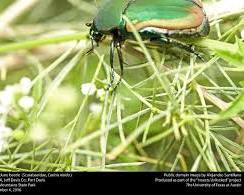
Green June Beetles (Cotinis nitida) are large metallic green scarab beetles commonly found throughout the eastern United States. These striking insects are well known for their loud buzzing flight, metallic coloration, and association with lawns, gardens, orchards, and areas rich in decaying organic matter.
Although adult beetles are primarily nuisance pests that feed on ripe fruits and tree sap, the larval stage, commonly called a grub, can become a significant turfgrass pest. Unlike many lawn grubs that feed heavily on roots, Green June Beetle larvae damage lawns by tunneling and uprooting grass as they crawl just beneath the soil surface.
These beetles are closely related to other scarab pests such as the Japanese Beetle and Fig Beetle, but they differ greatly in appearance, feeding behavior, and life cycle.
Quick Facts
- Scientific Name: Cotinis nitida
- Family: Scarabaeidae
- Order: Coleoptera
- Habitat: Lawns, orchards, gardens, compost-rich soil
- Diet: Fruit, sap, decaying organic matter
- Status: Turf and nuisance pest
- Adult Activity: Summer daytime flyer
- Generation: One generation per year
Taxonomy and Classification
Green June Beetles belong to the family Scarabaeidae, a large family of scarab beetles that includes dung beetles, rhinoceros beetles, June beetles, and flower chafers.
They are members of the order Coleoptera, which contains all true beetles. Like other scarabs, Green June Beetles undergo complete metamorphosis with four developmental stages:
- Egg
- Larva (grub)
- Pupa
- Adult beetle
Although sometimes confused with Figeater Beetles in the western United States, Green June Beetles are generally more common in eastern North America.
Unlike many scarab beetles that are nocturnal, Green June Beetles are active during daylight hours and are frequently seen flying during warm summer afternoons.
Physical Description
Adult Beetles
Adult Green June Beetles are large, stocky scarabs measuring approximately 3/4 to 1 inch long.
Their most recognizable features include:
- Metallic green coloration
- Golden-green underside
- Yellowish-brown wing margins
- Robust oval body
- Loud buzzing flight
The adults are highly reflective and may appear iridescent in sunlight.
Like the Fig Beetle, Green June Beetles often fly with their hardened wing covers (elytra) closed while the hind wings provide lift and propulsion.
Larvae (Grubs)
The larvae are large creamy-white grubs reaching up to 2 inches long. They possess:
- Brown head capsule
- C-shaped body
- Three pairs of thoracic legs
- Wrinkled segmented abdomen
One unusual characteristic is their habit of crawling on their backs when exposed on the soil surface. This distinctive movement helps separate them from other lawn grubs.
Distribution and Habitat
Green June Beetles are common throughout the eastern half of the United States and are especially abundant in warm, humid regions.
Preferred habitats include:
- Lawns
- Pastures
- Golf courses
- Compost-rich gardens
- Orchards
- Decaying organic matter
- Mulched landscapes
The larvae thrive in soils rich in:
- Compost
- Manure
- Decaying leaves
- Organic debris
- Thatch
Adults are commonly observed flying low over turfgrass during summer months.
Life Cycle
Green June Beetles typically produce one generation per year.
Egg Stage
Adult females lay eggs in moist soil containing abundant organic matter during mid to late summer.
Larval Stage
After hatching, the grubs begin feeding primarily on decaying organic material within the soil.
Unlike Japanese Beetle grubs, Green June Beetle larvae feed less on grass roots and more on organic debris and humus.
The larval stage overwinters underground and resumes feeding during spring.
Pupal Stage
Fully grown larvae create earthen pupal chambers within the soil where transformation into adults occurs.
Adult Stage
Adults emerge during early summer, especially in June and July, giving rise to the common name “June Beetle.”
The adults feed, mate, and lay eggs before dying later in the season.
Behavior and Damage
Damage caused by Green June Beetles occurs during both adult and larval stages.
Adult Damage
Adults feed on:
- Peaches
- Grapes
- Berries
- Figs
- Tree sap
- Overripe fruit
They chew into soft fruit tissue and may create openings that encourage rot and secondary insect infestations.
Although usually considered minor agricultural pests, adults can become nuisance insects around orchards and gardens.
Larval Damage
The larvae are generally considered the primary concern.
As the large grubs tunnel and crawl beneath turfgrass, they loosen and uproot grass roots. This causes:
- Brown turf patches
- Loose sod
- Spongy lawn surfaces
- Irregular damaged areas
Large populations may severely damage lawns, golf courses, and athletic fields.
Grubs frequently emerge at night and may be visible crawling across sidewalks or driveways after rainfall.
Management and Prevention
Management strategies focus on reducing attractive breeding conditions and targeting grubs in the soil.
Cultural Control
- Reduce excessive organic matter in lawns
- Avoid overuse of compost or manure
- Remove decaying vegetation
- Reduce heavy thatch buildup
These steps help reduce favorable egg-laying sites.
Mechanical Removal
Warm, soapy water poured over infested turf may force grubs to the surface where they can be collected manually.
Biological Control
Several biological controls are effective against scarab grubs, including:
- Beneficial nematodes (Heterorhabditis species)
- Milky spore disease (Paenibacillus popilliae)
These controls help suppress grub populations naturally.
Adult Control
For high-value fruit crops, physical exclusion methods such as netting are often preferred over insecticides.
Fermenting fruit traps may also attract and capture adults.
Ecological Importance
Although considered pests in some situations, Green June Beetles also contribute to decomposition processes by recycling organic matter within soil ecosystems.
Their larvae help break down compost and decaying plant material, contributing nutrients back into the soil.
Interesting Facts About Green June Beetles
- Adults are active during the daytime.
- Their buzzing flight is extremely loud.
- Grubs crawl on their backs when exposed.
- Adults often fly with closed wing covers.
- They are closely related to Fig Beetles and Japanese Beetles.