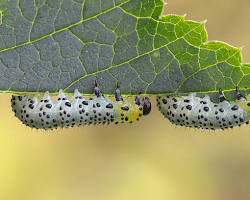
Gooseberry Sawflies (Nematus ribesii), also known as the Imported Currant Worm or Currant Sawfly, are destructive foliage-feeding pests of gooseberries and currants throughout the Northern Hemisphere. Although commonly mistaken for caterpillars, these insects are actually the larval stage of a small sawfly, a non-stinging relative of wasps and bees. ([turn0search4](https://en.wikipedia.org/wiki/Nematus_ribesii?utm_source=chatgpt.com))
Gooseberry Sawfly larvae are capable of rapidly stripping entire bushes of leaves within days. Severe infestations weaken plants, reduce fruit production, and limit the development of next year’s crop. Multiple generations per year make this pest particularly damaging in gardens, orchards, and berry-growing regions. :contentReference[oaicite:1]{index=1}
Because feeding often begins deep within the bush, infestations may go unnoticed until major defoliation has already occurred.
Quick Facts
- Scientific Name: Nematus ribesii
- Family: Tenthredinidae
- Order: Hymenoptera
- Habitat: Gooseberries and currants
- Diet: Leaves of Ribes species
- Status: Serious garden and fruit pest
- Main Damage: Rapid defoliation
- Generations: Up to three per year
Taxonomy and Classification
Gooseberry Sawflies belong to the order Hymenoptera, which also includes:
- Wasps
- Bees
- Ants
- Other sawflies
Unlike true flies, sawflies possess two pairs of wings and are more closely related to wasps. The family Tenthredinidae contains many plant-feeding sawfly species. :contentReference[oaicite:2]{index=2}
These insects undergo complete metamorphosis with four developmental stages:
- Egg
- Larva
- Pupa
- Adult
Sawfly larvae are often confused with moth caterpillars, but they can usually be identified by the number of fleshy abdominal prolegs:
- Sawfly larvae usually possess six or more pairs
- True caterpillars typically have five or fewer pairs
This distinction is important because biological controls such as Bacillus thuringiensis (Bt), which work well against caterpillars, are ineffective against sawfly larvae. :contentReference[oaicite:3]{index=3}
Physical Description
Adult Sawflies
The adult Gooseberry Sawfly is a small yellow-and-black insect that resembles a tiny wasp but lacks the narrow “waist” typical of true wasps.
Adults are:
- Yellowish with black markings
- Approximately 6–8 mm long
- Non-stinging
- Short-lived
Females are generally larger than males. :contentReference[oaicite:4]{index=4}
Larvae
The larvae are the destructive stage responsible for nearly all plant damage.
Young larvae begin pale green but mature into:
- Pale green bodies
- Distinct black spots
- Black heads
- Length up to 3/4 inch (20 mm)
The larvae often feed together in groups and may completely skeletonize leaves before consuming them entirely. :contentReference[oaicite:5]{index=5}
Eggs
Females lay tiny pale greenish-white eggs in neat rows along leaf veins, usually on the undersides of lower leaves. :contentReference[oaicite:6]{index=6}
Distribution and Habitat
Gooseberry Sawflies occur widely across:
- Europe
- North America
- Asia
They are common wherever currants and gooseberries are cultivated. :contentReference[oaicite:7]{index=7}
Their preferred hosts belong to the genus Ribes, including:
- Gooseberries
- Red currants
- White currants
- Black currants
Typical habitats include:
- Backyard gardens
- Berry farms
- Orchards
- Allotments
- Home landscapes
Warm growing seasons often support multiple overlapping generations each year. :contentReference[oaicite:8]{index=8}
Life Cycle
Gooseberry Sawflies overwinter as prepupae inside silk cocoons buried in soil near host plants. :contentReference[oaicite:9]{index=9}
Spring Emergence
Adults emerge during spring when currant and gooseberry leaves begin developing.
Females quickly begin laying eggs on young foliage.
Larval Feeding
Larvae hatch within days and begin feeding in groups, often hidden within the lower interior canopy.
Heavy infestations may completely defoliate bushes in only a short period. :contentReference[oaicite:10]{index=10}
Pupation
Mature larvae drop into the soil and form cocoons where pupation occurs.
Depending on climate, two or three generations may occur between spring and early autumn. :contentReference[oaicite:11]{index=11}
Behavior and Damage
Gooseberry Sawflies are highly destructive because of their rapid feeding behavior and multiple annual generations.
Defoliation
Larvae consume:
- Leaf tissue
- Leaf margins
- Entire leaves
Feeding often begins on lower interior foliage before spreading outward.
In severe infestations, bushes may become nearly leafless. :contentReference[oaicite:12]{index=12}
Fruit Loss
Defoliation reduces photosynthesis and weakens the plant, leading to:
- Reduced berry production
- Poor fruit quality
- Weakened shoots
- Reduced vigor next season
Repeated annual infestations may significantly weaken bushes over time.
Hidden Feeding
Because larvae initially feed deep within the bush canopy, infestations may remain unnoticed until extensive damage has occurred.
Management and Prevention
Early detection is the key to effective management.
Monitoring
Inspect the lower and inner foliage regularly beginning in spring.
Look for:
- Rows of eggs
- Tiny green larvae
- Chewed leaves
- Skeletonized foliage
Hand Removal
Small infestations can be controlled by:
- Removing infested leaves
- Knocking larvae into soapy water
- Hand-picking larvae
Because larvae feed in groups, manual removal is often highly effective.
Soil Cultivation
Light cultivation around bushes during fall or early spring may expose overwintering cocoons to predators and weather. :contentReference[oaicite:13]{index=13}
Chemical Control
Unlike moth caterpillars, Gooseberry Sawfly larvae are not controlled by Bt products.
Effective treatments may include:
- Insecticidal soap
- Neem oil
- Horticultural oils
- Targeted short-residual insecticides
Applications are most effective when larvae are young.
Biological Control
Natural enemies include:
- Parasitic wasps
- Predatory beetles
- Birds
- Nematodes
Beneficial nematodes such as Steinernema feltiae may help suppress larvae and soil stages. :contentReference[oaicite:14]{index=14}
Interesting Facts About Gooseberry Sawflies
- They are wasp relatives, not flies.
- Larvae can strip an entire bush within days.
- They often produce three generations per year.
- Bt sprays do not work against sawfly larvae.
- Larvae feed gregariously in groups.