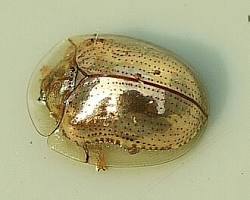
Golden Tortoise Beetles (Charidotella sexpunctata) are small, brilliantly reflective leaf beetles found throughout much of North and Central America. These remarkable insects are famous for their dazzling metallic gold coloration and their unusual ability to rapidly change color from bright gold to reddish-brown when disturbed, stressed, or mating. Because of this shimmering appearance, they are sometimes called “gold bugs.” :contentReference[oaicite:1]{index=1}
Golden Tortoise Beetles belong to a specialized group of leaf beetles known as tortoise beetles. Their flattened, rounded bodies and transparent shell-like margins resemble tiny turtle shells, giving them their common name. Although they occasionally feed on cultivated sweet potatoes and ornamental morning glories, they are generally considered only minor garden pests. :contentReference[oaicite:2]{index=2}
These beetles are also famous among entomologists and photographers because of their unusual optical coloration and the bizarre defensive behavior of their larvae, which carry shields made from fecal material and shed skins. :contentReference[oaicite:3]{index=3}
Quick Facts
- Scientific Name: Charidotella sexpunctata
- Family: Chrysomelidae
- Order: Coleoptera
- Habitat: Morning glories, bindweed, sweet potatoes
- Diet: Leaves of plants in the Convolvulaceae family
- Status: Minor foliage pest
- Size: Approximately 1/4 inch long
- Unique Feature: Metallic color-changing shell
Taxonomy and Classification
Golden Tortoise Beetles belong to the family Chrysomelidae, commonly known as leaf beetles. More specifically, they are part of the subfamily Cassidinae, which includes tortoise beetles and hispine beetles. :contentReference[oaicite:4]{index=4}
The species undergoes complete metamorphosis through four stages:
- Egg
- Larva
- Pupa
- Adult
The species name sexpunctata refers to the variable spotting patterns that may appear on the beetle’s shell-like wing covers. There are also recognized subspecies distributed throughout the Americas. :contentReference[oaicite:5]{index=5}
Scientists believe the dramatic color changes are caused by alterations in hydration beneath the outer cuticle layers. By manipulating moisture levels, the beetle changes how light reflects from its body surface. :contentReference[oaicite:6]{index=6}
Physical Description
Adult Golden Tortoise Beetles are tiny, rounded beetles usually measuring between 5 and 7 millimeters long. Their flattened bodies and transparent margins create a shield-like appearance similar to a miniature tortoise shell. :contentReference[oaicite:7]{index=7}
Metallic Coloration
The beetle’s most famous feature is its reflective metallic coloration.
When relaxed and undisturbed, adults often appear:
- Brilliant metallic gold
- Mirror-like bronze
- Highly reflective yellow-gold
When disturbed, mating, aging, or stressed, the beetles may rapidly transform into:
- Reddish-brown
- Coppery orange
- Dull bronze with black spots
This dramatic transformation can occur within minutes. :contentReference[oaicite:8]{index=8}
Transparent Shell Margins
The edges of the pronotum and wing covers extend outward as nearly transparent flanges that conceal the beetle’s legs and head from predators. :contentReference[oaicite:9]{index=9}
Larvae
The larvae are flattened, spiny, yellowish-brown grubs that possess one of the strangest defenses in the insect world.
Larvae carry a protective structure called a fecal shield or anal fork, composed of:
- Cast skins
- Fecal material
- Debris
This shield is held over the body like an umbrella and helps deter predators such as ants and spiders. :contentReference[oaicite:10]{index=10}
Distribution and Habitat
Golden Tortoise Beetles occur throughout much of the eastern and southern United States, Mexico, Central America, and parts of South America. :contentReference[oaicite:11]{index=11}
They are closely associated with plants in the morning glory family (Convolvulaceae).
Common host plants include:
- Morning glories
- Bindweed
- Sweet potatoes
- Wild ivy vines
- Ornamental vines
These beetles are most commonly found in:
- Gardens
- Agricultural fields
- Roadside vegetation
- Woodland edges
- Warm, humid habitats
Behavior and Feeding Habits
Golden Tortoise Beetles feed on foliage throughout both larval and adult stages.
Leaf Feeding
The beetles chew irregular holes into leaves and may skeletonize portions of foliage.
Typical feeding damage includes:
- Small holes in leaves
- Scraped leaf tissue
- Windowpane-like damage
- Minor defoliation
Although feeding injury is usually cosmetic, heavy infestations may occasionally damage young sweet potato plants. :contentReference[oaicite:12]{index=12}
Defense Mechanisms
The species possesses multiple defensive adaptations.
- The adult’s color-changing shell may startle predators.
- The reflective gold coloration may help camouflage the beetle among shiny leaf surfaces.
- Larval fecal shields act as physical and chemical barriers against predators.
Researchers believe these defenses reduce attacks from ants, assassin bugs, spiders, and parasitic wasps. :contentReference[oaicite:13]{index=13}
Life Cycle
Golden Tortoise Beetles typically produce multiple generations per year in warm climates.
Egg Stage
Females lay clusters of eggs on stems and the undersides of leaves. Eggs hatch within approximately 5–10 days. :contentReference[oaicite:14]{index=14}
Larval Stage
Larvae feed openly on foliage while carrying their fecal shields. This stage lasts approximately two to three weeks.
Pupal Stage
The larva pupates while attached to plant surfaces before emerging as an adult beetle roughly one to two weeks later. :contentReference[oaicite:15]{index=15}
Management and Prevention
Control is rarely necessary because Golden Tortoise Beetles usually cause only cosmetic damage.
Hand Removal
Adults and larvae can easily be picked from ornamental plants and gardens.
Weed Management
Removing bindweed and wild morning glories near gardens reduces breeding sites.
Organic Treatments
If populations become excessive, spot treatments using:
- Neem oil
- Insecticidal soap
- Short-residual garden insecticides
may help protect young sweet potato plants.
Natural Predators
Predators and parasitoids naturally regulate most populations.
Known natural enemies include:
- Lady beetles
- Assassin bugs
- Parasitic wasps
- Spiders
- Damsel bugs
:contentReference[oaicite:16]{index=16}
Scientific Importance
Golden Tortoise Beetles are widely studied for their optical color-changing mechanisms. Their reflective shell structures have inspired research into:
- Biomimicry
- Reflective materials
- Optical engineering
- Adaptive camouflage systems
Scientists continue studying how microscopic structural changes create the beetle’s dramatic metallic appearance. :contentReference[oaicite:17]{index=17}
Interesting Facts About Golden Tortoise Beetles
- They can rapidly change color from gold to red-brown.
- Their shell appears metallic without using pigments.
- Larvae carry shields made from feces and shed skins.
- They are sometimes called “gold bugs.”
- Their reflective shell resembles molten metal.