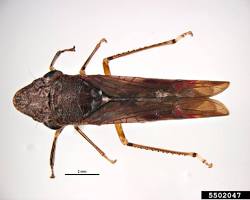
Glassy-winged Sharpshooters (Homalodisca vitripennis) are large invasive leafhoppers considered among the most economically destructive agricultural pests in North America. While these insects do feed on plant fluids directly, their greatest threat comes from their ability to transmit the deadly bacterium Xylella fastidiosa, which causes devastating plant diseases including Pierce’s Disease in grapevines. :contentReference[oaicite:1]{index=1}
Originally native to the southeastern United States, the Glassy-winged Sharpshooter became a major invasive pest after spreading into California during the 1990s. Its strong flight ability, wide host range, and highly mobile feeding behavior allow it to spread bacterial diseases rapidly between vineyards, citrus orchards, ornamental landscapes, and native vegetation. :contentReference[oaicite:2]{index=2}
Because Pierce’s Disease can kill grapevines within only a few years, the Glassy-winged Sharpshooter is regarded as one of the most serious threats to viticulture and perennial crop production worldwide. :contentReference[oaicite:3]{index=3}
Quick Facts
- Scientific Name: Homalodisca vitripennis
- Family: Cicadellidae
- Order: Hemiptera
- Habitat: Vineyards, citrus groves, ornamental landscapes
- Diet: Plant xylem fluids
- Status: Major invasive agricultural pest
- Main Threat: Transmission of Xylella fastidiosa
- Primary Crop Impact: Pierce’s Disease in grapes
Taxonomy and Classification
Glassy-winged Sharpshooters belong to the family Cicadellidae, commonly known as leafhoppers. They are members of the order Hemiptera, the true bugs, which possess piercing-sucking mouthparts adapted for feeding on plant fluids. :contentReference[oaicite:4]{index=4}
These insects undergo incomplete metamorphosis with three developmental stages:
- Egg
- Nymph
- Adult
The species name vitripennis refers to the insect’s translucent, glassy wings. The common name “sharpshooter” comes from their habit of forcefully ejecting droplets of excess fluid while feeding. :contentReference[oaicite:5]{index=5}
Glassy-winged Sharpshooters are unusually effective disease vectors because they feed directly from plant xylem tissue, allowing bacteria to colonize their mouthparts and spread between plants. :contentReference[oaicite:6]{index=6}
Physical Description
Adult Glassy-winged Sharpshooters are large for leafhoppers, measuring approximately 1/2 inch long.
Appearance
The adults are:
- Dark brown to black
- Speckled with pale ivory or yellow spots
- Equipped with clear, slightly smoky wings
- Broad-bodied and robust
The transparent wings contain reddish veins and fold roof-like over the body when at rest. :contentReference[oaicite:7]{index=7}
Mouthparts and Feeding
Like other sharpshooters, they possess needle-like stylets used to penetrate plant xylem vessels and extract water and nutrients.
Because xylem sap contains very low nutrient levels, sharpshooters must process enormous quantities of liquid to survive.
Sharpshooter Rain
As they feed, the insects eject excess water in tiny droplets often called “sharpshooter rain.” Heavy infestations may leave plants coated with a whitewashed residue after water evaporates. :contentReference[oaicite:8]{index=8}
Distribution and Habitat
The Glassy-winged Sharpshooter is native to the southeastern United States and northeastern Mexico but became invasive in California during the early 1990s. :contentReference[oaicite:9]{index=9}
Its host range includes more than 100 plant species, allowing it to thrive in diverse environments. :contentReference[oaicite:10]{index=10}
Common habitats include:
- Vineyards
- Citrus groves
- Avocado orchards
- Ornamental landscapes
- Riparian vegetation
- Nurseries
- Urban gardens
Citrus orchards are especially important because they provide ideal overwintering habitat for sharpshooter populations near vineyards. :contentReference[oaicite:11]{index=11}
Behavior and Damage
The primary threat posed by Glassy-winged Sharpshooters is their transmission of Xylella fastidiosa, a xylem-inhabiting bacterium responsible for multiple plant diseases. :contentReference[oaicite:12]{index=12}
Pierce’s Disease
In grapevines, the bacterium causes Pierce’s Disease, which blocks water movement through xylem tissue.
Symptoms include:
- Leaf scorch
- Yellowing and browning
- Fruit failure
- Weak vine growth
- Progressive vine decline
Most infected vines die within 2–5 years. :contentReference[oaicite:13]{index=13}
Other Diseases
The same bacterium also causes:
- Oleander leaf scorch
- Almond leaf scorch
- Citrus diseases
- Peach phony disease
The sharpshooter’s wide host range allows these diseases to spread rapidly across agricultural and ornamental landscapes. :contentReference[oaicite:14]{index=14}
Rapid Spread
Unlike smaller native sharpshooters, the Glassy-winged Sharpshooter can travel long distances and feed on woody plants, greatly accelerating disease spread. :contentReference[oaicite:15]{index=15}
Life Cycle
Glassy-winged Sharpshooters produce multiple generations per year in warm climates.
Egg Stage
Females lay egg masses on the undersides of leaves and coat them with protective white secretions called brochosomes. :contentReference[oaicite:16]{index=16}
Nymph Stage
Nymphs feed on small stems and foliage while undergoing several molts before becoming adults.
Unlike adults, nymphs lose bacterial contamination during molting. :contentReference[oaicite:17]{index=17}
Adult Stage
Adults are highly mobile and remain infectious for life once they acquire the bacterium. :contentReference[oaicite:18]{index=18}
Management and Prevention
Management programs are highly coordinated due to the major economic threat posed to vineyards and perennial crops.
Monitoring
Yellow sticky traps and visual inspections are used extensively near vineyards, nurseries, and transportation corridors. :contentReference[oaicite:19]{index=19}
Systemic Insecticides
Systemic insecticides are commonly used to kill sharpshooters before they can transmit bacteria. Treatments are often applied through soil drenches or trunk injections. :contentReference[oaicite:20]{index=20}
Biological Control
Parasitic wasps in the genus Gonatocerus are widely used as biological controls because they attack sharpshooter eggs. Some releases have reduced sharpshooter populations dramatically. :contentReference[oaicite:21]{index=21}
Host Plant Management
Removing nearby host plants and unmanaged vegetation can reduce both sharpshooter populations and bacterial reservoirs.
Economic Importance
The Glassy-winged Sharpshooter threatens billions of dollars in agricultural production, especially within California’s grape and wine industries. Pierce’s Disease alone causes significant economic losses annually. :contentReference[oaicite:22]{index=22}
California produces approximately 94% of U.S. wine grapes, making sharpshooter management critically important. :contentReference[oaicite:23]{index=23}
Interesting Facts About Glassy-winged Sharpshooters
- They can eject liquid waste at remarkable speed using “superpropulsion.”
- Adults remain infectious for life after acquiring bacteria.
- Their host range exceeds 100 plant species.
- They are among the most destructive vineyard pests in California.
- Parasitic wasps are important biological control agents.