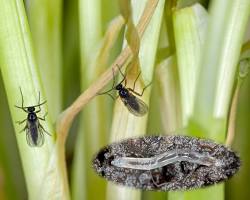
Fungus Gnats are small, dark, delicate flies in the family Sciaridae. They are commonly associated with moist soil, decaying organic matter, indoor potted plants, greenhouses, nurseries, and propagation areas. Adult fungus gnats are mostly nuisance pests, often seen flying weakly around houseplants or resting on the soil surface. The larvae, however, can become damaging plant pests when populations are high, especially in seedlings, cuttings, young plants, and greenhouse crops.
These insects are strongly linked to overwatering and poorly drained growing media. Fungus gnat larvae thrive in damp soil where fungi, algae, and decomposing organic material are abundant. While mature houseplants may tolerate small populations, young plants can suffer root injury, wilting, yellowing, stunting, and poor establishment.
Taxonomy and Classification
- Kingdom: Animalia
- Phylum: Arthropoda
- Class: Insecta
- Order: Diptera
- Family: Sciaridae
- Common Name: Fungus Gnats
Fungus gnats belong to the order Diptera, the true flies. Like other flies, they undergo complete metamorphosis with egg, larva, pupa, and adult stages. They are sometimes confused with shore flies, but fungus gnats are more slender, mosquito-like, and closely tied to moist growing media. Shore flies are usually more compact and commonly associated with algae-covered surfaces.
Physical Description
Adult Fungus Gnats are usually about 1/8 inch long and grayish-black to dark brown. They have long legs, long antennae, narrow bodies, and clear wings. Their delicate, mosquito-like appearance makes them easy to distinguish from sturdier flies. Adults are weak fliers and often move in short, erratic flights over the soil surface.
The larvae are the most important stage from a plant-health perspective. Fungus gnat larvae are small, slender, translucent to whitish, legless maggots with a distinct shiny black head capsule. They usually live in the top 1 to 2 inches of moist soil or potting mix. In severe infestations, larvae may be found feeding around roots, on decaying plant debris, or near drainage holes.
Eggs are tiny and laid in clusters or singly on moist soil. Pupae form in the growing medium before adults emerge and begin the cycle again.
Distribution and Habitat
Fungus Gnats are found worldwide and are especially common wherever plants are grown in moist organic media. They occur in homes, greenhouses, nurseries, interior plant displays, hydroponic setups, compost areas, and commercial propagation systems.
Common fungus gnat habitats include:
- Overwatered houseplants
- Greenhouse benches
- Seedling trays
- Propagation flats
- Nursery pots
- Compost piles
- Organic potting mixes
- Poorly drained containers
Infestations are often introduced through contaminated potting soil, new plants, compost, or nursery stock. Once indoors, fungus gnats can reproduce continuously if soil remains wet.
Behavior and Life Cycle
The fungus gnat life cycle can be completed in as little as three to four weeks under warm, moist conditions. Females lay eggs on damp soil, especially where organic matter and fungal growth are present. Larvae hatch and begin feeding in the growing medium before pupating and emerging as adults.
Because development is rapid, overlapping generations are common. This is why a small number of adult gnats can quickly become a persistent indoor plant problem.
Adult fungus gnats do not bite, sting, or damage household materials. Their main role is reproduction and dispersal. They are often noticed flying near windows, lights, plant shelves, and potted plants.
Plant Damage
Fungus gnat larvae normally feed on fungi, algae, and decaying organic matter. However, when populations are high or plants are young and tender, larvae may feed on root hairs, fine feeder roots, and soft stem tissue.
Damage symptoms may include:
- Wilting despite moist soil
- Yellowing leaves
- Stunted growth
- Poor seedling development
- Root pruning or root injury
- Damping-off in seedlings
- Plant decline in heavily infested pots
Seedlings, cuttings, and young greenhouse crops are most vulnerable. Damage can mimic drought stress, nutrient deficiency, or root disease, making diagnosis difficult unless larvae or adult gnats are observed.
Fungus gnats may also contribute to disease problems by spreading fungal spores and pathogens such as Pythium, which can cause damping-off and root rot in young plants.
Signs of Infestation
- Small black flies hovering around potted plants
- Adults resting on soil, pots, windows, or plant trays
- Tiny larvae in the top layer of moist soil
- Seedlings collapsing or growing poorly
- Persistent gnats after watering
- Wet potting mix that never dries between waterings
Management and Control (IPM)
Effective management of Fungus Gnats focuses on eliminating the moist conditions needed for larval survival. Chemical sprays aimed at flying adults rarely solve the problem because larvae remain protected in the soil.
Moisture control is the most important step. Allow the top 1 to 2 inches of soil to dry between waterings whenever plant species allow. Drying the surface layer disrupts larval development and reduces egg laying.
Improve drainage by using containers with drainage holes, emptying saucers after watering, and avoiding compacted or overly organic potting media.
Use yellow sticky traps placed near or horizontally above the soil surface. These traps capture adults and help monitor population levels.
Remove decaying plant debris from pots, trays, and greenhouse benches. Fallen leaves and decomposing material provide food for larvae.
Apply a dry surface barrier such as sterile sand, fine gravel, or an appropriate top dressing. This can make it harder for adults to lay eggs in the soil surface.
Use biological controls such as Bacillus thuringiensis israelensis (Bti), often sold in mosquito control products, as a soil drench. Bti targets fly larvae and is commonly used in indoor plant and greenhouse settings.
Beneficial nematodes, especially Steinernema feltiae, may also be applied as a soil drench to attack larvae in the growing medium.
Prevention
Preventing fungus gnats begins with good watering habits. Avoid keeping soil constantly saturated, especially in indoor plants during cooler months when evaporation is slower. Use clean potting media, inspect new plants before bringing them indoors, and quarantine new plants if adult gnats are present.
In greenhouses and nurseries, sanitation is essential. Benches, trays, drains, and propagation areas should be cleaned regularly. Algae and organic buildup should be reduced, and irrigation should be managed carefully to prevent chronic moisture.
Conservation and Research
Although fungus gnats are pests in plant production, they are also part of natural soil ecosystems where they help break down fungi and organic matter. Research continues into improved biological control methods, including better Bti formulations, beneficial nematode use, predatory mites, and integrated greenhouse pest management programs.
Conclusion
Fungus Gnats are common moisture-associated flies that become pests in potted plants, greenhouses, nurseries, and propagation systems. Adults are mostly a nuisance, but larvae can injure roots and contribute to plant decline in seedlings and young plants. The best control strategy is to reduce excess moisture, improve drainage, remove organic debris, trap adults, and use targeted biological controls when needed. With proper watering and sanitation, fungus gnat infestations can usually be controlled without heavy pesticide use.