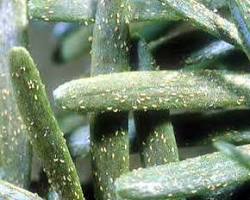
Frost Mites (Aculus schlechtendali), more commonly known as the Apple Rust Mite or Apple Leaf Mite, are microscopic plant-feeding mites that attack apple, pear, and other pome fruit trees. Despite their common name, these mites are not associated with freezing temperatures or winter weather. The term “frost” refers to the silvery or bronzed appearance their feeding causes on leaves and fruit surfaces, often resembling frost damage.
Frost Mites belong to the family Eriophyidae, a specialized group of highly adapted mites known for their unusual worm-like shape and reduced number of legs. These mites are significant orchard pests because heavy infestations reduce photosynthesis, weaken trees, decrease fruit quality, and stunt overall plant growth.
However, Frost Mites also play a complex ecological role within orchard systems. Low populations can serve as an important food source for beneficial predatory mites that help suppress more damaging pest species such as the European Red Mite.
Taxonomy and Classification
- Kingdom: Animalia
- Phylum: Arthropoda
- Class: Arachnida
- Subclass: Acari
- Family: Eriophyidae
- Genus: Aculus
- Species: Aculus schlechtendali
- Common Names: Frost Mite, Apple Rust Mite, Apple Leaf Mite
Frost Mites belong to the subclass Acari, which includes mites and ticks. Within this group, the family Eriophyidae contains many highly specialized plant-feeding mites that infest buds, leaves, and fruit.
Eriophyid mites are unique because adult individuals possess only two pairs of legs, unlike most mites and spiders which have four pairs.
These mites undergo simple metamorphosis through the following stages:
- Egg
- Larva
- Nymph
- Adult
Frost Mites are closely related to:
- Rust Mites
- Bud Mites
- Gall Mites
Many of these relatives are also economically important pests in orchards and agricultural systems.
Physical Description
Frost Mites are among the smallest plant-feeding arthropods found in orchards. Adults measure only about 0.15 to 0.20 millimeters long and are invisible to the naked eye without magnification.
Key physical characteristics include:
- Worm-like elongated body
- White, pale yellow, or translucent coloration
- Only two pairs of legs
- Tapered wedge-shaped form
- Soft-bodied appearance
Because of their tiny size, infestations are usually detected by observing plant symptoms rather than seeing the mites themselves.
The mites typically congregate along:
- Leaf midribs
- Leaf veins
- Leaf undersides
- Developing fruit surfaces
Heavy infestations may require a hand lens or microscope for proper identification.
Distribution and Habitat
Frost Mites occur worldwide wherever apples, pears, and other pome fruits are cultivated.
Common host plants include:
- Apple trees
- Pear trees
- Crabapple trees
- Other pome fruit species
During the growing season, the mites live primarily on the foliage and fruit surfaces of host trees.
They prefer:
- Warm orchard environments
- Dense foliage
- Actively growing leaves
- Protected leaf undersides
Overwintering occurs as fertilized females hidden beneath:
- Bud scales
- Twig crevices
- Bark cracks
- Protected branch areas
As spring growth begins, overwintering females migrate onto new foliage and begin feeding and reproduction.
Life Cycle
Frost Mites have multiple overlapping generations each year, especially during warm growing seasons.
The life cycle progresses rapidly under favorable orchard conditions.
Important stages include:
- Overwintering female survival
- Spring migration to foliage
- Egg deposition on leaves
- Nymph development
- Rapid summer population buildup
Population growth often peaks during mid to late summer when temperatures and foliage conditions favor reproduction.
Because generations overlap continuously, mite numbers may increase dramatically if natural predators are absent or orchard conditions become favorable.
Behavior and Feeding
Frost Mites feed by puncturing plant epidermal cells with specialized mouthparts and extracting cellular contents.
Feeding occurs mainly along leaf veins and undersides where the mites remain somewhat protected from environmental exposure.
Their feeding damages plant tissues and disrupts normal photosynthesis.
Unlike chewing insects, Frost Mites do not create holes in leaves. Instead, they cause discoloration and physiological stress through microscopic feeding injury.
Large populations may spread across extensive portions of the canopy during peak growing periods.
Damage and Symptoms
The damage caused by Frost Mites is primarily associated with leaf discoloration, reduced photosynthesis, and decreased fruit quality.
Common symptoms include:
- Silvery “frosted” leaf appearance
- Bronzing or rust-colored foliage
- Leaf curling or rolling
- Reduced shoot growth
- Smaller fruit size
- Reduced fruit quality
- Overall tree stress
Frosting and Rusting
Heavy feeding causes leaves to develop a silvery sheen or frosted appearance on upper surfaces.
Leaf undersides often become rusty brown or reddish due to tissue damage.
This discoloration reduces the leaf’s ability to absorb sunlight and conduct efficient photosynthesis.
Reduced Photosynthesis
Damaged foliage produces less energy for the tree, which may lead to:
- Reduced fruit development
- Poor fruit coloration
- Weak terminal growth
- General decline in tree vigor
Fruit Impact
Heavy infestations may reduce fruit size and quality, particularly in commercial orchards where market appearance is important.
Beneficial Ecological Role
Interestingly, low to moderate populations of Frost Mites may actually benefit orchard ecosystems.
These mites serve as an important food source for beneficial predatory mites such as:
- Typhlodromus pyri
- Other predatory phytoseiid mites
These predators help suppress more destructive pests like:
- European Red Mites
- Spider mites
- Other harmful orchard pests
Because of this ecological relationship, orchard managers often tolerate low Frost Mite populations as part of integrated pest management programs.
Signs of Infestation
- Silvered or frosted leaves
- Bronzed or rusty foliage
- Leaf curling
- Reduced fruit size
- Declining photosynthetic vigor
- Microscopic mites on leaf undersides
Symptoms often become most noticeable during mid to late summer.
Management and Control (IPM)
Management of Frost Mites focuses on balancing pest suppression with conservation of beneficial predatory mites.
Monitoring
Regular orchard scouting is essential. Inspect leaves using a hand lens to monitor mite populations and evaluate damage severity.
Monitoring helps determine whether treatment thresholds have been reached.
Dormant Oil Applications
Horticultural dormant oils applied before bud break are highly effective against overwintering females.
Dormant oils help reduce spring populations before rapid reproduction begins.
Selective Miticides
Selective acaricides may be used when infestations become economically damaging.
Selective products are preferred because they spare beneficial predatory mites that naturally regulate pest populations.
Predator Conservation
Avoid broad-spectrum insecticides whenever possible. These chemicals may eliminate beneficial predators and lead to secondary mite outbreaks.
Maintaining predator populations is one of the most important components of sustainable orchard mite management.
Research and Orchard Management
Researchers continue studying Frost Mites and orchard mite ecology to improve integrated pest management systems.
Current research focuses on:
- Predatory mite conservation
- Improved dormant oil application
- Selective miticide development
- Biological control enhancement
- Orchard ecosystem balance
Modern commercial orchards increasingly rely on IPM strategies that reduce unnecessary pesticide use while preserving beneficial organisms.
Conclusion
Frost Mites (Aculus schlechtendali) are microscopic eriophyid mites that infest apples, pears, and other pome fruits worldwide. Their feeding causes bronzing, rusting, and silvery frosting of leaves, reducing photosynthesis and negatively affecting fruit quality and tree vigor. Despite their pest status, low populations may benefit orchard ecosystems by supporting predatory mites that suppress more damaging pests. Effective management relies on careful monitoring, dormant oil applications, selective miticides, and conservation of beneficial natural enemies within integrated orchard pest management systems.