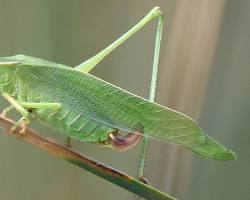
Forktailed Katydids (Scudderia furcata) are medium-sized green insects belonging to the long-horned grasshopper family Tettigoniidae. These insects are well known for their remarkable camouflage, leaf-like appearance, and rhythmic nighttime songs produced by males during late summer and fall. Although they occasionally feed on crops, ornamentals, and fruit trees, Forktailed Katydids are generally considered only minor pests and are more often appreciated as a familiar part of North American summer ecosystems.
Like other katydids, Forktailed Katydids possess extremely long antennae and powerful hind legs adapted for climbing and jumping. Their bright green bodies blend almost perfectly into surrounding foliage, making them difficult to detect during daylight hours despite their relatively large size.
The species gets its name from the male’s distinctive forked abdominal tip, which is an important identification characteristic used by entomologists. While they may occasionally cause cosmetic feeding damage to leaves and fruit, these insects rarely reach population levels that justify serious control measures.
Taxonomy and Classification
- Kingdom: Animalia
- Phylum: Arthropoda
- Class: Insecta
- Order: Orthoptera
- Family: Tettigoniidae
- Genus: Scudderia
- Species: Scudderia furcata
- Common Name: Forktailed Katydid
Forktailed Katydids belong to the order Orthoptera, which also includes crickets, grasshoppers, and locusts. Members of the family Tettigoniidae are commonly called katydids or long-horned grasshoppers because of their exceptionally long antennae.
Unlike true grasshoppers, katydids are generally more arboreal and spend much of their lives in shrubs, trees, and tall vegetation.
Forktailed Katydids undergo incomplete metamorphosis with three developmental stages:
- Egg
- Nymph
- Adult
Nymphs resemble smaller wingless versions of adults and gradually develop through several molts.
Physical Description
Adult Forktailed Katydids are typically 1 to 1.5 inches long, though their antennae often extend several times the length of the body.
Key identifying features include:
- Bright green coloration
- Extremely long thread-like antennae
- Leaf-shaped wings
- Long hind legs adapted for jumping
- Slender elongated body
- Forked abdominal tip in males
Their wings resemble green leaves with visible vein-like patterns, providing outstanding camouflage among foliage.
Males are especially recognizable by the forked or notched structure at the end of the abdomen, which gives the species its common name.
Females possess a long curved ovipositor used for inserting eggs into plant tissue.
Nymphs are wingless and may appear lighter green than adults during early developmental stages.
Distribution and Habitat
Forktailed Katydids are widely distributed throughout much of North America, especially in temperate regions with abundant vegetation.
Preferred habitats include:
- Woodland edges
- Weedy fields
- Shrubs and hedgerows
- Gardens
- Fruit orchards
- Tall grasses
- Tree canopies
- Meadows
These katydids spend most of their lives within foliage where their camouflage provides protection from predators.
Because they rely heavily on vegetation for food and shelter, they are commonly found in areas with dense plant growth and moderate humidity.
Behavior and Ecology
Forktailed Katydids are primarily nocturnal insects. During daylight hours they remain motionless among leaves where their coloration and wing shape make them nearly invisible.
At night, they become active and feed on vegetation while males begin producing their characteristic songs.
These insects are generally solitary and spend much of their time climbing through foliage rather than moving across the ground.
Their diet includes:
- Leaves
- Flower petals
- Pollen
- Soft fruit surfaces
- Tender plant tissue
- Occasionally small insects
Although mainly herbivorous, some katydids may opportunistically consume small soft-bodied insects or insect eggs.
Forktailed Katydids serve as important prey for:
- Birds
- Bats
- Spiders
- Small mammals
- Predatory insects
Their camouflage and nighttime behavior help reduce predation risk.
Sound Production and Communication
One of the most recognizable features of Forktailed Katydids is the male’s nighttime singing behavior.
Males produce sound through a process called stridulation. This occurs when a scraper structure on one wing rubs against a file-like structure on the opposite wing.
The resulting sound is often described as:
- Buzzing
- Rhythmic chirping
- Dry rattling
- Repetitive clicking
Singing activity usually peaks during warm summer evenings and early autumn.
The primary purpose of these calls is attracting females for mating. Each katydid species produces distinct acoustic patterns that help individuals identify suitable mates.
Researchers study katydid stridulation extensively to understand insect communication and acoustic behavior.
Life Cycle
Forktailed Katydids generally produce one generation per year.
Females insert eggs into plant stems, leaves, or soft vegetation using the ovipositor. Eggs overwinter and hatch the following spring.
Young nymphs emerge during warm weather and begin feeding immediately on tender foliage.
As they grow, nymphs molt repeatedly before developing wings and reproductive structures.
Adults are most common from midsummer through early fall.
Damage and Economic Importance
Forktailed Katydids are usually considered minor agricultural and ornamental pests because feeding damage is generally light and localized.
Typical feeding injury includes:
- Irregular holes in leaves
- Chewed leaf margins
- Minor fruit surface blemishes
- Scraped fruit skin
- Damage to ornamental foliage
Fruit feeding occasionally occurs on:
- Apples
- Peaches
- Pears
- Garden fruits
Most fruit injury is cosmetic and rarely affects internal quality.
In gardens and landscapes, the insects are usually tolerated because damage is minimal and populations remain relatively low.
Nuisance Factors
The primary nuisance associated with Forktailed Katydids is their persistent nighttime singing.
During peak activity periods, large numbers of calling males may create continuous nighttime noise around wooded residential areas, gardens, or orchards.
Although harmless, the sounds may occasionally disturb homeowners near dense vegetation.
Signs of Activity
- Green leaf-like insects in shrubs or trees
- Chewing damage on leaves
- Nocturnal buzzing or chirping sounds
- Minor fruit surface scarring
- Long antennae visible among foliage
Because of their camouflage, the insects are often heard long before they are seen.
Management and Control
Control of Forktailed Katydids is rarely necessary because infestations are usually minor and damage is limited.
Hand Removal
Hand-picking is highly effective in gardens and ornamental plantings because the insects are relatively large and slow-moving.
Vegetation Management
Reduce dense weeds and overgrown vegetation near vulnerable crops or ornamental plants to limit harborage areas.
Monitoring
Inspect fruit trees and garden plants during late summer when katydid activity is highest.
Chemical Control
Insecticides are rarely necessary but may occasionally be used in commercial orchards or high-value crops if populations become unusually large.
Targeting immature nymph stages is generally more effective than treating adults.
Ecological Importance
Forktailed Katydids contribute to ecosystem biodiversity and serve as both herbivores and prey organisms.
Their feeding activity helps recycle plant material, while their presence supports predators such as birds, bats, and spiders.
Their songs also contribute to the natural nighttime soundscape of forests and fields.
Research and Scientific Importance
Scientists study Forktailed Katydids and related species to better understand:
- Acoustic communication
- Stridulation mechanics
- Camouflage evolution
- Orthopteran behavior
- Insect sensory ecology
Their complex sound production systems make them important subjects in bioacoustics research.
Conclusion
Forktailed Katydids (Scudderia furcata) are common North American long-horned grasshoppers recognized for their bright green coloration, leaf-like wings, extremely long antennae, and rhythmic nighttime songs. Although they occasionally feed on leaves and fruit surfaces, they are generally considered only minor pests. Their camouflage, acoustic communication, and ecological role as herbivores and prey make them fascinating and important members of woodland and garden ecosystems.