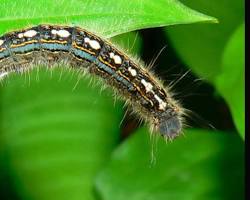
Forest Tent Caterpillars (Malacosoma disstria) are native North American moths whose larval stage is well known for causing extensive defoliation of hardwood forests. Despite their common name, these caterpillars do not construct the large silken tents associated with the closely related Eastern Tent Caterpillar. Instead, they create smaller silken mats on tree trunks and branches where groups of caterpillars gather to rest, molt, and regulate body temperature.
Forest Tent Caterpillars are among the most important cyclical forest defoliators in Canada and the United States. During outbreak years, millions of caterpillars may strip leaves from large areas of aspen, maple, oak, birch, and other deciduous trees. Although the visual impact can be dramatic, healthy trees usually survive because they are capable of producing a second flush of leaves later in the growing season.
Outbreaks typically occur in cycles every 10 to 15 years and may last several seasons before natural predators, parasites, diseases, and environmental conditions reduce populations.
Taxonomy and Classification
- Kingdom: Animalia
- Phylum: Arthropoda
- Class: Insecta
- Order: Lepidoptera
- Family: Lasiocampidae
- Genus: Malacosoma
- Species: Malacosoma disstria
- Common Name: Forest Tent Caterpillar
Forest Tent Caterpillars belong to the moth family Lasiocampidae, commonly known as lappet moths. They are closely related to Eastern Tent Caterpillars but differ in appearance, behavior, and host preference.
Unlike Eastern Tent Caterpillars, which build conspicuous communal tents in branch crotches, Forest Tent Caterpillars construct only thin silken resting mats.
Physical Description
The adult Forest Tent Caterpillar moth is a stocky, fuzzy, orange-brown insect with broad wings and a relatively thick body. Adults are nocturnal and are rarely noticed unless attracted to lights.
Adult moth features include:
- Dull tan to orange-brown coloration
- Two dark oblique lines across the forewings
- Furry thorax and abdomen
- Broad rounded wings
- Short lifespan focused on reproduction
The larval stage is the destructive phase responsible for defoliation.
Forest Tent Caterpillar larvae grow up to about 2 inches long and are easily recognized by:
- Blue-gray to dark brown body coloration
- Thin orange or yellow side stripes
- Fine hairs covering the body
- Distinctive row of white footprint- or keyhole-shaped spots along the back
The row of pale “footprint” markings is one of the best identification features and helps distinguish them from Eastern Tent Caterpillars.
Egg masses are also distinctive. Females deposit eggs in dark brown, varnish-like bands completely encircling small twigs.
Distribution and Habitat
Forest Tent Caterpillars are native to North America and occur throughout much of Canada and the northern United States.
They are especially common in:
- Aspen forests
- Maple forests
- Oak woodlands
- Mixed hardwood forests
- Urban shade trees
- Shelterbelts and windbreaks
- Riparian hardwood habitats
Preferred host trees include:
- Trembling aspen
- Sugar maple
- Oak
- Birch
- Basswood
- Elm
- Poplar
Outbreaks often occur over enormous geographic regions, affecting millions of acres of forest during severe infestation cycles.
Life Cycle
The Forest Tent Caterpillar has one generation per year and undergoes complete metamorphosis with four stages:
- Egg
- Larva (caterpillar)
- Pupa
- Adult moth
The species overwinters in the egg stage. Tiny fully formed larvae remain protected inside the egg mass during winter.
In spring, eggs hatch around the same time deciduous trees begin leafing out. Newly emerged caterpillars immediately begin feeding on expanding foliage.
The larvae are highly social and travel together in large groups. They frequently move up and down tree trunks in dense processions while feeding and searching for resting sites.
As caterpillars mature, they molt several times before spinning silken cocoons where pupation occurs.
Adult moths emerge during summer, mate, lay eggs, and die shortly afterward.
Behavior and Feeding
Forest Tent Caterpillars are active daytime feeders and are highly gregarious during their larval stage.
Unlike solitary caterpillar species, they feed in groups and move collectively across tree trunks and branches. These synchronized movements help provide protection against predators and improve feeding efficiency.
The caterpillars feed primarily on leaves of deciduous hardwood trees. Young larvae skeletonize leaves, while older larvae consume entire leaves except for larger veins.
Large populations may completely strip trees of foliage within days.
During rest periods and molts, caterpillars gather on silken mats located on trunks or large branches.
Damage and Economic Importance
The primary damage caused by Forest Tent Caterpillars is widespread defoliation.
Symptoms include:
- Rapid leaf loss
- Bare tree canopies
- Accumulations of caterpillar droppings
- Visible caterpillar processions on trunks
- Stress to repeated-defoliated trees
Healthy deciduous trees usually survive because defoliation occurs early enough for a second flush of leaves to develop later in the season.
However, repeated severe defoliation over several years may cause:
- Reduced tree growth
- Branch dieback
- Increased vulnerability to disease
- Tree mortality in weakened or stressed trees
Urban infestations may create nuisance problems because of large numbers of wandering caterpillars, falling frass, and stripped ornamental trees.
Signs of Infestation
- Large groups of caterpillars on trunks and branches
- Silken resting mats on bark
- Trees stripped of leaves
- White footprint-shaped spots on caterpillars
- Dark egg bands around small twigs
- Accumulations of caterpillar droppings beneath trees
Natural Enemies
Forest Tent Caterpillar populations are naturally regulated by:
- Parasitic flies
- Parasitic wasps
- Predatory beetles
- Birds
- Fungal diseases
- Viral pathogens
During large outbreaks, viral diseases often spread rapidly through dense populations and contribute significantly to outbreak collapse.
Natural enemy activity is one reason outbreaks usually decline after several years.
Management and Control (IPM)
Management of Forest Tent Caterpillars depends on infestation severity and tree value.
Egg Mass Removal
Inspect trees during winter and prune out egg masses whenever practical. Removing egg bands before spring reduces future caterpillar numbers.
Banding and Physical Barriers
Sticky bands or barriers placed around trunks may help intercept crawling caterpillars as they move between feeding and resting sites.
Biological Insecticides
Bacillus thuringiensis (Bt) is highly effective when applied to foliage while caterpillars are still small. Bt targets caterpillars specifically and is considered environmentally safer than many broad-spectrum insecticides.
Caterpillars must consume treated foliage for Bt to work effectively.
Tree Health Maintenance
Water and fertilize stressed trees appropriately to help them recover from defoliation.
Healthy trees are far more capable of surviving repeated feeding events.
Monitoring
Outbreaks are cyclical and often collapse naturally after several years. Monitoring programs help predict population increases and determine whether intervention is necessary.
Conservation and Research
Forest Tent Caterpillars are important ecological insects despite their pest status. Their outbreaks influence forest nutrient cycling, wildlife populations, and forest succession dynamics.
Researchers study:
- Population outbreak cycles
- Natural predator relationships
- Forest recovery after defoliation
- Climate influences on outbreaks
- Biological control systems
Understanding these outbreak cycles helps forest managers predict future infestations and minimize economic damage.
Conclusion
Forest Tent Caterpillars (Malacosoma disstria) are important native North American defoliators that periodically cause widespread damage to hardwood forests. Unlike Eastern Tent Caterpillars, they do not build large tents but instead form silken resting mats on tree bark. Their caterpillars are easily identified by the row of white footprint-shaped markings along their backs. Although severe outbreaks may temporarily strip forests of foliage, healthy trees usually recover through re-foliation. Management focuses on monitoring, egg mass removal, biological controls such as Bt, and maintaining tree health during outbreak cycles.