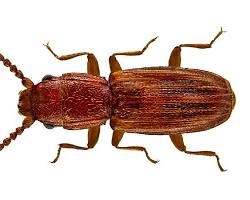
Flat Grain Beetles are small stored product pests commonly associated with the genera Cryptolestes and Oryzaephilus, including species such as the Rusty Flat Grain Beetle (Cryptolestes ferrugineus) and the Saw-toothed Grain Beetle (Oryzaephilus surinamensis). These insects are among the most widespread pests found in stored grain, cereal products, warehouses, grain bins, flour mills, feed facilities, and food processing operations worldwide.
Flat Grain Beetles are considered secondary grain pests because they usually attack grain that has already been damaged by harvesting, moisture problems, mold, or other insects. Instead of feeding on intact kernels, they prefer broken grain, grain dust, moldy material, and processed food products. Their presence often indicates poor grain storage conditions, excessive moisture, or sanitation problems within storage facilities.
Although individually tiny, large infestations can cause major economic losses through contamination, spoilage, heating of stored grain, reduced grain quality, and the encouragement of fungal and mold growth.
Taxonomy and Classification
- Kingdom: Animalia
- Phylum: Arthropoda
- Class: Insecta
- Order: Coleoptera
- Family: Laemophloeidae
- Genus: Cryptolestes
- Related Species: Oryzaephilus surinamensis (Saw-toothed Grain Beetle)
- Common Name: Flat Grain Beetles
Flat Grain Beetles belong to the beetle order Coleoptera and undergo complete metamorphosis with egg, larva, pupa, and adult stages.
The genus Cryptolestes contains several economically important stored grain pests known for their flattened body shape and ability to invade narrow spaces within grain masses and storage equipment.
Their body design allows them to move easily between kernels, beneath floor liners, inside cracks, and within grain dust accumulations where other insects may not easily penetrate.
Physical Description
Adult Flat Grain Beetles are extremely small, slender insects measuring about 1/16 to 1/8 inch long. Their bodies are flattened and elongated, helping them navigate tightly packed grain and narrow crevices.
Key identifying features include:
- Flattened reddish-brown or rusty body
- Very long thread-like antennae
- Narrow elongated shape
- Small head and thorax
- Fast movement through grain masses
Many species appear shiny or slightly glossy under magnification.
The larvae are tiny whitish-yellow grubs with brown head capsules. They move freely through grain dust, broken kernels, and infested food products while feeding.
Pupation occurs within the grain mass or protected crevices inside storage facilities.
Distribution and Habitat
Flat Grain Beetles are cosmopolitan pests found throughout nearly all grain-producing regions of the world. They occur anywhere stored grain or processed cereal products are available.
Common infestation sites include:
- Grain bins
- Grain elevators
- Flour mills
- Warehouses
- Feed mills
- Food processing facilities
- Stored flour and cereals
- Bulk grain storage systems
- Animal feed storage
Within grain storage facilities, Flat Grain Beetles are commonly concentrated in:
- Broken grain accumulations
- Grain dust
- Warm moist pockets
- Equipment crevices
- Residual debris beneath floors
- Wall and bin cracks
They are particularly associated with poorly cleaned storage systems and grain with elevated moisture levels.
Life Cycle
Flat Grain Beetles undergo complete metamorphosis with four developmental stages:
- Egg
- Larva
- Pupa
- Adult
Females lay eggs loosely among grain particles, dust, or hidden crevices. Under favorable warm conditions, development may occur rapidly and several generations may be produced annually.
Development speed depends heavily on:
- Temperature
- Humidity
- Grain condition
- Food availability
- Moisture content
Warm grain masses with high humidity allow populations to expand rapidly. In heated storage systems or warm climates, continuous reproduction may occur year-round.
Behavior and Feeding
Flat Grain Beetles are highly adapted to life within stored grain environments. Their flattened bodies allow them to penetrate deeply into grain masses and survive within equipment and structural crevices.
Unlike primary grain pests such as Rice Weevils, Flat Grain Beetles usually cannot successfully infest whole undamaged kernels.
Instead, they feed primarily on:
- Broken grain kernels
- Grain dust
- Moldy grain
- Processed cereals
- Damaged seed material
- Fungal growth
- Stored food debris
Because they thrive on damaged material, their presence often signals existing storage problems such as moisture migration, poor sanitation, mold growth, or prior insect infestation.
Damage and Economic Importance
The primary impact of Flat Grain Beetles is contamination and spoilage rather than direct destruction of intact grain.
Major forms of damage include:
- Grain contamination with insects and frass
- Heating of grain masses
- Promotion of mold growth
- Reduced grain quality and grading
- Development of musty odors
- Economic losses during storage and processing
Heavy infestations may generate metabolic heat inside grain masses. Combined with increased moisture and fungal growth, this can lead to “hot spots” within storage bins.
These hot spots encourage further insect development and accelerate grain deterioration.
Contaminated grain may be downgraded or rejected entirely by buyers, leading to significant financial losses for producers and storage facilities.
Signs of Infestation
- Small reddish-brown beetles in grain or flour
- Musty or moldy odors in stored grain
- Heating within grain bins
- Visible grain dust accumulations
- High moisture pockets in storage
- Larvae moving through grain fines
- Beetles in cracks, seams, and equipment
Because these beetles are extremely small, infestations may remain unnoticed until grain quality declines significantly.
Management and Control (IPM)
Effective management of Flat Grain Beetles requires strong sanitation practices, environmental control, and proper grain storage management.
Sanitation
Thorough sanitation is the foundation of control. All old grain, dust, debris, and residual material should be removed from storage bins, floors, conveyors, and equipment before new grain is introduced.
Even small amounts of leftover grain can support beetle populations.
Moisture Control
Store grain at safe moisture levels, generally around 12–14% depending on crop type. Dry grain greatly reduces fungal growth and insect development.
Temperature Management
Cool grain using aeration fans whenever possible. Temperatures below 60°F significantly slow beetle reproduction and feeding activity.
Cold winter aeration is especially important in temperate regions.
Monitoring
Monitor stored grain regularly using grain probes, traps, temperature sensors, and moisture measurements. Early detection allows infestations to be managed before severe spoilage develops.
Chemical Control
Residual insecticides may be applied to empty bins and storage structures before loading grain.
Grain protectants may also be applied directly to grain during loading when permitted by regulations.
In severe infestations, professional fumigation may be required. Fumigation is highly regulated and must be conducted only by trained professionals.
Research and Modern Storage Management
Researchers continue studying improved non-chemical management methods for Flat Grain Beetles and other stored product pests.
Current research areas include:
- Modified atmosphere storage
- Low-oxygen grain systems
- Improved aeration strategies
- Biological control methods
- Automated grain monitoring systems
- Reduced-risk insecticides
Integrated Pest Management programs combining sanitation, monitoring, moisture management, and environmental control are considered the most effective long-term approach.
Conclusion
Flat Grain Beetles are among the most important secondary pests of stored grain worldwide. These tiny flattened beetles thrive in grain dust, broken kernels, moldy grain, and poorly maintained storage systems. Although they usually do not attack intact kernels directly, they contribute heavily to contamination, spoilage, grain heating, fungal growth, and economic losses. Effective control depends on excellent sanitation, moisture management, temperature control, monitoring, and integrated grain storage practices that reduce favorable conditions for infestation.