Overview
Fish Moths, more commonly known as Silverfish, are small wingless insects that thrive in dark, humid environments inside homes and buildings. These ancient insects belong to one of the oldest surviving insect groups on Earth and are easily recognized by their silvery metallic appearance and distinctive fish-like movement.
The scientific name for the common Fish Moth is Lepisma saccharinum. These insects are considered nuisance household pests because they feed on starches, adhesives, paper products, fabrics, and stored organic materials. Although they do not bite, sting, or spread disease, they can cause significant damage to books, wallpaper, photographs, important documents, and clothing.
Fish moths are especially common in areas with persistent moisture problems and poor ventilation. Their presence often signals elevated humidity levels or water leaks within a structure.
These pests are frequently encountered in:
- Bathrooms
- Basements
- Laundry rooms
- Kitchens
- Attics
- Storage areas
- Libraries and archives
Because they are nocturnal and highly secretive, infestations may go unnoticed for long periods before visible damage appears.
Taxonomy and Classification
- Kingdom: Animalia
- Phylum: Arthropoda
- Class: Insecta
- Order: Zygentoma
- Family: Lepismatidae
- Species: Lepisma saccharinum
- Common Names: Fish Moth, Silverfish
Fish moths belong to the ancient insect order Zygentoma, formerly grouped under the now-obsolete order Thysanura.
These insects are considered primitive because they:
- Lack wings
- Undergo incomplete metamorphosis
- Continue molting throughout life
- Retain ancient anatomical features
Fish moths are closely related to:
- Firebrats
- Bristletails
- Other primitive wingless insects
Unlike many insects, adults continue shedding their exoskeleton even after reaching maturity.
Physical Description
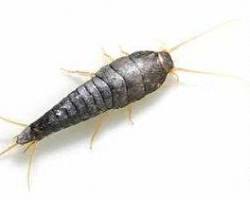
Adult Fish Moths are small elongated insects with flattened bodies covered in fine silvery scales.
Important identifying features include:
- Silvery-gray metallic coloration
- Tapered fish-like body shape
- Wingless body
- Long antennae
- Three tail-like appendages
- Rapid wriggling movement
Adults typically measure between 1/2 and 3/4 inch long.
The body narrows toward the rear, giving the insect its characteristic fish-like appearance.
The three long appendages extending from the abdomen consist of:
- Two lateral cerci
- One central filament
These structures help the insect sense its surroundings while moving through narrow crevices.
Their scales give the body a shiny metallic appearance that resembles polished silver.
Fish moths are highly agile and move with a rapid side-to-side wriggling motion similar to a swimming fish.
Distribution and Habitat
Fish Moths are distributed worldwide and commonly inhabit human structures.
They thrive in environments with:
- High humidity
- Warm temperatures
- Limited airflow
- Dark hiding places
Optimal humidity levels for survival range from approximately 70% to 90%.
Common indoor habitats include:
- Bathrooms
- Basements
- Kitchens
- Laundry rooms
- Attics
- Wall voids
- Closets
- Storage boxes
They are frequently found hiding behind:
- Baseboards
- Wallpaper
- Bookshelves
- Cabinets
- Pipes
- Appliances
Fish moths avoid light and spend daylight hours concealed in cracks and crevices.
Life Cycle
The life cycle of Fish Moths is unusually long compared to many household insects.
They undergo incomplete metamorphosis consisting of:
- Egg
- Nymph
- Adult
Egg Stage
Females deposit eggs in hidden cracks, crevices, and protected humid locations.
Eggs are:
- Small
- Oval-shaped
- Whitish in color
Hatching time varies depending on humidity and temperature.
Nymph Stage
Nymphs resemble miniature adults but are smaller and lighter in color.
As they grow, they molt repeatedly while gradually developing their metallic scales.
Nymphs feed on the same materials as adults.
Adult Stage
Adult Fish Moths may live for several years under favorable conditions.
Unlike most insects, adults continue molting throughout their lives.
They are capable of surviving:
- Long periods without food
- Extended dry conditions
- Low-nutrient environments
This resilience makes infestations difficult to eliminate completely.
Behavior and Feeding
Fish Moths are nocturnal scavengers that feed primarily on materials containing carbohydrates, starches, and proteins.
Their preferred food sources include:
- Paper
- Book bindings
- Wallpaper paste
- Photographs
- Cotton
- Silk
- Rayon
- Stored grains
- Dead insects
They are especially attracted to adhesives and materials containing polysaccharides.
Feeding damage often appears as:
- Irregular holes
- Surface scraping
- Yellow stains
- Jagged paper edges
Fish moths are most active at night and quickly retreat when exposed to light.
Damage and Economic Importance
Fish Moths are considered destructive household pests because of the damage they cause to stored materials and personal belongings.
Commonly damaged items include:
- Books
- Documents
- Wallpaper
- Photographs
- Clothing
- Cardboard boxes
- Stored food products
Libraries, museums, archives, and storage facilities are particularly vulnerable.
Heavy infestations may result in:
- Destruction of valuable documents
- Damage to collectibles
- Ruined textiles
- Contaminated food items
Although Fish Moths do not spread disease, their presence often indicates:
- Moisture problems
- Poor ventilation
- Water leaks
- Excess humidity
Signs of Infestation
- Silvery insects seen at night
- Irregular holes in paper or fabrics
- Yellowish stains
- Shed skins
- Damage to wallpaper or books
- Insects found in damp areas
Fish moths are commonly discovered when lights are turned on suddenly in dark rooms.
Management and Control (IPM)
Successful management of Fish Moths relies heavily on reducing moisture and eliminating hiding places.
Humidity Reduction
Lowering indoor humidity is one of the most effective control methods.
Helpful strategies include:
- Using dehumidifiers
- Improving ventilation
- Repairing leaks
- Increasing airflow
Dry environments significantly reduce survival and reproduction.
Sanitation
Regular cleaning removes food sources and hiding places.
Important sanitation practices include:
- Vacuuming cracks and crevices
- Removing paper clutter
- Storing fabrics properly
- Keeping storage areas dry
Exclusion
Seal cracks and entry points around:
- Baseboards
- Pipes
- Cabinets
- Walls
- Floor gaps
Reducing hiding places helps limit infestation development.
Storage Protection
Store valuable materials in sealed containers when possible.
This is especially important for:
- Books
- Photographs
- Documents
- Textiles
Chemical Control
Residual insecticides and insecticidal dusts may be applied to hidden harborages when infestations are severe.
Common treatment areas include:
- Wall voids
- Baseboards
- Closets
- Storage spaces
Boric acid and diatomaceous earth are often used in crack-and-crevice treatments.
Ecological Importance
In natural environments, Fish Moths contribute to decomposition by feeding on dead organic material.
They help recycle:
- Plant debris
- Dead insects
- Organic matter
However, indoors they are primarily considered nuisance and structural pests.
Research and Scientific Importance
Fish Moths are studied because of their evolutionary significance as primitive insects.
Researchers investigate:
- Primitive insect evolution
- Moisture adaptation
- Pest management methods
- Long-term survival mechanisms
Their ancient lineage provides important information about early insect development and adaptation.
Conclusion
Fish Moths, commonly known as Silverfish, are ancient wingless insects that thrive in dark humid indoor environments. Their silvery scales, rapid fish-like movement, and preference for starch-rich materials make them distinctive household pests. Although harmless to humans, they can damage books, documents, fabrics, wallpaper, and stored goods over time. Effective control depends on reducing humidity, improving sanitation, sealing hiding places, and maintaining dry indoor conditions to prevent long-term infestations.