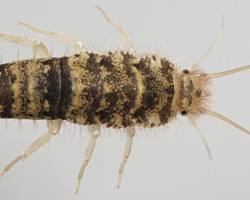
The Firebrat (Thermobia domestica) is a small, wingless household insect closely related to the Silverfish. It belongs to one of the oldest surviving groups of insects and is recognized for its unusual preference for extremely warm and humid environments. Unlike Silverfish, which commonly inhabit damp bathrooms, basements, and kitchens, Firebrats thrive near furnaces, boilers, ovens, fireplaces, hot water pipes, and other heat-producing areas.
Although Firebrats are not dangerous to humans, they are considered nuisance and structural pests because they feed on starchy materials, paper products, fabrics, glues, and stored foods. In homes, commercial bakeries, libraries, laundries, and heated industrial facilities, they may damage books, wallpaper paste, archival materials, and dry food products if populations become established.
Taxonomy and Classification
- Kingdom: Animalia
- Phylum: Arthropoda
- Class: Insecta
- Order: Zygentoma
- Family: Lepismatidae
- Genus: Thermobia
- Species: Thermobia domestica
- Common Name: Firebrat
Firebrats belong to the ancient insect order Zygentoma, formerly grouped under the order Thysanura. These primitive insects are wingless throughout their entire lives and undergo simple metamorphosis rather than complete metamorphosis like beetles or flies.
Their evolutionary lineage is extremely old, with ancestors existing long before many modern insect groups appeared. Firebrats retain several primitive insect characteristics, including their elongated body shape and tail-like appendages.
Physical Description
Adult Firebrats are about 1/2 inch long and have elongated, flattened, teardrop-shaped bodies. Their appearance resembles Silverfish, but several important differences help distinguish them.
Key identifying features include:
- Mottled gray or brown coloration
- Speckled body pattern
- Long antennae
- Three tail-like appendages at the rear
- Wingless body
- Fast-running movement
The three tail appendages consist of two lateral cerci and one central filament. Their bodies are covered with fine scales that give them a slightly shiny appearance.
Unlike the uniformly silver-colored Silverfish, Firebrats usually appear mottled or spotted with gray and brown patterns. They are extremely quick runners and immediately seek shelter when exposed to light or disturbance.
Nymphs resemble smaller versions of adults and continue molting throughout much of their lives.
Distribution and Habitat
Firebrats are cosmopolitan insects found worldwide. Their distribution is closely associated with human structures that provide warmth and humidity.
They thrive in temperatures ranging between 90°F and 108°F, making them one of the few common household pests strongly adapted to extreme indoor heat.
Typical infestation sites include:
- Boiler rooms
- Furnace areas
- Commercial bakeries
- Laundry rooms
- Attics
- Wall voids near heating ducts
- Around fireplaces
- Near hot water pipes
- Industrial kitchens
Firebrats require both heat and humidity for successful development. Cool or dry environments are generally unsuitable for long-term survival.
In homes, infestations are most often discovered near appliances or structural heat sources. They may hide beneath insulation, behind baseboards, inside wall voids, or within stored paper products.
Behavior and Ecology
Firebrats are nocturnal scavengers that spend most daylight hours hidden in cracks, crevices, wall voids, or protected spaces near heat sources. At night, they emerge to search for food.
Their diet consists largely of carbohydrates, starches, proteins, and cellulose-containing materials. Common food sources include:
- Wallpaper paste
- Book bindings
- Paper products
- Cardboard
- Stored flour
- Cereal products
- Rayon fabrics
- Cotton and linen
- Glue and adhesives
- Dead insects
Firebrats are highly adaptable scavengers and may survive for long periods on surprisingly limited food sources. Their preference for starchy materials makes libraries, archives, storage areas, and paper-rich environments especially vulnerable.
Under favorable conditions, Firebrats can live several years, with some individuals surviving up to six years. This unusually long lifespan contributes to persistent infestations if environmental conditions remain suitable.
Life Cycle
Firebrats undergo simple metamorphosis with three main stages:
- Egg
- Nymph
- Adult
Females lay eggs in hidden cracks and crevices close to warm, humid environments. Eggs hatch into tiny nymphs that resemble miniature adults.
Nymphs molt repeatedly as they grow. Unlike many insects, Firebrats continue molting even after reaching adulthood.
Development speed depends heavily on temperature and humidity. Under ideal warm conditions, development may occur relatively quickly, while cooler environments slow growth significantly.
Because Firebrats reproduce slowly compared to many other household pests, infestations often build gradually over time.
Damage and Economic Importance
Firebrats are primarily nuisance and contamination pests rather than direct health threats. However, their feeding habits can cause noticeable property damage.
Common damage includes:
- Irregular holes in paper
- Damage to books and documents
- Scraped wallpaper surfaces
- Fabric damage
- Contaminated stored foods
- Deterioration of archival materials
Libraries, museums, archives, bakeries, and storage facilities may experience economic losses when Firebrats infest paper products or food materials.
Unlike cockroaches, Firebrats are not strongly associated with disease transmission. Their primary impact is nuisance activity and material damage.
Signs of Infestation
- Small fast-moving insects near heat sources
- Damage to paper, wallpaper, or fabric
- Firebrats found in attics or boiler rooms
- Yellowish stains or feeding marks on paper
- Shed skins near hiding places
- Activity in warm humid areas at night
Because they avoid light and hide deeply in cracks, infestations are often overlooked until damage becomes visible.
Management and Control (IPM)
Successful control of Firebrats focuses on altering the environmental conditions they require and reducing food and harborage sources.
Reduce heat and humidity whenever possible. Lowering temperatures and improving ventilation are among the most effective long-term control measures.
Eliminate food sources by storing flour, cereals, and dry foods in sealed containers. Remove excess paper clutter and cardboard storage where possible.
Vacuum regularly to remove eggs, shed skins, food debris, and hidden insects from cracks and crevices.
Seal cracks and crevices around baseboards, pipes, wall voids, and flooring to reduce hiding places.
Apply insecticidal dusts such as boric acid or food-grade diatomaceous earth in inaccessible wall voids, attic spaces, or hidden harborages where Firebrats travel.
Use residual insecticides carefully around active infestation sites if necessary. Professional pest management may be required in severe infestations or commercial facilities.
Prevention
Preventing Firebrat infestations involves reducing excessive indoor heat and moisture while maintaining cleanliness in storage and utility areas.
Important prevention measures include:
- Repairing moisture problems
- Improving attic ventilation
- Reducing paper clutter
- Sealing stored foods
- Inspecting warm utility spaces regularly
- Cleaning behind appliances and heating equipment
Routine inspections in warm mechanical areas can help identify infestations before large populations develop.
Conservation and Research
Although Firebrats are considered nuisance pests, they are scientifically interesting because of their ability to tolerate unusually high temperatures. Researchers study them to better understand insect heat tolerance, primitive insect evolution, and basic insect physiology.
They are also occasionally used in laboratory studies involving insect development and environmental adaptation.
Conclusion
The Firebrat (Thermobia domestica) is a heat-loving, wingless household insect closely related to the Silverfish. Unlike Silverfish, Firebrats thrive in extremely warm and humid environments such as boiler rooms, attics, bakeries, and areas near furnaces or hot water pipes. While they do not bite or spread disease, they can damage paper, fabrics, food products, and archival materials by feeding on starches and organic debris. Effective control relies on reducing heat and humidity, eliminating food sources, improving sanitation, and sealing hiding areas to disrupt their preferred environment.