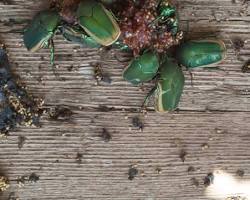
Fig Beetles (Cotinis mutabilis), also known as the Green Fig Beetle or Figeater Beetle, are large metallic green scarab beetles native to the southwestern United States and parts of Mexico. These insects are commonly associated with ripening fruit, compost piles, gardens, orchards, and urban landscapes during the warm summer months. Although their loud buzzing flight and large size often alarm homeowners, Fig Beetles are generally considered nuisance pests rather than highly destructive agricultural insects. :contentReference[oaicite:0]{index=0}
Adult Fig Beetles feed primarily on soft, overripe, or damaged fruit such as figs, peaches, grapes, plums, and pears. Their feeding creates holes and surface damage that can reduce fruit quality and attract secondary pests like wasps and ants. Meanwhile, the larval stage consists of large white grubs that typically live in compost, mulch, manure, and organically rich soil where they feed mainly on decaying material. Unlike many turf-damaging scarab grubs, Fig Beetle larvae are usually beneficial decomposers rather than serious root feeders. :contentReference[oaicite:1]{index=1}
Because of their shiny metallic appearance, Fig Beetles are frequently mistaken for Japanese Beetles or Green June Beetles, though they differ significantly in behavior, size, and distribution.
Taxonomy and Classification
- Kingdom: Animalia
- Phylum: Arthropoda
- Class: Insecta
- Order: Coleoptera
- Family: Scarabaeidae
- Genus: Cotinis
- Species: Cotinis mutabilis
- Common Names: Fig Beetle, Green Fig Beetle, Figeater Beetle
Fig Beetles belong to the scarab beetle family Scarabaeidae, which includes many familiar beetles such as June beetles, rhinoceros beetles, and dung beetles.
They undergo complete metamorphosis with four life stages:
- Egg
- Larva (grub)
- Pupa
- Adult beetle
Unlike some destructive scarab beetles, Fig Beetles are primarily scavengers and opportunistic fruit feeders rather than aggressive plant pests. :contentReference[oaicite:2]{index=2}
Physical Description
Adult Fig Beetles are large, robust insects typically measuring between 1 and 1.25 inches long. Their size, coloration, and loud flight make them highly noticeable in gardens and orchards. :contentReference[oaicite:3]{index=3}
Key identifying characteristics include:
- Metallic green body coloration
- Bronze or copper highlights
- Dull yellow or orange striping on wing covers
- Heavy-bodied scarab shape
- Loud buzzing flight
- Strong legs adapted for digging and climbing
One of the species’ most distinctive behaviors is its unusual flight pattern. Fig Beetles often fly with their hardened wing covers (elytra) closed while extending only their membranous hind wings. This creates a loud clumsy buzzing sound frequently compared to a small drone. :contentReference[oaicite:4]{index=4}
The larvae are large creamy-white grubs with brown head capsules and a characteristic C-shaped body.
Important larval features include:
- Length up to 2 inches
- Creamy white coloration
- Brown hardened head
- Strong chewing mouthparts
- Unusual habit of crawling on their backs
The larvae are commonly found in compost piles, manure, mulch, and organically rich soil. :contentReference[oaicite:5]{index=5}
How to Tell Fig Beetles Apart from Similar Beetles
Fig Beetles are often confused with other metallic green scarab beetles, especially the Green June Beetle and the Japanese Beetle.
Size Differences
Adult Fig Beetles are relatively large, usually reaching 1 to 1.25 inches in length. Japanese Beetles are much smaller, generally around half an inch long. :contentReference[oaicite:6]{index=6}
Geographic Range
Fig Beetles are most common in the southwestern United States, including California, Arizona, Nevada, New Mexico, and Texas. Japanese Beetles are more common in eastern and Midwestern states. :contentReference[oaicite:7]{index=7}
Appearance
Fig Beetles often display bronze or copper highlights and subtle striping on the wing covers. Japanese Beetles possess distinctive white tufts along the abdomen. :contentReference[oaicite:8]{index=8}
Flight Pattern
Fig Beetles fly slowly and noisily with a clumsy buzzing motion, while Japanese Beetles fly more quickly and quietly. :contentReference[oaicite:9]{index=9}
Distribution and Habitat
Fig Beetles are native to the southwestern United States and northern Mexico. They are especially common in:
- California
- Arizona
- Texas
- Nevada
- New Mexico
- Northern Mexico
Preferred habitats include:
- Fruit orchards
- Gardens
- Compost piles
- Mulched landscapes
- Lawns
- Urban landscapes
- Agricultural fields
Larvae thrive in moist soil rich in organic matter, while adults are commonly found feeding on ripe fruit during summer and early fall. :contentReference[oaicite:10]{index=10}
Life Cycle
Fig Beetles generally produce one generation per year.
Egg Stage
Females lay eggs in soil rich in decaying organic matter such as compost, mulch, manure, or moist turf.
Larval Stage
The larvae feed mainly on decomposing organic material and contribute to decomposition and nutrient recycling.
Unlike many turf-damaging grubs, Fig Beetle larvae usually do not seriously injure healthy grass roots. :contentReference[oaicite:11]{index=11}
Pupal Stage
Pupation occurs in underground earthen cells formed within the soil.
Adult Stage
Adults emerge during summer and begin feeding on ripe or fermenting fruit.
Behavior and Feeding
Adult Fig Beetles are most active during warm daylight hours and are strongly attracted to:
- Ripe figs
- Peaches
- Grapes
- Plums
- Pears
- Overripe fruit
- Fermenting fruit odors
Adults often prefer fruit that is already split, damaged, or overripe. They burrow into soft fruit flesh and feed on juices and pulp, leaving irregular holes and contamination behind. :contentReference[oaicite:12]{index=12}
Their feeding frequently attracts:
- Wasps
- Ants
- Fruit flies
- Secondary fungal decay
Larvae remain mostly hidden underground and function primarily as decomposers.
Damage and Economic Importance
The primary damage caused by Fig Beetles comes from adult feeding on ripening fruit.
Common damage includes:
- Deep holes in fruit
- Surface scarring
- Fruit spoilage
- Attraction of secondary pests
- Reduced market quality
Commercial orchards and backyard fruit gardens may experience economic losses when populations are high.
Larvae rarely cause significant turf damage unless populations become extremely dense. :contentReference[oaicite:13]{index=13}
Signs of Infestation
- Large metallic green beetles around fruit trees
- Loud buzzing flight sounds
- Damaged ripe fruit
- Holes in figs, peaches, or grapes
- Large grubs in compost or mulch
- Fermenting fruit odors attracting beetles
Management and Control (IPM)
Management of Fig Beetles focuses primarily on protecting fruit and reducing attractants.
Fruit Exclusion
Cover ripening fruit with fine mesh bags, organza bags, or netting to prevent beetle access. This is one of the most effective non-chemical controls. :contentReference[oaicite:14]{index=14}
Prompt Harvesting
Harvest fruit promptly as soon as it ripens to reduce attraction.
Remove all:
- Fallen fruit
- Overripe fruit
- Damaged fruit
- Fermenting fruit debris
Trapping
Fermenting fruit traps using overripe peaches, figs, or fruit juice can attract and drown adult beetles. :contentReference[oaicite:15]{index=15}
Larval Management
If grubs become problematic in turf or compost areas, beneficial biological controls may be used including:
- Beneficial nematodes
- Milky spore disease
- Improved compost management
However, larval treatment is often unnecessary because the grubs contribute beneficial decomposition activity. :contentReference[oaicite:16]{index=16}
Chemical Control
Chemical insecticides are rarely recommended for homeowners because adults are highly mobile and infestations are usually localized and temporary.
Ecological Importance
Although adult Fig Beetles can damage fruit crops, the larvae serve beneficial ecological functions by breaking down organic material and recycling nutrients within soil ecosystems.
Their decomposition activity helps improve soil quality and organic matter turnover.
Adult beetles also provide food for:
- Birds
- Raccoons
- Lizards
- Predatory insects
- Small mammals
Research and Scientific Importance
Researchers study Fig Beetles to better understand:
- Scarab beetle ecology
- Fruit pest behavior
- Organic decomposition systems
- Biological control strategies
- Non-chemical orchard management
Research also focuses on improving exclusion techniques and attractant traps for home orchards and gardens. :contentReference[oaicite:17]{index=17}
Conclusion
Fig Beetles (Cotinis mutabilis) are large metallic green scarab beetles native to the southwestern United States and Mexico. Although their loud buzzing flight and fruit-feeding habits make them noticeable garden pests, they are generally considered nuisance insects rather than highly destructive agricultural threats. Adults feed primarily on soft ripe fruit, while larvae act mostly as beneficial decomposers in compost and organically rich soil. Effective management relies on prompt fruit harvesting, physical exclusion, sanitation, and trapping rather than extensive pesticide use. :contentReference[oaicite:18]{index=18}