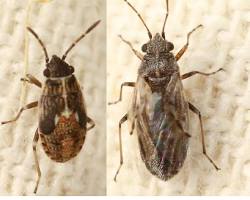
False Chinch Bugs (*Nysius* spp.) are small, plant-feeding insects that belong to the seed bug family. They are considered occasional, but potentially severe, pests of agricultural crops, particularly wheat, corn, and vegetable seedlings, as well as garden plants. While they superficially resemble the true Chinch Bug (*Blissus leucopterus*), they rarely cause the type of catastrophic, chronic damage seen with true Chinch Bugs. Their damage usually occurs when large swarms migrate from drying wild host plants (weeds) onto cultivated crops.
Taxonomy and Classification
False Chinch Bugs belong to the family Lygaeidae (seed bugs) in the order Hemiptera (true bugs). They undergo incomplete metamorphosis (egg, nymph, adult). There are several species, all characterized by their piercing-sucking mouthparts which are used to extract sap from the host plant.
Physical Description
Adult False Chinch Bugs are tiny, elongated, and slender, measuring about 1/8 inch long.
- Coloration: Typically dull gray or brownish-black with clear, membranous wings that overlap across the back.
- Nymphs: Younger stages (nymphs) are often reddish or pinkish with black markings and lack wings.
- Behavior: They congregate in huge numbers, especially in the nymph stage, on the stems and leaves of plants, often covering the ground near dying weeds.
Distribution and Habitat
False Chinch Bugs are found across North America and other temperate agricultural zones. Their primary habitat is weedy fields, particularly those with mustards and other broadleaf weeds. When the weeds dry out in late spring or early summer, massive numbers of bugs migrate en masse to adjacent green, cultivated plants, seeking moisture and food.
Behavior and Damage
False Chinch Bugs have multiple generations per year. They overwinter as adults in protected areas (leaf litter, debris). The most serious damage is associated with mass migration:
- Sap Removal: They use their piercing-sucking mouthparts to feed on plant sap, causing stippling, wilting, and discoloration.
- Mass Infestation: When huge numbers infest seedlings or small plants, the cumulative feeding can cause rapid desiccation, yellowing, and death of the plant (often called **burning**).
- Crop Impact: They can be highly destructive to young vegetables, seedlings, newly emerged grains, and delicate ornamental flowers during these migration periods.
Management and Prevention
Control is focused on preventing the migration from weed hosts.
- Weed Control (Prevention): The best defense is to eliminate weeds and wild host plants adjacent to vulnerable crops, especially before they begin to dry out. However, weeds should not be mowed or tilled simultaneously, as this can trigger immediate mass migration.
- Barrier/Trench: In agricultural settings, a temporary barrier, such as a deep furrow or ditch, can be dug between the weedy area and the crop field to trap the crawling insects.
- <Chemical Control: If mass migration is occurring, the bugs can be treated with a fast-acting insecticide directed at the band of insects as they cross the boundary between the infested and clean areas.
Conservation and Research
False Chinch Bugs are managed as occasional, migrating agricultural pests. Research focuses on understanding the triggers for mass migration and developing sustainable pest management strategies that integrate weed control with chemical barriers.
False chinch bugs (genus Nysius) are small seed-feeding insects that often appear in large numbers during hot, dry weather. They typically build up in weedy areas and migrate into gardens, crop fields, landscape beds, and around home foundations when weeds dry out. Unlike true chinch bugs that damage turfgrass, false chinch bugs most often affect seedlings and young plants.
How to Identify False Chinch Bugs
- Size: Small, about 1/8 inch long
- Color: Gray to brown with clear or smoky wings
- Behavior: Fast-moving and often seen in large migrating groups
- Damage: Wilting or stunting of seedlings; rarely kills established plants
Most outbreaks are temporary and tied to drought conditions or rapid weed die-off nearby.
False Chinch Bug Treatment Methods
Management works best when using an Integrated Pest Management (IPM) approach. Start with prevention and low-impact methods before considering chemical controls.
1. Cultural Control (Prevention First)
- Control weeds early: Remove mustard weeds, pigweed, Russian thistle, and other broadleaf weeds before they dry out and trigger migration.
- Maintain proper irrigation: Consistent watering reduces plant stress and makes seedlings less vulnerable.
- Reduce dusty conditions: Dry soil encourages outbreaks.
- Strengthen plant health: Proper fertilization and spacing help plants tolerate feeding damage.
Weed management is the single most important long-term control strategy.
2. Mechanical & Physical Control
- Strong water spray: Knock insects off plants with a firm stream of water.
- Floating row covers: Protect young vegetable seedlings during migration periods.
- Hand removal: Shake plants over a bucket of soapy water in small gardens.
- Vacuuming: Remove swarms around foundations and entry points.
These methods are especially useful in home gardens and small planting areas.
3. Habitat Modification
- Create a vegetation-free buffer: Maintain a 2–3 foot weed-free strip around gardens and home foundations.
- Mulch garden beds: Helps retain soil moisture and reduce dust.
- Seal structural gaps: Prevent nuisance entry into homes.
4. Biological Control
False chinch bugs have natural predators such as big-eyed bugs and other beneficial insects. Preserving these predators helps reduce future outbreaks.
- Avoid unnecessary broad-spectrum insecticides
- Encourage beneficial insects in gardens
5. Chemical Control (When Necessary)
Chemical treatment may be justified when seedlings are actively wilting or large migrations threaten crops or ornamentals.
- Insecticidal soap: Effective for light infestations with thorough coverage.
- Neem oil: Works best when applied early and repeatedly.
- Pyrethroid-based products: Provide faster knockdown during heavy outbreaks (always follow label directions).
Apply treatments during early morning or evening hours and avoid spraying during windy conditions. Always follow label instructions for edible crops and pollinator safety.
False Chinch Bugs Around Homes
During migrations, false chinch bugs may gather on siding, patios, and foundations. They are usually nuisance invaders and do not reproduce indoors.
- Vacuum visible clusters
- Seal cracks and entry points
- Maintain weed-free landscaping around the home
- Consider a labeled perimeter treatment if swarms persist
When Do Outbreaks Occur?
False chinch bug populations typically surge in late spring and early summer, especially during drought or after surrounding weeds dry up. Preventive weed control and consistent irrigation significantly reduce the likelihood of major infestations.
Bottom Line
Most false chinch bug problems are short-term and manageable with weed control, irrigation management, and seedling protection. Chemical treatments should be reserved for heavy outbreaks that threaten young plants.