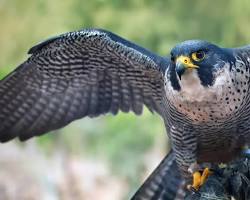
Falcons are highly specialized birds of prey belonging to the family Falconidae. Known for their incredible speed, aerial agility, and sharp hunting skills, falcons are among the most efficient predators in the avian world. These diurnal raptors are found across much of the globe and occupy habitats ranging from arctic tundra and deserts to forests, coastlines, grasslands, and densely populated urban environments.
Falcons are famous for their streamlined body shape, long pointed wings, and rapid hunting dives. Many species capture prey in mid-air using remarkable speed and precision. The most famous species, the Peregrine Falcon (Falco peregrinus), is widely recognized as the fastest animal on Earth, capable of exceeding 200 miles per hour during a hunting dive known as a “stoop.”
In addition to their ecological importance, falcons are valued as indicators of environmental health and have played a major role in conservation history following the widespread decline caused by DDT pesticide use during the mid-20th century.
Taxonomy and Classification
- Kingdom: Animalia
- Phylum: Chordata
- Class: Aves
- Order: Falconiformes
- Family: Falconidae
- Genus: Falco (true falcons)
- Common Names: Falcons, Kestrels, Hobbies
The family Falconidae includes true falcons as well as related birds such as kestrels and hobbies. Unlike hawks and eagles, falcons possess a unique notch on the beak called a tomium, which functions like a cutting tooth. This adaptation allows falcons to quickly sever the spinal cord or neck of prey after capture.
The genus Falco contains many of the best-known falcon species, including:
- Peregrine Falcon
- American Kestrel
- Gyrfalcon
- Merlin
- Saker Falcon
- Prairie Falcon
Physical Description
Falcons vary greatly in size depending on the species. Smaller falcons such as the American Kestrel may weigh only a few ounces, while large species like the Gyrfalcon can rival hawks in size.
Despite size differences, most falcons share several key characteristics:
- Long, narrow, pointed wings
- Streamlined aerodynamic bodies
- Strong hooked beaks
- Sharp talons
- Large forward-facing eyes
- Powerful chest muscles for flight
Their wings are specially adapted for high-speed flight and rapid maneuvering. Falcons generally have shorter tails and more tapered wings than hawks, allowing for greater aerial speed.
Many species display gray, brown, black, or white plumage patterns. Facial markings are often distinctive, particularly the dark “mustache” or malar stripe seen on Peregrine Falcons and several related species.
Falcons possess exceptional eyesight, allowing them to detect prey from long distances while soaring at great heights. Their visual acuity far exceeds that of humans.
Distribution and Habitat
Falcons are distributed across nearly every continent except Antarctica. They are highly adaptable and occupy a wide variety of habitats, including:
- Grasslands
- Mountains
- Cliffs and coastal areas
- Deserts
- Forests
- Tundra
- Agricultural areas
- Cities and urban environments
Some falcons are migratory, traveling thousands of miles between breeding and wintering grounds. Others remain year-round in suitable territories.
Urban environments have become important habitats for several species, especially Peregrine Falcons. Tall buildings, bridges, smokestacks, and skyscrapers mimic natural cliff faces and provide nesting locations overlooking abundant prey such as pigeons and starlings.
Behavior and Hunting
Falcons are active daytime hunters and are widely regarded as some of the most skilled aerial predators in the animal kingdom. Their hunting behavior depends on species, habitat, and prey type.
Many falcons hunt by soaring or circling high overhead before launching into a rapid dive toward prey. During these stoops, the bird folds its wings partially against its body to reduce drag and maximize speed.
The Peregrine Falcon is especially famous for this behavior and may exceed 200 mph during a dive, making it the fastest animal on Earth.
Smaller falcons, such as kestrels, frequently hover in place while scanning the ground below. This hovering behavior, called kiting, allows them to locate insects, rodents, or reptiles before striking.
Falcons primarily feed on:
- Small birds
- Pigeons
- Songbirds
- Rodents
- Lizards
- Insects
- Bats
- Small mammals
Many species capture prey directly in mid-air using speed and agility rather than relying solely on ambush tactics.
Nesting and Reproduction
Unlike many birds, Falcons are generally not elaborate nest builders. Instead, they rely on:
- Cliff ledges
- Rock crevices
- Tree cavities
- Abandoned nests of other birds
- Urban ledges and structures
Females typically lay several eggs in a shallow scrape or natural depression. Both parents participate in protecting the nest and feeding young.
Falcon chicks, called eyasses, hatch covered in soft down and depend entirely on parental care. Young birds grow rapidly and begin flight training several weeks after hatching.
Ecological Importance
Falcons play an important ecological role as apex aerial predators. By hunting birds, rodents, and insects, they help regulate prey populations and maintain ecological balance.
In agricultural areas, smaller falcons and kestrels can provide natural pest control by consuming grasshoppers, mice, voles, and other crop pests.
Urban Peregrine Falcons also help limit pigeon populations in cities.
Because falcons occupy high positions in food chains, they are sensitive to environmental contamination. Their health and reproductive success often reflect the condition of surrounding ecosystems.
Conservation History
During the mid-1900s, many falcon populations declined dramatically due to the widespread use of the pesticide DDT. The chemical caused eggshell thinning, leading to widespread reproductive failure, especially in Peregrine Falcons.
Conservation efforts included:
- DDT bans and restrictions
- Captive breeding programs
- Reintroduction projects
- Nest protection
- Legal protection of raptors
These programs became one of the greatest wildlife recovery success stories in modern conservation. Peregrine Falcon populations have rebounded in many parts of the world and are now commonly seen in both natural and urban environments.
Human Interaction and Conflict
Falcons are generally considered beneficial predators and are legally protected in many countries. Most interactions with humans are positive, especially among birdwatchers, conservationists, and falconers.
However, conflicts occasionally occur near airports, poultry facilities, racing pigeon operations, or areas where predation on domestic birds becomes a concern.
In some urban areas, Peregrine Falcons are intentionally encouraged because they naturally reduce populations of nuisance birds.
Falconry
Falconry, the ancient practice of hunting with trained birds of prey, has been practiced for thousands of years. Falcons are among the most prized birds used in falconry because of their speed, intelligence, and aerial hunting ability.
Species commonly used in falconry include:
- Peregrine Falcons
- Saker Falcons
- Gyrfalcons
- Merlins
Modern falconry is highly regulated in many countries and often contributes to raptor conservation and education.
Conclusion
Falcons are among the most extraordinary birds of prey in the world, combining speed, agility, intelligence, and hunting precision. From the tiny American Kestrel hovering over fields to the Peregrine Falcon diving at incredible speeds, these raptors play a vital ecological role as predators and indicators of environmental health. Their remarkable recovery from pesticide-related declines also highlights the importance of conservation efforts and habitat protection. Today, falcons continue to inspire scientists, birdwatchers, and wildlife enthusiasts around the globe.