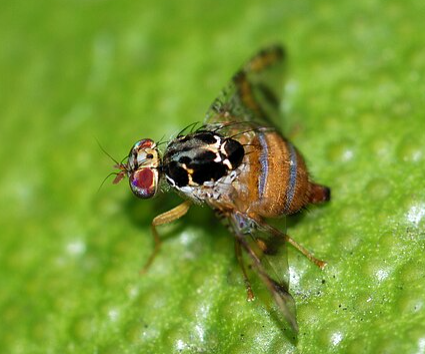
European Fruit Flies refers to several species of fruit-infesting flies in the family Tephritidae, including major agricultural pests such as the Cherry Fruit Fly (Rhagoletis cerasi) and the Mediterranean Fruit Fly (Ceratitis capitata). These insects are among the most destructive pests of fruit crops worldwide. Damage occurs when females lay eggs inside ripening fruit, where the developing larvae (maggots) feed internally, causing decay and rendering the fruit unfit for consumption or sale.
Taxonomy and Classification
European Fruit Flies belong to the family Tephritidae within the order Diptera (true flies). This family is commonly referred to as “true fruit flies” and is distinct from vinegar flies due to their patterned wings and specialized behaviors. They undergo complete metamorphosis with egg, larva, pupa, and adult stages. Many species are designated as quarantine pests due to their economic impact, and their spread is regulated by international agricultural authorities.
Physical Description
Adult fruit flies in this group are slightly larger than common household fruit flies and often display bright coloration, including shades of brown, yellow, and black. A defining feature is their distinctive patterned wings, often marked with bands or spots. Adults frequently hold their wings in a spread or lowered position and exhibit characteristic wing-waving behaviors.
The larvae are small, legless maggots that are white to yellowish in color. They are typically found inside fruit tissue, where they feed and develop. The pupae are brown, barrel-shaped structures located in the soil beneath host plants.
Distribution and Habitat
These fruit flies are native to Europe, the Mediterranean region, and parts of Africa but have spread globally through trade and transportation. They are highly invasive and are now present in many fruit-growing regions. Their habitat is closely tied to fruit-bearing plants, where adults seek suitable hosts for egg-laying and larvae develop within fruit.
Behavior and Life Cycle
European Fruit Flies may produce one to several generations per year, depending on environmental conditions. Females use a sharp ovipositor to puncture the skin of ripening fruit and deposit eggs beneath the surface. These punctures often leave small visible marks.
After hatching, larvae tunnel through the fruit, feeding on the flesh and causing it to soften and decay. Once mature, larvae exit the fruit and drop to the ground, where they pupate in the soil. In many regions, the pupal stage may overwinter until favorable conditions allow adult emergence in the following season.
Damage and Economic Impact
Damage caused by European Fruit Flies is severe and economically significant:
- Internal Fruit Damage: Larval feeding destroys fruit quality, leading to soft, rotting produce that cannot be sold.
- Crop Loss: Entire harvests may be lost during heavy infestations.
- Quarantine Restrictions: Infestations can trigger strict trade limitations, affecting both domestic and international markets.
- High Control Costs: Management programs require extensive monitoring, trapping, and treatment efforts.
Management and Prevention
Effective management relies on early detection and integrated control strategies.
- Monitoring and Trapping: Use pheromone or food-based traps to detect and track adult populations.
- Exclusion: Fine mesh netting can prevent flies from accessing fruit on trees or bushes.
- Sanitation: Remove and destroy fallen or infested fruit promptly to prevent larvae from completing development.
- Chemical Control: Targeted insecticide applications combined with attractant baits can reduce adult populations.
- Biological and Genetic Control: Programs such as the Sterile Insect Technique (SIT) are used in some regions to suppress populations.
Conservation and Research
European Fruit Flies are among the most intensively studied agricultural pests due to their global impact. Research efforts focus on improving early detection methods, enhancing biological control strategies, and refining integrated pest management approaches. Advances in genetic control techniques and environmentally sustainable practices continue to play a key role in reducing their impact on global agriculture.