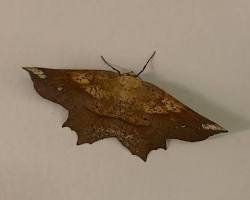
Euchlaena Inchworm Moths are part of the family Geometridae, whose larvae are commonly known as inchworms. These caterpillars are named for their distinctive looping movement and are common defoliators of trees and shrubs.
The “Twig-Mimics”: Euchlaena Inchworm Moths
Euchlaena Inchworm Moths (genus Euchlaena) are a fascinating group of Geometrid moths widely distributed across the United States. These moths are primarily a curiosity of woodland gardens and shrubberies. They are master mimics, known for their larval ability to perfectly resemble a dead twig. While they consume the foliage of various hardwoods and shrubs, they rarely reach population levels that cause significant economic damage, making them a minor herbivore in the landscape.
Technical Identification: Diagnostic Markers
- Phenotype (Adult): Characterized by broad, scalloped wings that are typically ochre, tan, or deep brown with fine dark striations. A primary diagnostic key is the angular, wavy wing margins and the way they hold their wings flat and slightly tilted when resting.
- Larval Phenotype (Inchworms): The larvae are classic loopers or inchworms. They are slender, cryptically colored in shades of grey, brown, or mottled green, and feature small bumps that mimic the lenticels and buds of a tree branch.
- Locomotion: Lacking middle prolegs, they move with a distinctive looping gait. When threatened, they often stand stiffly at an angle from a branch, becoming visually indistinguishable from a twig.
Ecological Impact: Low-Level Herbivory
The primary impact of Euchlaena species is the consumption of host foliage, though their role as a food source for birds is ecologically vital.
- Host Range: In the United States, they feed on a wide variety of plants including Oak, Birch, Willow, and Dogwood. Their feeding usually results in small, irregular notches on the leaf margins rather than total defoliation.
- Nocturnal Activity: Adults are nocturnal and are frequent visitors to porch lights. During the day, they rest on tree bark where their mottled wing patterns provide near-perfect camouflage.
- Ecosystem Value: As part of the food web, Euchlaena larvae are a critical protein source for nesting songbirds. Their presence in a garden is often a sign of a healthy, diverse local habitat.
Management & Conservation Strategies
Management of Euchlaena Inchworm Moths in gardens is generally unnecessary and focuses on tolerance.
| Strategy | Technical Specification | Operational Benefit |
|---|---|---|
| Habitat Maintenance | Preserving U.S. native hardwoods | Maintains the natural food source for these moths without requiring supplemental care. |
| Predator Support | Installing bird houses and bat boxes | Ensures that natural predators keep moth populations in balance with the landscape. |
| Pesticide Avoidance | Limiting broad-spectrum insecticides | Protects both the harmless caterpillars and the beneficial birds that feed on them in parks and yards. |
- Monitoring: Inspect the tips of branches on deciduous trees in the Summer. Finding a “twig” that moves when touched is a primary way to identify Euchlaena larvae.
- Light Mitigation: To prevent moth exhaustion, Pestipedia.com recommends using motion-sensor lighting or yellow bulbs. This helps maintain nocturnal biodiversity.
Taxonomy
- Order: Lepidoptera
- Family: Geometridae
- Genus: Euchlaena
Physical Description
Adult moths are typically slender with broad wings and subtle coloration that helps them blend into tree bark. Larvae are thin and elongated, lacking the middle prolegs found in other caterpillars.
Behavior and Damage
Larvae feed on leaves of trees and shrubs, sometimes causing defoliation during outbreaks. Damage may include:
- Skeletonized leaves
- Reduced plant growth
- Tree stress
They are often classified as tree pests and garden pests.
Management
- Monitor for early infestations
- Encourage beneficial insects
- Remove larvae when possible